Visual evidence before signing off clean
A line producing both chemical and food-contact packaging requires certified cleaning before every switch to the food-contact batch. Today it depends on a human sign-off with no evidence. With iLEAN Edge, fixed cameras validate the state before authorizing startup.
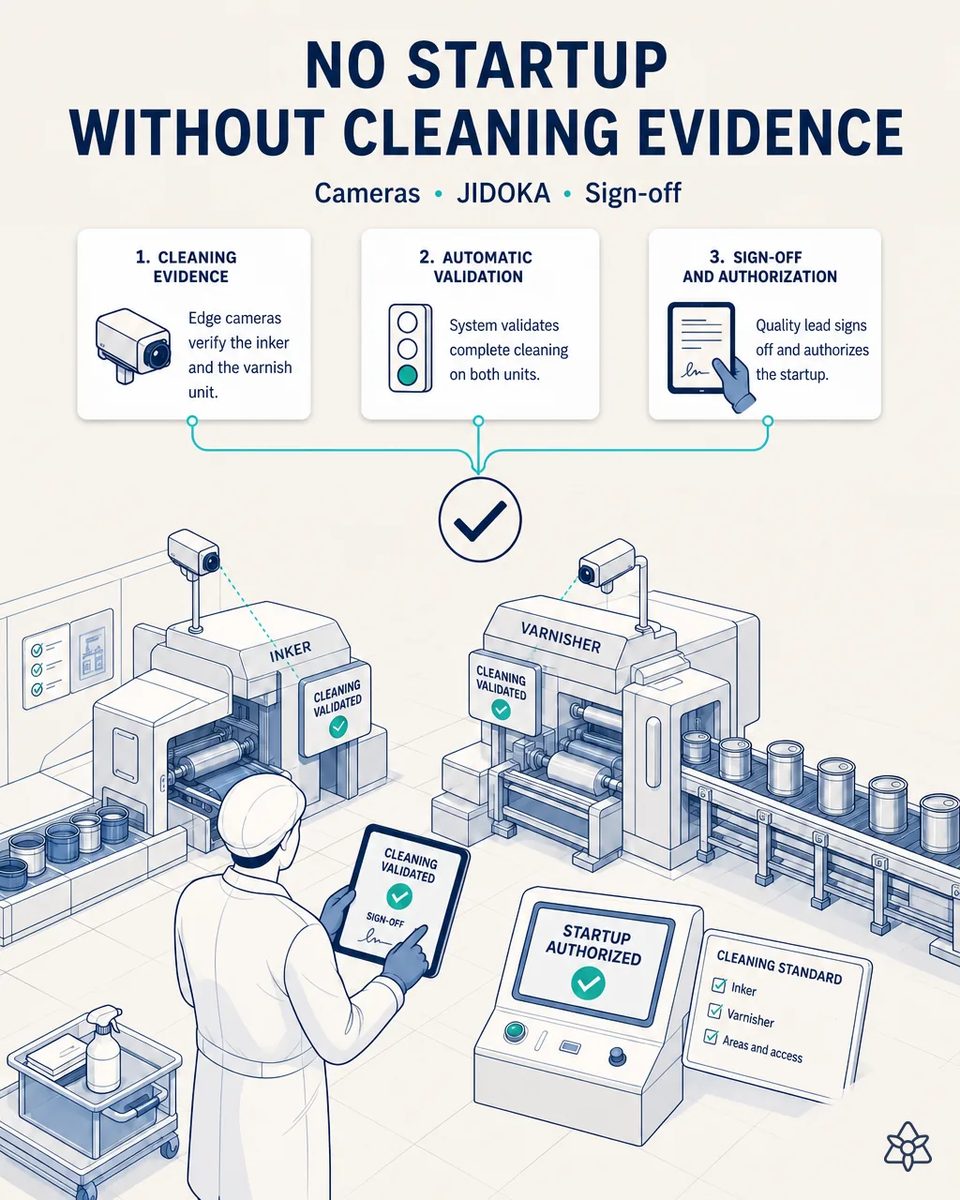
The cleaning sign-off is the weakest link of a shared line.
Leftover ink or varnish from the chemical run can contaminate the first food-contact batch. A cross-contamination event puts the BRC Packaging Materials certification at risk overnight.
- A line producing both chemical and food-contact packaging requires certified cleaning before every switch to a food-contact run.
- Today it depends on a human sign-off with no evidence: a ticked box on a sheet, under pressure because the changeover sits on the shift's critical path.
- Leftover ink or varnish from the chemical run can contaminate the first sheets of the food-contact batch. The residue is not always visible to a person in a hurry, and it does not announce itself until much later.
- A single cross-contamination event puts the BRCGS Packaging certification at risk overnight, and with it the food-contact contracts.
Edge with JIDOKA AI — the cameras check, the quality lead signs on evidence.
Edge + JIDOKA AI. Fixed cameras on the inker and varnish unit compare the current state against the clean reference state. The line won't start until every camera reports OK and the quality lead signs off based on visual evidence.
The camera does not replace the sign-off; it gives it something to stand on. The quality lead still decides, but on images of each critical point instead of on trust. That is also what lets the signature stand up later in front of an auditor.
The chemical-to-food changeover signed blind versus signed on evidence
| Aspect | Today | With iLEAN Edge |
|---|---|---|
| Cleaning sign-off | A tick on a checklist | Each critical point compared with its clean reference |
| Inker and varnish unit | Checked by eye | Fixed cameras on both |
| Leftover chemical ink or varnish | Found in the first food sheets, if at all | Detected before startup |
| Line start | When someone signs | Only when every camera reports OK |
| Proof for the auditor | A signature | Before and after images per changeover |
| Certification exposure | Overnight, on one event | Each switch backed by evidence |
Blind sign-off with cross-contamination risk → sign-off based on visual evidence at each critical point.
Impact estimate — the payback depends on your food-contact mix.
The block below is an estimate to be validated against your plant's actual data. We put it forward so the committee has an order of magnitude; we refine it during the assessment.
- We do not fix a payback range here: it depends on the weight of the food-contact line in your mix, and we size it with your numbers.
- What it protects is the certification behind hundreds of thousands of euros in food-contact contracts. Losing it is not a cost per run, it is the loss of the food-contact business at that site.
- Blind sign-off becomes sign-off on visual evidence at every critical point of the changeover. The quality lead signs knowing what they are signing, and can prove it later.
- And the evidence of each switch is stored, which is exactly what the next audit asks for.
Protects a certification worth hundreds of thousands of euros in food-contact contracts; payback depends on the weight of the food-contact line in the mix. Estimate to validate.
And the fair question from the production manager
“What if the camera blocks the line for nothing?” — comparing the inker and the varnish unit against their own clean reference state is an anchored task where the best models drop below 1.5% error [1]. In case of doubt the system does not block silently: it escalates to the quality lead, who signs on the images. It stops on a visible discrepancy, not on model uncertainty. And because the check takes seconds, it does not lengthen a changeover that already sits on the critical path.
[1] OpenAI paper "Why Language Models Hallucinate", 2025 — on the reliability of AI in anchored tasks.
What people ask about cleaning before a food-contact run
Which points do the cameras cover?
The inker and the varnish unit, the two places where chemical-run residue can carry over, plus any access point the cleaning standard defines. The reference images are taken with your team on a line declared clean, so the comparison is against your own standard.
Does the line really not start without the OK?
Correct: JIDOKA AI holds the startup until every camera reports OK and the quality lead signs. Any exception is recorded with its author. Skipping the check is possible only with a named signature, never silently.
Does it apply to switches between two food-contact runs?
It can, but the case is built for the chemical-to-food switch, where cross-contamination puts the certification at risk. Extending it to other critical switches is a configuration choice once the first one runs.
Why is there no payback range?
Because it depends on how much of your volume goes to food contact. We calculate it with your mix rather than publish a range that would not apply to you. The value at stake is the certification behind the food-contact contracts, and that is sized with your figures.
Does the evidence serve the BRCGS audit?
Yes. Each changeover leaves before and after images plus the signature, which feeds the evidence pack case directly. The auditor sees what the line looked like before startup, not only who signed.
More cases from this series
- The lab spreadsheet stops living in a world apart from the ERPiLEAN absorbs the lab's varnish migration and adhesion spreadsheet and pushes it to the ERP after…
- The truck no longer waits while the delivery note is typedA photo of the delivery note and heat-number labels digitizes tinplate receiving and pushes it to the…
- A supplier alert that doesn't cost 90 minutes of stopped lineiLEAN reads a coil delay alert instantly and replans the work order before the lithography line stops.
- The curing curve, without touching the ovenAn external camera digitizes the varnish curing curve of an isolated vintage oven, with no replacement…
- Nothing enters the central system without human validationEvery iLEAN capture passes through a tablet with a visual summary before crossing into the ERP: the…
- Information that no longer dies at the end of the shiftWith a Bluetooth earpiece, the line manager dictates issues while walking and iLEAN structures and saves…
Tell us how many chemical-to-food changeovers your shared lines run each week.
We work on your plant's real data, not ours. Assessment with no commitment.
Request estimated ROI within 48h ‹ See all cases of metal packaging See packaging