Zero print defects without slowing the line
At real lithography line speed, the human eye tires and lets through sheets with color registration defects, scratches or varnish bubbles. iLEAN Edge places an overhead camera that inspects every sheet in milliseconds.
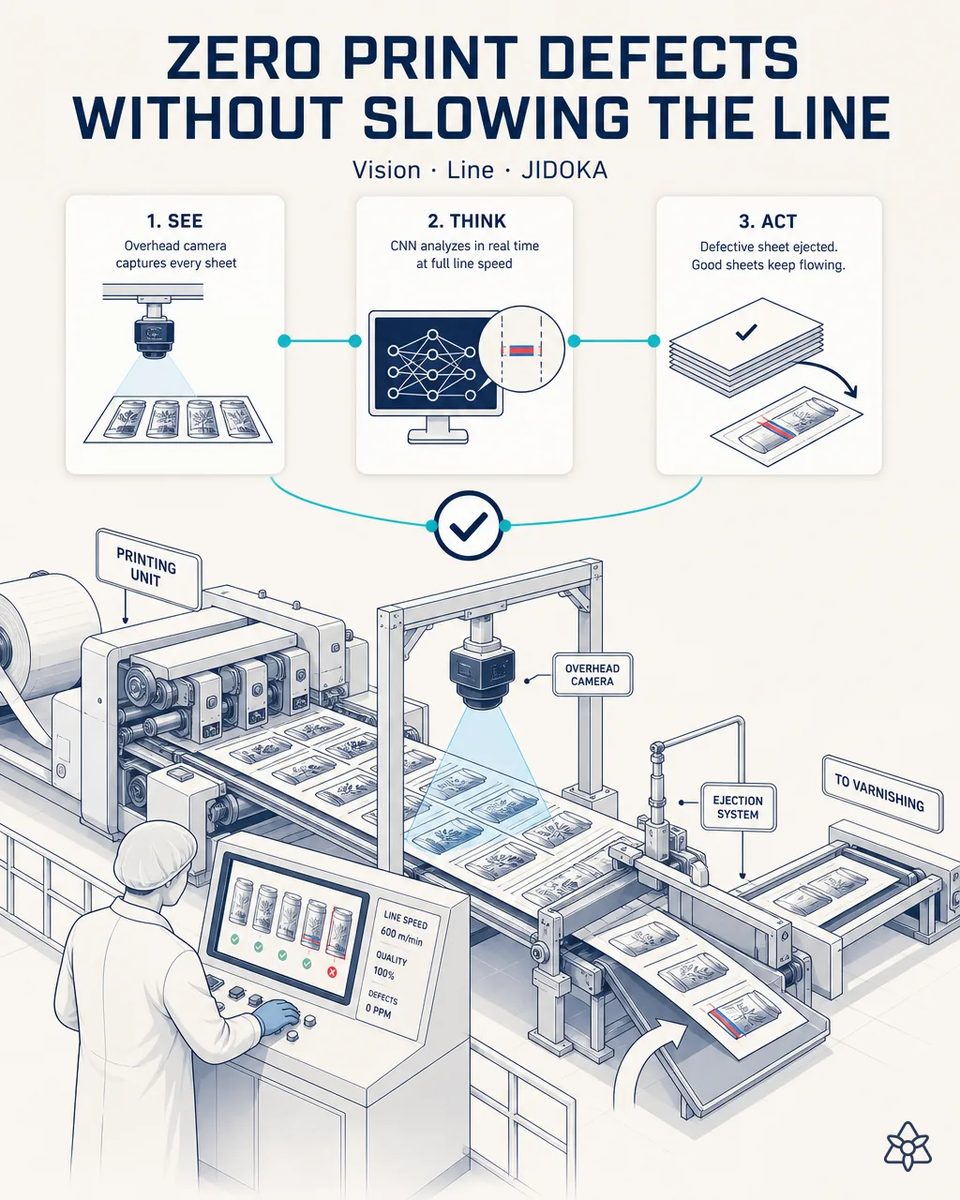
At line speed the eye tires, and sampling leaves gaps.
Those defective sheets move on to forming and end up as a defective can body or, worse, a varnish failure that compromises food contact. Sampling inspection leaves gaps.
- At real lithography line speed, the human eye tires and lets through sheets with color registration defects, scratches or varnish bubbles.
- Sampling inspection of 1-2% of sheets leaves every other sheet unchecked. A register shift that starts between two samples can run for hundreds of sheets before anyone sees it.
- A defective sheet moves on to forming and becomes a defective can body or, worse, a varnish failure that compromises food contact. Forming, welding and coding add cost to a sheet that was already lost.
- By the time the complaint arrives from the packer client, the run has been formed, coded and shipped. At that point the cost is no longer a sheet, it is a run and a client conversation. And the root cause is hard to find, because nobody knows which sheets of the run were affected.
Edge — local CNN vision over the litho line, no image sent to the cloud.
Edge — local CNN vision, with no image sent to the cloud (latency, cost, bandwidth). Model trained on good and bad examples of the specific format and Pantone. Automatic rejection before forming.
The model is trained on good and bad sheets of your own formats and Pantones, not on a generic library. That is what lets it reject a register shift without rejecting the design. And it sees every sheet, not the one in fifty that a person has time to look at.
Sampling the litho output versus inspecting every sheet
| Aspect | Sampling inspection | With iLEAN Edge |
|---|---|---|
| Sheets inspected | 1-2% sample | 100% |
| Color registration defect | Caught if it falls in the sample | Rejected sheet by sheet, at line speed |
| Varnish bubbles and scratches | Depend on the inspector's fatigue | Classified at line speed |
| Where a bad sheet is stopped | At the packer client, as a complaint | Before forming |
| Image processing | — | Local, no cloud latency or bandwidth |
| Model reference | — | Your formats and Pantones |
1-2% sampling → 100% sheet control. Print/varnish defect complaints → drastic reduction.
Impact estimate — to be validated with your numbers.
The block below is an estimate to be validated against your plant's actual data. We put it forward so the committee has an order of magnitude; we refine it during the assessment.
- Estimated payback 5-12 months, depending on the current reject ratio.
- Inspection coverage goes from a 1-2% sample to every printed sheet. Every reject is stored with its image, which turns complaints into data per unit and per run. Quality can see whether a defect grows with a blanket, an ink batch or a specific unit of the press.
- Print and varnish defect complaints from packer clients drop sharply. Each one avoided is a client conversation that does not have to happen.
- And defective sheets are removed before forming adds the cost of the can body to them.
Estimated payback of 5 to 12 months depending on current reject ratio. Estimate to validate.
And the fair question from the production manager
“What if it rejects good sheets?” — the false reject is the real risk, which is why the model is trained on good and bad examples of the specific format and Pantone, under that line's lighting. Classifying a known defect type on a known design is an anchored task where the best models drop below 1.5% error [1], and borderline sheets are escalated to a person instead of being discarded. Every decision on a borderline sheet feeds back into training, so false rejects fall as the model learns your designs.
[1] OpenAI paper "Why Language Models Hallucinate", 2025 — on the reliability of AI in anchored tasks.
What people ask about inspecting printed sheets
Does it slow the litho line down?
No. Inference runs locally next to the line in milliseconds per sheet, without sending images to the cloud. It does not depend on the plant network either, so a network outage does not leave the line uninspected.
Which defects does it detect in metal packaging?
Color registration shifts, scratches and varnish bubbles, the ones that become a defective can body or a food-contact varnish failure if they pass. The defect catalog is agreed with quality at commissioning, using real sheets from your runs.
What happens with a new design or Pantone?
The model is updated with examples of that format. A high-mix litho plant usually switches the model according to the active run. New formats are added from a short series of good and bad sheets, not from a new project.
Where does a rejected sheet go?
To an ejection point before forming, while good sheets keep flowing to varnishing; nothing has to stop. Each rejected sheet is stored with its image and run, so quality can see which defect is growing and on which unit.
Does it replace the quality inspector?
No. It takes over the tiring sheet-by-sheet check and leaves the inspector the borderline cases and the root cause analysis. The inspector stops being the inspection and becomes the person who decides on what the camera doubts.
More cases from this series
- The lab spreadsheet stops living in a world apart from the ERPiLEAN absorbs the lab's varnish migration and adhesion spreadsheet and pushes it to the ERP after…
- The truck no longer waits while the delivery note is typedA photo of the delivery note and heat-number labels digitizes tinplate receiving and pushes it to the…
- A supplier alert that doesn't cost 90 minutes of stopped lineiLEAN reads a coil delay alert instantly and replans the work order before the lithography line stops.
- The curing curve, without touching the ovenAn external camera digitizes the varnish curing curve of an isolated vintage oven, with no replacement…
- Nothing enters the central system without human validationEvery iLEAN capture passes through a tablet with a visual summary before crossing into the ERP: the…
- Information that no longer dies at the end of the shiftWith a Bluetooth earpiece, the line manager dictates issues while walking and iLEAN structures and saves…
Tell us what share of your litho output you can inspect today.
We work on your plant's real data, not ours. Assessment with no commitment.
Request estimated ROI within 48h ‹ See all cases of metal packaging See packaging