Zero weeks rebuilding traceability before the audit
The day the BRC Packaging Materials auditor arrives, someone spends two weeks rebuilding the quarter's cleaning traceability, in each plant separately. With iLEAN Edge + Agents, every critical change generates its own dossier automatically.
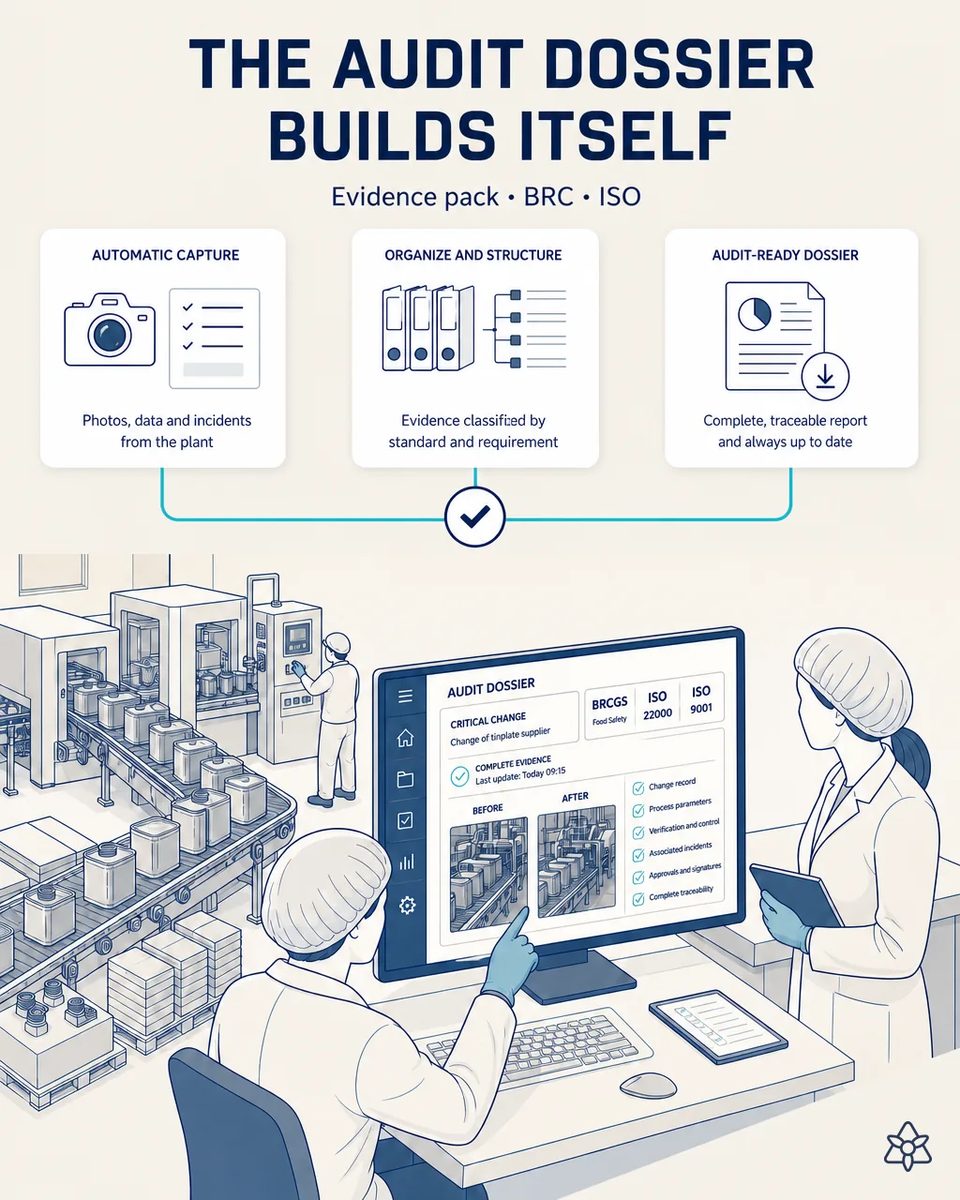
The auditor asks for proof, and the plant answers with folders.
The auditor asks for proof, the plant shows scattered papers, and a non-conformity gets raised over documentation gaps — made worse by having to repeat the exercise at each plant.
- The day the BRCGS Packaging auditor arrives, somebody has spent two weeks rebuilding the quarter's cleaning traceability. Those are two weeks of a quality team taken away from the plant to look backwards. And the result still depends on what was written down three months earlier.
- And the exercise is done in each plant separately, because each keeps its records its own way. Two plants of the group, two ways of filing, and two rebuilds of the same quarter.
- The auditor asks for proof, the plant shows scattered papers, and a nonconformity gets raised over documentation gaps rather than over the process itself.
- With ISO 9001 and client audits on top, the same evidence gets rebuilt again for each standard. The process is usually sound; what fails is the ability to prove it on the day. That gap, not the process, is what the auditor ends up writing up.
Edge captures each critical change; Agents files it by standard and by plant.
Edge (before/after photos of each critical point + change data) + Agents (organizes the dossier by certification standard and by plant). The auditor logs in and downloads the period's evidence pack, with nobody spending hours rebuilding it.
The dossier is not assembled before the audit, it is closed at the moment each change happens. Anything rebuilt afterwards inherits the gaps of whatever nobody wrote down. And it is precisely in those gaps that documentation nonconformities are raised.
Rebuilding the audit file versus an evidence pack that already exists
| Aspect | Today | With iLEAN Agents |
|---|---|---|
| Pre-audit rebuilding | Two weeks per plant | None |
| Evidence of a critical change | Scattered papers | Before and after photos plus change data |
| How it is organized | By whoever prepared it | By standard and by plant |
| Documentation nonconformity | Raised during the audit | Risk eliminated |
| The auditor's access | Folders brought to a meeting room | Login and download of the period |
| Second plant of the group | The same work, done again | The same pack, another filter |
2 weeks pre-audit rebuilding, per plant → zero. Documentation non-conformity risk → eliminated.
Impact estimate — to be validated with your numbers.
The block below is an estimate to be validated against your plant's actual data. We put it forward so the committee has an order of magnitude; we refine it during the assessment.
- Estimated payback 6-12 months, depending on audit frequency and the weight of the food-contact segment.
- Two weeks of pre-audit rebuilding per plant go to zero. The quality team spends that time on the process instead of on proving it.
- The risk of a nonconformity raised over documentation gaps disappears. Gaps are detected when a change happens without its evidence, not on the auditor's day.
- And the certification is protected continuously, not only in the weeks before the auditor's visit. Which is what a food-contact packer client really asks of its packaging supplier.
Estimated payback of 6 to 12 months depending on audit frequency and the weight of the food-contact segment, continuously protecting the certification. Estimate to validate.
And the fair question from the production manager
“Isn't this a document manager with another name?” — no: a document manager stores what somebody decides to upload after the fact. Here the evidence is captured by Edge at the change itself, and classifying it by standard requirement and plant is an anchored task where the best models drop below 1.5% error [1]. The quality lead reviews the pack before the auditor sees it. History from before deployment stays where it is; the pack builds from day one forward.
[1] OpenAI paper "Why Language Models Hallucinate", 2025 — on the reliability of AI in anchored tasks.
What people ask about the BRCGS evidence pack
Does one pack serve BRCGS Packaging and ISO 9001?
Yes. The evidence is the same; Agents indexes it against each standard's requirements, so the work is not done twice per scheme. Client audits get another view of the same evidence, without a third rebuild.
How are two plants handled?
Each change is tagged with its plant, so the auditor of one site sees that site, and group quality sees both side by side. Differences between how the two plants handle the same change become visible instead of being discovered by the auditor.
What does the auditor actually receive?
Access to the period's evidence pack, filtered by scope, which they can review and download without entering plant systems. Access is limited to the period and scope of their audit, and every download is logged.
Which changes generate a dossier?
The critical ones defined with quality, typically chemical-to-food changeovers, varnish changes and tinplate supplier changes, each with before and after photos. The list is agreed at commissioning and can grow as new critical points appear.
Does it warn about missing evidence?
Yes: a critical change without its evidence is flagged when it happens, not discovered on the day of the audit. That is the function with the most value, because it turns a future nonconformity into a task for today.
More cases from this series
- The lab spreadsheet stops living in a world apart from the ERPiLEAN absorbs the lab's varnish migration and adhesion spreadsheet and pushes it to the ERP after…
- The truck no longer waits while the delivery note is typedA photo of the delivery note and heat-number labels digitizes tinplate receiving and pushes it to the…
- A supplier alert that doesn't cost 90 minutes of stopped lineiLEAN reads a coil delay alert instantly and replans the work order before the lithography line stops.
- The curing curve, without touching the ovenAn external camera digitizes the varnish curing curve of an isolated vintage oven, with no replacement…
- Nothing enters the central system without human validationEvery iLEAN capture passes through a tablet with a visual summary before crossing into the ERP: the…
- Information that no longer dies at the end of the shiftWith a Bluetooth earpiece, the line manager dictates issues while walking and iLEAN structures and saves…
Tell us how long your last BRCGS audit took to prepare, plant by plant.
We work on your plant's real data, not ours. Assessment with no commitment.
Request estimated ROI within 48h ‹ See all cases of metal packaging See packaging