Zero typing errors on batch and date
The coder that prints batch and date on each can's base has an API but sits isolated from the ERP. A typing error when switching work orders can immobilize half a run. With iLEAN, the ERP publishes the batch to the coder automatically.
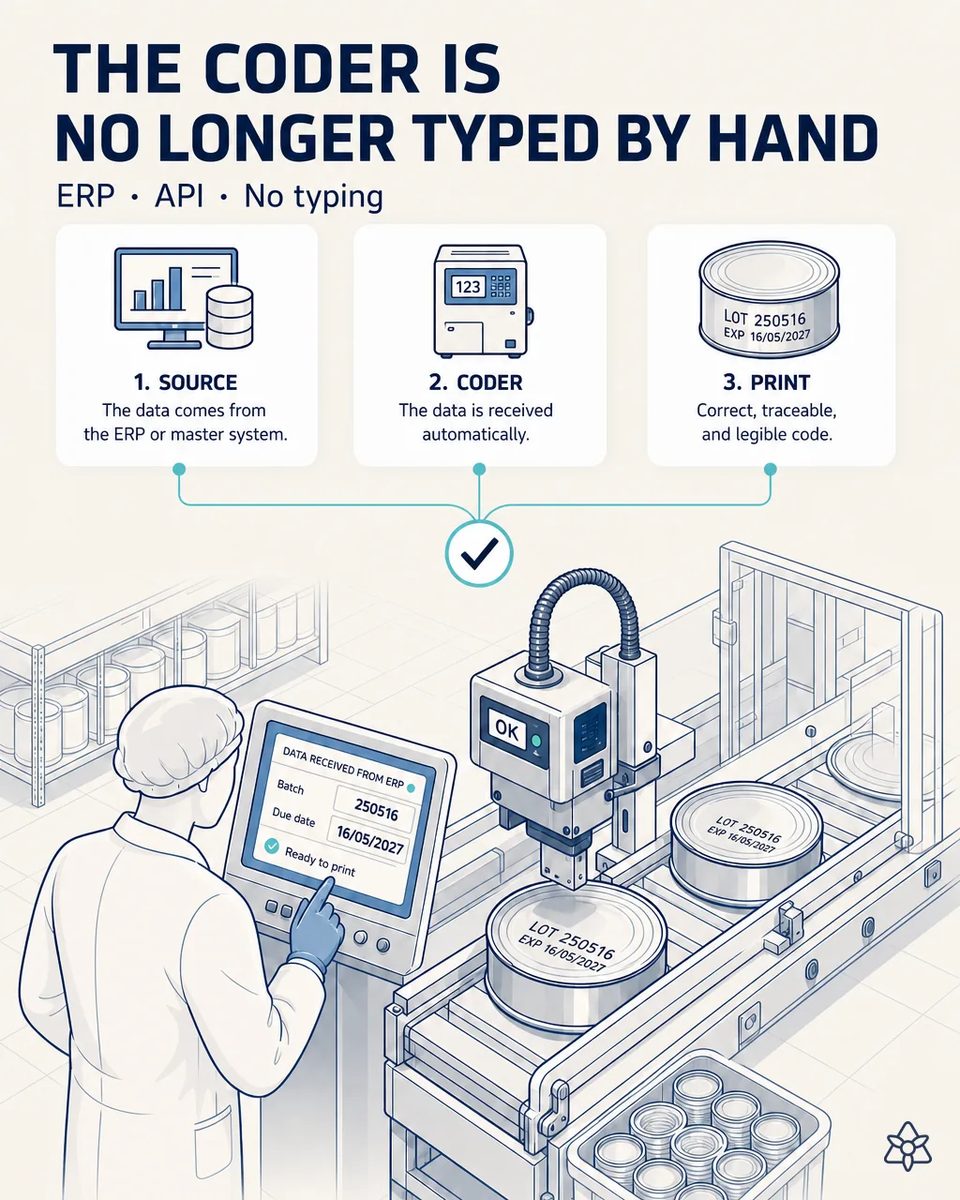
One digit typed on the coder can hold half a run.
When the work order changes, someone types the new batch by hand on the coder or body-welder panel. One typo can immobilize half a run at the packer client's plant.
- The coder that prints batch and date on each can's base has a documented API, and it still sits isolated from the ERP.
- At every work order change, somebody types the new batch by hand on the coder or body welder panel, with the same data already in the ERP. The same value is entered twice, and the second time it is entered under time pressure.
- Plants live with 2-3 typing errors a month, and some of them end in a hold.
- A wrong batch is rarely caught at the plant: it turns up at the packer client's plant, where it can immobilize half a run.
Connect stitches ERP and coder through their APIs — neither system is replaced.
Connect stitches two modern systems together via API. When the ERP marks a work order start, it automatically publishes batch and varnish spec to the coder or welder. Changing the work order = one tap in the ERP, not typing on the machine.
Changing a work order becomes one tap in the ERP instead of typing on the machine. The batch that reaches the can is the batch the ERP holds, by construction. There is no second keyboard where the value can change on its way to the can end.
The coder typed by hand versus the coder fed by the ERP
| Aspect | Today | With iLEAN Connect |
|---|---|---|
| Batch and date at an order change | Typed on the machine panel | Published by the ERP at order start |
| Human-origin coding errors | 2-3 a month | Zero |
| Varnish spec on the body welder | Selected by hand | Sent with the work order |
| Where a wrong batch is found | At the packer client | It cannot be produced |
| Order change on the line | Typing under time pressure | One tap in the ERP |
| Coder and ERP in metal packaging | — | Both kept, now talking to each other |
2-3 typing errors a month (some tied to holds) → zero human-origin coding errors.
Impact estimate — to be validated with your numbers.
The block below is an estimate to be validated against your plant's actual data. We put it forward so the committee has an order of magnitude; we refine it during the assessment.
- Estimated payback 3-6 months, from cutting human-origin coding errors to zero.
- Holds caused by a mistyped batch or date stop happening, including those found only at the packer client. Each of those holds costs far more than the minutes saved at the order change.
- Order changes stop depending on somebody typing correctly under time pressure. The order change becomes faster too, because nobody has to look up and type the new values.
- And the varnish spec reaches the body welder with the work order, not from memory.
Estimated payback of 3 to 6 months, cutting human-origin coding errors to zero. Estimate to validate.
And the fair question from the production manager
“Isn't it simpler to just be careful when typing?” — the plant already is, and it still gets 2-3 errors a month: at cadence, care does not scale. Here the ERP value travels as is, with nothing reinterpreted on the way; the only interpretive step in the chain is upstream, when a work order is captured from paper, an anchored task where the best models drop below 1.5% error [1] and which a person validates before it reaches the ERP. What disappears is the keystroke on the machine, which is exactly where the 2-3 monthly errors come from.
[1] OpenAI paper "Why Language Models Hallucinate", 2025 — on the reliability of AI in anchored tasks.
What people ask about connecting the coder in metal packaging
Do we need to replace the coder?
No. Connect uses the API the coder already has and the event the ERP publishes when a work order starts; both machines stay as they are. No machine shutdown window is needed to deploy it, which is why it does not wait in the IT queue.
What data travels to the coder in metal packaging?
The batch, the date and, on the body welder, the varnish spec of the active work order, all taken from the ERP without anyone retyping them. The same value that is in the ERP is the value printed on the can.
What happens if the coder's API is unavailable?
The order change is not silently skipped: the line lead is alerted and can enter the data manually, with that exception recorded. That way the fallback exists, but it can no longer happen without leaving a trace.
Why does a single typo cost so much?
Because a wrong batch or date on a can is usually found at the packer client's line, and the hold then covers everything that cannot be told apart. One digit becomes a hold on half a run because nobody can prove which cans are right.
Can the same pattern connect other machines?
Yes. Any modern machine with an API that is still fed by hand fits the same way; the coder goes first because its error reaches the client. Slitters, palletizers or labelers fed by hand are the usual next candidates.
More cases from this series
- The lab spreadsheet stops living in a world apart from the ERPiLEAN absorbs the lab's varnish migration and adhesion spreadsheet and pushes it to the ERP after…
- The truck no longer waits while the delivery note is typedA photo of the delivery note and heat-number labels digitizes tinplate receiving and pushes it to the…
- A supplier alert that doesn't cost 90 minutes of stopped lineiLEAN reads a coil delay alert instantly and replans the work order before the lithography line stops.
- The curing curve, without touching the ovenAn external camera digitizes the varnish curing curve of an isolated vintage oven, with no replacement…
- Nothing enters the central system without human validationEvery iLEAN capture passes through a tablet with a visual summary before crossing into the ERP: the…
- Information that no longer dies at the end of the shiftWith a Bluetooth earpiece, the line manager dictates issues while walking and iLEAN structures and saves…
Tell us which machine in your plant still gets typed by hand despite having an API.
We work on your plant's real data, not ours. Assessment with no commitment.
Request estimated ROI within 48h ‹ See all cases of metal packaging See packaging