Every bottle inspected before it is cased
In a premium tequila, the bottle is part of the product: the distributor and the consumer are paying for the packaging too. At line speed, the human eye lets through the slightly low fill, the label one degree crooked, the badly heat-sealed capsule or the tax stamp lifting at a corner. With iLEAN Edge, a camera over the line inspects every bottle in milliseconds and rejects the ones that fail before they are cased.
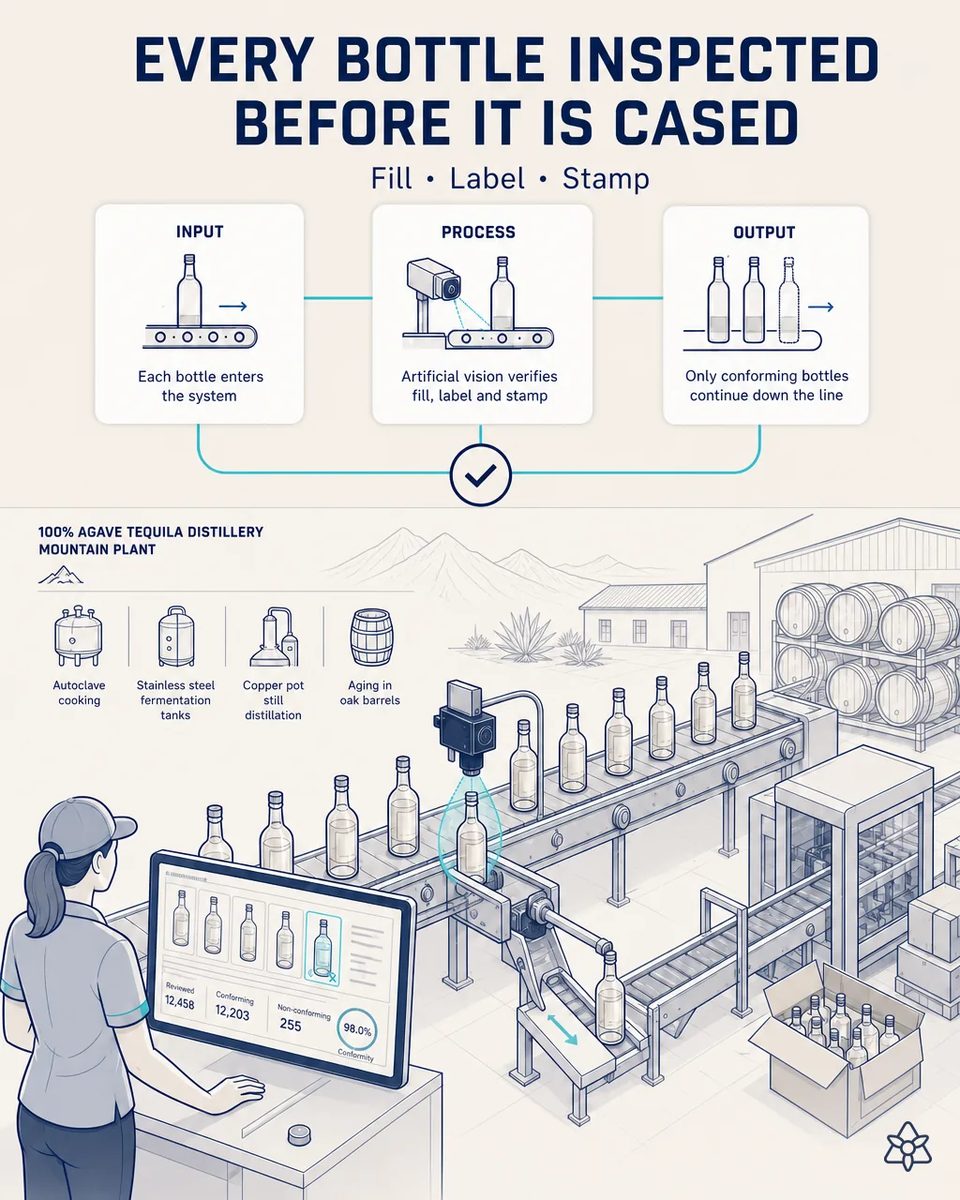
At line speed, the human eye lets through exactly what the premium distributor notices.
Control is visual and human, done by a person who has spent hours looking at identical bottles. The defects that get through are precisely the subtle ones — and those are exactly the ones a premium distributor does notice and does return. In contract production the problem scales: the cosmetic defect is claimed by the client who commissioned the brand, with a contract behind it. That is not a credit note, it is an uncomfortable conversation with whoever gives you volume. And there is a third layer: the tax stamp. A missing or misplaced stamp is not a cosmetic defect, it is a compliance problem.
- In a premium tequila the bottle is part of the product: the distributor and the consumer are paying for the glass, the label and the capsule too.
- Control is visual and human, done by a person who has spent hours looking at identical bottles. The defects that get through are the subtle ones — the slightly low fill, the label one degree crooked, the badly heat-sealed capsule — and those are the ones a premium distributor returns.
- In contract production the cosmetic defect is claimed by the client who commissioned the brand, with a contract behind it. That is not a credit note; it is an uncomfortable conversation with whoever gives you volume.
- And the marbete: a missing or lifting tax stamp is not a cosmetic defect, it is a compliance problem.
Edge — AI vision on the line, local inference in milliseconds.
Edge, AI vision on the line. The flow:
The camera inspects 100% of bottles and stores the image of every reject as evidence tied to the batch. The person stays in command: they decide what is reworked and what is scrapped, and review edge cases from a screen of thumbnails instead of staring at the conveyor. Rejects are not lost in a bin: each one has its image, its batch and its reason, and the same images feed the evidence pack of the batch.
- An industrial camera mounted over the line, after filling, labeling and stamp application, and before the case packer.
- Local inference in the plant itself, in milliseconds: no dependence on the cloud or on connectivity, which in a mountain plant is no small detail.
- The network is trained on images of this plant's actual bottles and labels, brand by brand.
- It detects out-of-range fill level, crooked or swapped front and back labels, incomplete capsule or seal, missing or misplaced tax stamp, and visible particles or haze.
- It rejects the bottle before casing and stores the image as evidence tied to the batch.
The person stays in command: they decide what is reworked and what is scrapped, and review edge cases from a screen of thumbnails.
Inspection by eye versus Edge vision
| Aspect | Visual inspection | With iLEAN Edge |
|---|---|---|
| Coverage | Sampling, depends on fatigue | 100% of bottles, constant |
| Fill level slightly low | Passes at line speed | Rejected before casing |
| Front and back label swapped or crooked | Noticed by the distributor | Detected in the plant |
| Missing or misplaced marbete | A compliance problem in the market | Caught before the case packer |
| Evidence per batch | None | Image of every reject |
| Connectivity needed | — | None: inference is local |
From sampling by eye to inspecting 100% of bottles, with visual evidence per batch. From distributor returns and cosmetic claims to detection inside the plant.
Impact estimate — to be validated with your numbers.
The block below is an estimate to be validated against your plant's actual data. We put it forward so the committee has an order of magnitude; we refine it during the assessment.
- Estimated reduction in escaped defects of at least 30% versus human control at line speed.
- Estimated payback 6-12 months, depending on bottle volume and the average cost of a return.
- Distributor returns and cosmetic claims turned into detection inside the plant, with the image of every reject to show a brand client.
- And a compliance layer on the marbete that today rests on whoever happens to be looking at the moment the stamp lifts at a corner, bottle after bottle.
Estimated reduction in escaped defects of at least 30% versus human control at line speed. Estimated payback 6-12 months depending on bottle volume and the average cost of a return. *Estimate to be validated.*
And the fair question from the production manager
"What if it rejects good bottles?" — the false positive is the real risk of any vision system, which is why the network is trained on images of this plant's actual bottles and labels, brand by brand, under that line's lighting, not on a generic model. In tasks anchored that way the best models drop below 1.5% error [1]. Borderline cases are not simply rejected: they go to the thumbnail screen for a person to decide, and every decision feeds back into training. Thresholds are tightened or loosened by quality, not by the model.
[1] OpenAI paper "Why Language Models Hallucinate", 2025 — on the reliability of AI in anchored tasks.
What people ask about bottle inspection on the line
What does it detect?
Out-of-range fill level, crooked or swapped front and back labels, incomplete capsule or seal, missing or misplaced tax stamp, and visible particles or haze in the liquid. Each defect type has its own threshold, set with quality at commissioning, so a brand with a deliberately high fill is not rejected for it.
Does it keep up with line speed?
Yes. Inference runs locally in the plant and resolves in milliseconds per bottle. It does not depend on the cloud or on connectivity, which in a mountain plant matters. The camera sits after filling, labeling and stamp application and before the case packer.
How many bottles are needed to train it?
Fewer than feared, because the defect catalog on a bottling line is short and repetitive. What is needed is real images of your bottles and labels, brand by brand. New defect types are added from the thumbnail screen as they appear, without retraining from scratch.
Does it work with several brands on the same line?
Yes, switching the model with the active bottling order. That is the normal situation in a plant that bottles for other brands. Each brand's labels, capsule and fill level are its own reference, and a swap between brands is itself a detected defect.
Who decides what happens to a rejected bottle?
The person. The camera diverts the bottle and stores the image; whether it is reworked or scrapped is decided from the thumbnail screen. The count of rejects per reason and per batch is what the bottling meeting looks at the next morning.
More cases from this series
- Every kilo of agave, accounted for in the bottleFour rings reconciling kilos of agave, liters of must, liters at 40% and stamped bottles, batch by…
- Every batch writes its own evidence packEvery batch generates its own file: agave origin, cooking curve, analysis, cuts, bottling and stamps,…
- Agave intake traced by photoPhotograph the weigh ticket and the field folios: kilos, field and folio post to the ERP with one tap,…
- The agave truck alert, read at second zeroiLEAN reads the delay or tonnage-change alert from the agave truck, cross-references the cooking…
- The autoclave panel, digitized without touching the machineAn external camera reads the pressure, temperature and time curve of the agave cooking autoclave. No PLC…
- The coder prints what the ERP says, with no typingBrand, batch, category and market travel from the ERP to the coder through the API, and tax stamp…
Tell us what your last distributor return cost you and what caused it.
We work on your plant's real data, not ours. Assessment with no commitment.
Request estimated ROI within 48h ‹ See all cases of tequila distilleries See food industry