Every kilo of agave, accounted for in the bottle
The core pain of a 100% agave tequila distillery is always the same number: how many liters at 40% come out of every metric ton of agave, and why this batch yielded differently from the last. Agave is 60-70% of variable cost, and today the explanation arrives weeks late, with the batch already in barrel. The iLEAN system coordinates the eleven cases before it into four rings that have to reconcile against each other — and if they do not, it says so at the time.
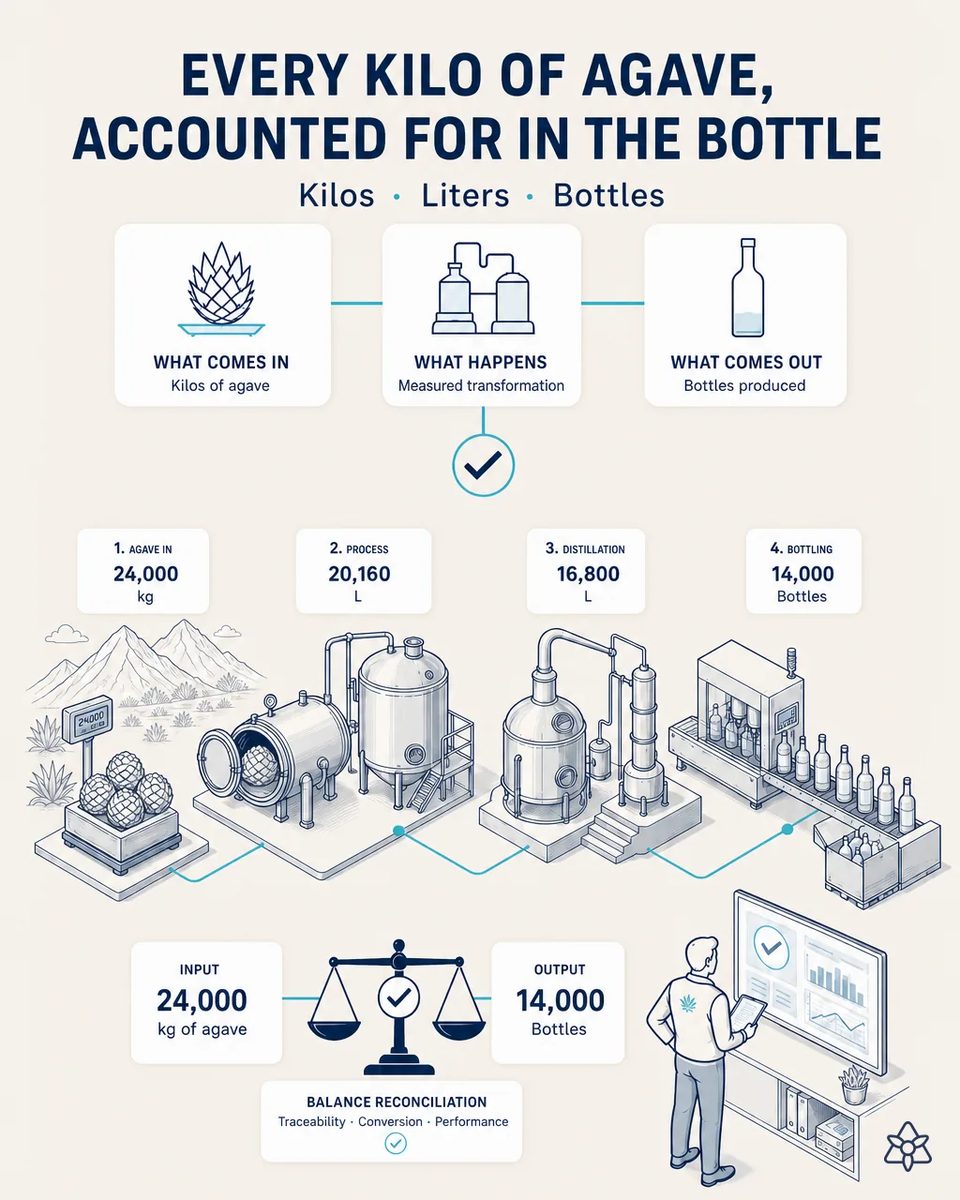
Every hypothesis about a low-yield batch is plausible and none is provable.
The agave-to-bottle balance is calculated after the fact and in aggregate. By the time the month's yield drop is spotted, there is no telling whether it was the maturity of one supplier's agave, a different cooking curve, a fermentation that fell short, a more conservative cut or a loss in bottling. Every hypothesis is plausible and none is provable, because each link's data lives on a different medium with a different delay. The conversation ends up being about opinions. And in a plant that also bottles for other brands, the same discrepancy has a second face: a misattributed batch. That is not a margin problem, it is a contract and a certification problem.
- The agave-to-bottle balance is calculated after the fact and in aggregate. By the time the month's yield drop is spotted, the batch is already in barrel.
- There is no telling whether it was the maturity of one supplier's agave, a different cooking curve, a fermentation that fell short, a more conservative cut or a loss in bottling. Each link's data lives on a different medium with a different delay, so the conversation ends up being about opinions.
- Agave is 60-70% of variable cost. Every liter at 40% per metric ton that is not explained is margin nobody can go and recover.
- And in a plant that also bottles for other brands, the same discrepancy has a second face: a misattributed batch. That is not a margin problem, it is a contract and a certification problem.
Four rings that reconcile — it is all of the above, orchestrated.
No single ring solves the problem: each one already exists today in some form and the yield still cannot be explained. The strength is in the reconciliation, kilos to liters of must to liters at 40% to stamped bottles, because what gives a loss away is four independent sources ceasing to agree. When they do not, JIDOKA AI holds the next step until a person looks — and the master distiller still decides what to do about it.
- Ring 1 — Agave coming in (cases 7 and 3): net kilos per truck, field of origin, field folio and harvest date enter by photo and validation at intake, not by typing. Every autoclave load knows which agave it was made from.
- Ring 2 — Process (cases 1, 2, 4, 5 and 6): the cooking curve arrives from the autoclave panel by camera; brix and tank curve from the photographed log and the master distiller's voice; the analysis from the lab; the cuts and proof signed on the tablet at the still. The batch ends up described in full and in a comparable form.
- Ring 3 — Bottling (cases 8, 9 and 10): the ERP bottling order drives the coder; the Edge camera inspects bottle by bottle; the changeover between brands is validated by vision before start-up. The liters going out are attributed to the right brand and the right batch, with evidence.
- Ring 4 — Balance and file (case 11): Agents reconciles the three previous rings batch by batch: kilos → liters of must → liters at 40% → stamped bottles. If the gap exceeds tolerance, JIDOKA AI flags it and holds the next step until a person reviews it. The batch file closes itself, ready for the certifier.
- SMED AI works in parallel so that brand and batch changeovers do not stretch out because of these extra checks: the plant does not run slower for being safer.
The four rings, and what each one closes
| Ring | Which cases it draws on | What it closes |
|---|---|---|
| 1 · Agave coming in | Intake (7) + supply alerts (3) | Net kilos, field and folio per autoclave load |
| 2 · Process | Batch log (1) + autoclave (2) + headset (4) + tablet (5) + lab (6) | Cooking curve, brix, analysis, cuts and proof, signed |
| 3 · Bottling | Coder (8) + bottle inspection (9) + brand changeover (10) | Liters out, attributed to the right brand and batch |
| 4 · Balance and file | Evidence pack (11) | Kilos → must → liters at 40% → bottles, reconciled |
| JIDOKA AI | Across all four | Holds the next step when the gap exceeds tolerance |
| SMED AI | In parallel | Changeovers do not stretch because of the extra checks |
From a yield known in aggregate at month end to a yield per batch with its explanatory variables beside it, on the same table. From "we do not know why this batch yielded less" to a comparison across batches with cooking curve, tank temperature, fermentation days, cut point and bottling loss. From possible misattributed batches to a discrepancy caught before the product moves on.
Impact estimate — to be validated with your average yield and its dispersion.
The block below is an estimate to be validated against your plant's actual data. We put it forward so the committee has an order of magnitude; we refine it during the assessment.
- In a sub-sector where raw material is 60-70% of variable cost, every percentage point of yield recovered or loss explained has a direct, recurring effect on margin.
- Estimated payback 6-12 months, driven by the yield improvement rather than by administrative savings.
- Elimination of misattributed-batch risk, which in contract production is contractual risk.
- And a yield conversation held over one table with the explanatory variables beside each batch, instead of over opinions.
In a sub-sector where raw material is 60-70% of variable cost, every percentage point of yield recovered or loss explained has a direct, recurring effect on margin; on top of that comes the elimination of misattributed-batch risk, which in contract production is contractual risk. Estimated payback 6-12 months, driven by the yield improvement rather than by administrative savings. *Estimate to be validated: we need the current average yield (liters at 40% per metric ton) and its dispersion across last year's batches.*
And the fair question from the production manager
"Do we have to deploy all twelve cases to get this?" — no, and framing it that way would be the way never to start. The rings are built in layers and each case pays on its own from the first month. With intake and the batch log you already have ring 1 and half of ring 2, which is where half the missing explanation sits. Each ring rests on anchored captures where the best models drop below 1.5% error [1] and on a human signature, so the balance is built on data somebody stood behind.
[1] OpenAI paper "Why Language Models Hallucinate", 2025 — on the reliability of AI in anchored tasks.
What people ask about the complete system
Where do you start?
With the case that has fewest dependencies and the shortest deployment, which in this matrix is agave intake or the batch log. What matters is that each layer pays on its own.
What does the reconciliation give that each control does not?
Exactly what escapes today: the explanation. A slightly immature load passes intake, a slightly short fermentation passes the log, and the batch that adds the two yields low with nobody able to say why.
What if a ring flags a false discrepancy?
JIDOKA AI stops on a verifiable gap between sources, not on model uncertainty. When the doubt is the model's, the case is escalated to a person and the batch does not wait for the machine.
Does the master distiller lose any decision?
None. The system tells him which batches yielded differently and what they had in common. What to change in the cook, the tank or the cut remains his call.
Can the return be estimated before committing?
Yes. With your average yield in liters at 40% per metric ton, its dispersion across last year's batches and the cost of agave, the return per ring is estimated before deciding the order.
More cases from this series
- Every batch writes its own evidence packEvery batch generates its own file: agave origin, cooking curve, analysis, cuts, bottling and stamps,…
- Agave intake traced by photoPhotograph the weigh ticket and the field folios: kilos, field and folio post to the ERP with one tap,…
- The agave truck alert, read at second zeroiLEAN reads the delay or tonnage-change alert from the agave truck, cross-references the cooking…
- The autoclave panel, digitized without touching the machineAn external camera reads the pressure, temperature and time curve of the agave cooking autoclave. No PLC…
- The coder prints what the ERP says, with no typingBrand, batch, category and market travel from the ERP to the coder through the API, and tax stamp…
- The batch log stops dying on paperThe master distiller photographs his batch sheet and the process enters the system structured, with no…
Give us your average yield and its dispersion across batches and we will return the calculation.
We work on your plant's real data, not ours. Assessment with no commitment.
Request estimated ROI within 48h ‹ See all cases of tequila distilleries See food industry