The coder prints what the ERP says, with no typing
The coder on the bottling line is a modern machine with an API, bought in the last few years, and yet somebody keys every job change in by hand: brand, category, batch, destination market. The same data already sitting in the ERP bottling order. In a plant that bottles several brands under the same standard, that double entry is exactly where the expensive mistake gets in. Connect stitches the two ends together through the API.
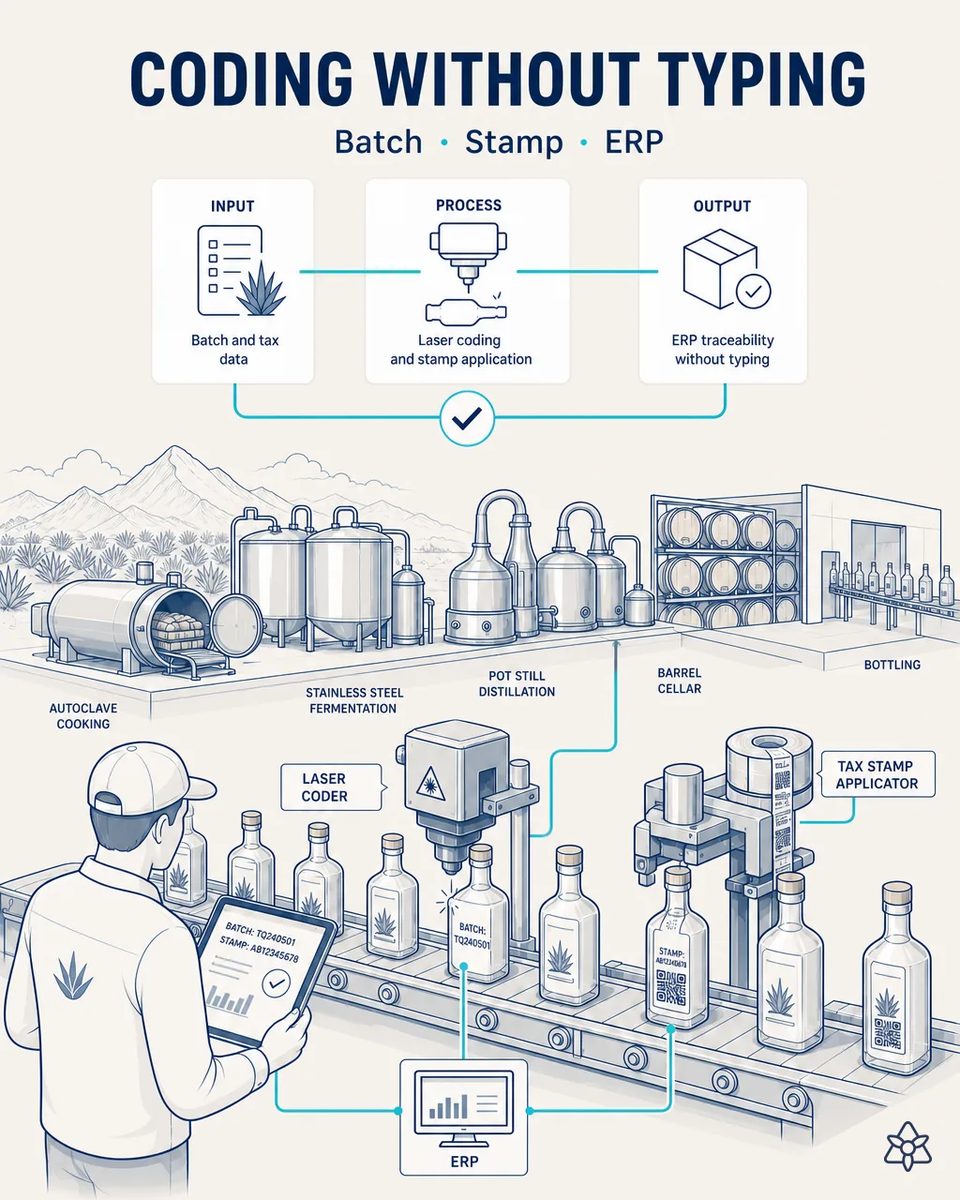
The same data typed twice, and the error only shows on the pallet.
The coder and the tax stamp control system are "almost integrated": they have interfaces, but nobody had time to tie them to the ERP, so they run as islands fed by keyboard. The bottling supervisor types at the start of every job and types again when the format or the market changes. Every keystroke is a chance for error, and the error only surfaces once the bottle is already cased: the right brand with the previous batch code, or the data set for the wrong market. On top of that comes tax stamp reconciliation, done today by hand and after the fact: adding up what was consumed and squaring it against bottles filled. By the time a discrepancy appears, weeks have gone by.
- The coder and the tax stamp control system are "almost integrated": they have interfaces, but nobody had time to tie them to the ERP, so they run as islands fed by keyboard.
- The bottling supervisor types brand, category, batch and destination market at the start of every job, and types again when the format or the market changes. The same data is already sitting in the ERP bottling order.
- The error only surfaces once the bottle is cased: the right brand with the previous batch code, or the data set for the wrong market. In a plant bottling several brands under the same standard, that is where the expensive mistake gets in.
- Marbete reconciliation is done by hand and after the fact, adding up what was consumed against bottles filled. By the time a discrepancy appears, weeks have gone by.
Connect as a stitcher of modern systems — replacing neither.
Connect as a stitcher of modern systems. The flow:
What the ERP says is what the machine prints, with no intermediate typing, and the stamp range assigned to the order is registered at the start and reconciled at the close against the bottles the Edge camera actually counted. A coding error stops being something you catch on the pallet and becomes something that cannot happen by construction. And the bottling supervisor keeps doing the same job with one screen fewer.
- The ERP bottling order — brand, category (blanco, reposado, añejo, extra añejo, cristalino), batch, volume, proof, destination market — is published to the coder through its API.
- What the ERP says is what the machine prints. No intermediate typing.
- The range of tax stamps assigned to the order is registered at the start.
- When the order closes, it reconciles automatically against the bottles actually filled, counted by the Edge camera from case 9.
- Any discrepancy is visible the same day, not at month end.
Without replacing the coder, without replacing the ERP and without anyone learning a new screen.
The isolated coder versus the stitched coder
| Aspect | Today | With iLEAN Connect |
|---|---|---|
| Keying per bottling job | Twice | Zero |
| Brand, category, batch, market | Typed on the coder panel | Published from the ERP order |
| A coding error | Caught on the pallet | Impossible by construction |
| Marbete reconciliation | By hand, at month end | Automatic, per order |
| A stamp discrepancy | Visible weeks later | Visible the same day |
| The coder and the ERP | — | Neither is replaced |
From two keying entries per bottling job to zero. From manual, after-the-fact stamp reconciliation to automatic reconciliation per order. From coding errors caught on the pallet to coding errors made impossible by construction.
Impact estimate — to be validated with your numbers.
The block below is an estimate to be validated against your plant's actual data. We put it forward so the committee has an order of magnitude; we refine it during the assessment.
- Estimated payback 5-10 months.
- The bulk of the value is not typing time: it is the coding incidents avoided, which in premium product and contract production carry reputational as well as economic cost.
- Marbete consumption reconciled per bottling order instead of after the fact.
- And a bottling supervisor who no longer learns a new screen, because the order travels on its own.
Estimated payback 5-10 months. The bulk of the value is not typing time but the coding incidents avoided, which in premium product and contract production carry reputational as well as economic cost. *Estimate to be validated.*
And the fair question from the production manager
"Isn't a classic integration project cleaner?" — it is, the day it reaches the top of the IT list, and that is the problem: this is the classic case of a modern coder still isolated because there was never time. Stitching through the existing APIs replaces neither system and needs no shutdown window. Where a field still has to be read from a printed order, that is an anchored task, where the best models drop below 1.5% error [1], and the supervisor confirms the job before the first bottle is coded. A discrepancy between order and coder is shown before the job starts, not after the pallet is wrapped.
[1] OpenAI paper "Why Language Models Hallucinate", 2025 — on the reliability of AI in anchored tasks.
What people ask about connecting the coder to the ERP
Do we have to replace the coder or the ERP?
Neither. Connect uses the API the coder already has and what the ERP publishes when the bottling order opens. If the coder's API is limited, an adapter is checked before anything else. Most coders bought in the last few years expose enough to publish a job and read back what was printed.
What data travels to the coder?
Brand, category — blanco, reposado, añejo, extra añejo, cristalino — batch, volume, proof and destination market, exactly as they sit on the ERP bottling order. What the coder actually printed is read back and confirmed to the ERP, so the record is what was printed, not what was requested.
How are the marbetes reconciled?
The stamp range assigned to the order is registered at the start; at the close it is squared against the bottles actually filled, counted by the Edge camera. Any gap is visible that day. A range consumed but not filled, or filled but not consumed, is exactly the kind of discrepancy that today surfaces weeks later.
Does it cover a change of market mid-job?
Yes: the change is made on the ERP order and travels to the coder. That is the moment where typing produced the most expensive errors, and the previous job's data can no longer linger on the coder panel by mistake.
Does the same pattern work for other machines?
Any modern island with an interface fed by hand fits the same way. You start with the coder because it underpins the batch code and the stamp on every bottle. The tax stamp control system is usually the second island stitched, for the same reason.
More cases from this series
- Every kilo of agave, accounted for in the bottleFour rings reconciling kilos of agave, liters of must, liters at 40% and stamped bottles, batch by…
- Every batch writes its own evidence packEvery batch generates its own file: agave origin, cooking curve, analysis, cuts, bottling and stamps,…
- Agave intake traced by photoPhotograph the weigh ticket and the field folios: kilos, field and folio post to the ERP with one tap,…
- The agave truck alert, read at second zeroiLEAN reads the delay or tonnage-change alert from the agave truck, cross-references the cooking…
- The autoclave panel, digitized without touching the machineAn external camera reads the pressure, temperature and time curve of the agave cooking autoclave. No PLC…
- The batch log stops dying on paperThe master distiller photographs his batch sheet and the process enters the system structured, with no…
Tell us which coder you run and how you reconcile marbetes today.
We work on your plant's real data, not ours. Assessment with no commitment.
Request estimated ROI within 48h ‹ See all cases of tequila distilleries See food industry