The agave truck alert, read at second zero
Agave arrives on trucks leaving fields hours from the plant, and the news that one is late, carries less tonnage or comes from a different field lands by messaging app on the phone of someone who is out on the floor with their hands full. By the time it is read, the autoclave is scheduled and the tank reserved. With iLEAN Connect the system reads the alert at second zero, cross-references it with the cooking schedule and hands the production manager a concrete action.
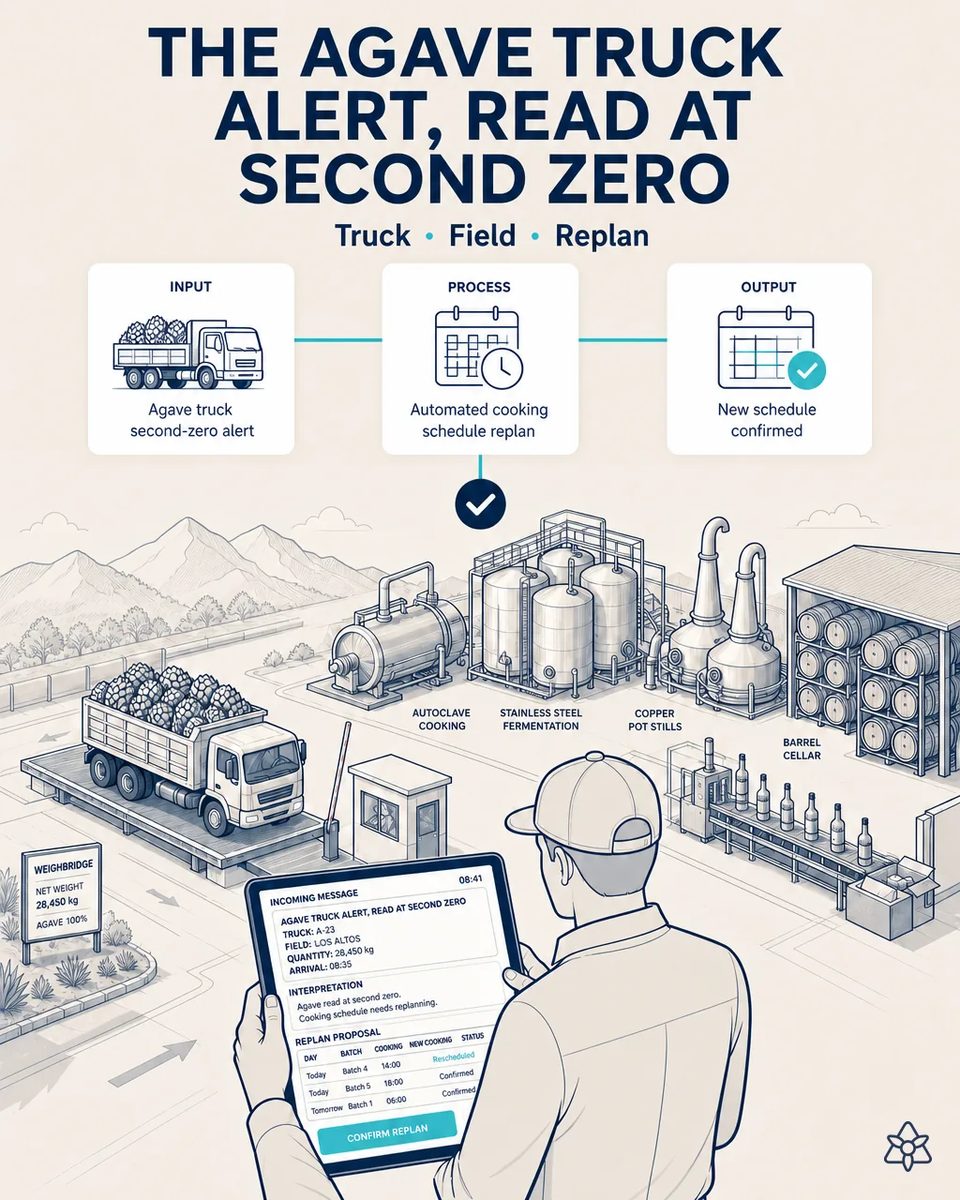
The alert that changes the day lands on a phone nobody can look at.
The critical alerts in this sub-sector — a delayed or canceled agave truck, actual tonnage differing from what was committed, a change of field of origin, a price variation, a carrier incident, a notice from the certifying body about an inspection — arrive through informal channels into personal inboxes and phones. Nobody can watch their phone and close a batch at the same time. And in a plant that cooks in batches, reacting an hour late means a wasted autoclave load and an idle fermentation tank. The cost is not theoretical: it is a load that was not made and tank hours that do not come back. Worse, reacting late forces emergency purchases at worse prices, on the input that is already the plant's largest variable cost line.
- A delayed or canceled agave truck, actual tonnage below what was committed, a change of field of origin, a price variation, a carrier incident, a notice from the certifying body about an inspection: all of it arrives through informal channels into personal inboxes and phones.
- Nobody can watch a phone and close a batch at the same time. By the time the message is read, the autoclave is scheduled and the tank reserved. The person it was sent to is usually the one with the least time to read it.
- In a plant that cooks in batches, reacting an hour late is a wasted autoclave load and an idle fermentation tank. That cost is not theoretical: it is a load that was not made and tank hours that do not come back.
- And reacting late forces emergency agave purchases at worse prices, on the input that is already 60-70% of variable cost.
Connect in chaotic-sources mode — silent copy on a corporate channel, twenty-four seven.
Connect in chaotic-sources mode. The flow:
iLEAN does not say you have a new message: it says what can be done about it. Which load moves up, which tank frees up and who needs to be told, with the information already joined up. The production manager still decides; what changes is that the alert arrives with its consequences worked out, and in time. In a batch plant, time is the only thing that turns an alert into a wasted load or into an ordinary Tuesday.
- iLEAN sits silently copied in 24/7 on a dedicated plant mailbox and a business messaging number. Never on anyone's personal phone: the channel is corporate and explicit.
- The moment a message lands, it extracts the intent — delay, tonnage change, origin change — and the entities: supplier, field, kilos, transport, date.
- It cross-references those against the cooking schedule and the live purchase orders in the ERP.
- It hands the production manager a concrete action: which load moves up, which tank frees up and who needs to be told.
Step 4 is where the difference lies. iLEAN does not say "you have a new message": it says what can be done about it. The decision stays human; what changes is that it arrives with the information already joined up, and in time.
Today's alert versus the cross-referenced alert
| Aspect | Today, on a phone | With iLEAN Connect |
|---|---|---|
| When the alert is read | When somebody looks at the phone | Second zero |
| Human lag | 2-4 hours | Seconds |
| An autoclave load without agave | Discovered at loading time | Rescheduled while the alert is warm |
| The reserved tank | Sits idle | Freed or reassigned in time |
| Emergency purchases | At whatever price the day allows | Fewer, and planned |
| Who decides | The production manager | The production manager — iLEAN proposes |
From 2-4 hours of human lag to seconds. From replanning once the truck has already failed to show up, to replanning while the alert is still warm.
Impact estimate — to be validated with your numbers.
The block below is an estimate to be validated against your plant's actual data. We put it forward so the committee has an order of magnitude; we refine it during the assessment.
- Estimated payback 4-8 months.
- Recovered cooking loads and fermentation tank hours that today are lost to late reaction.
- Fewer emergency agave purchases at worse prices, on the plant's largest variable cost line.
- And a production manager who replans while the alert is still warm instead of once the truck has already failed to show up.
Estimated payback 4-8 months from recovered cooking loads and tank hours, plus fewer emergency purchases at worse prices. *Estimate to be validated.*
And the fair question from the production manager
"Is iLEAN going to read my team's personal messages?" — no. It sits in copy on a dedicated plant mailbox and a business messaging number, and it only sees what suppliers and carriers send to those corporate channels. On extraction, classifying the intent of a supply alert — delay, tonnage change, origin change — is an anchored task where the best models drop below 1.5% error [1], and the reshuffle is executed by a person. Suppliers and carriers keep writing exactly as they do today; nobody is asked to fill in a form.
[1] OpenAI paper "Why Language Models Hallucinate", 2025 — on the reliability of AI in anchored tasks.
What people ask about reading agave supply alerts
Which alerts does it recognize?
Delayed or canceled trucks, tonnage differing from what was committed, a change of field of origin, price variations, carrier incidents and notices from the certifying body. Each one is routed to the role that must act. A message that is only a greeting or a confirmation is filed, not escalated.
What does the production manager actually receive?
A concrete action, not a notification: which autoclave load moves up, which fermentation tank frees up, which purchase order is affected and who needs to be told. It arrives on the tablet or the corporate phone with the original message attached, so the manager can read it in one tap.
Does it cross-reference the ERP?
Yes, the live purchase orders and the cooking schedule. That is what turns a message about kilos into a decision about loads and tanks. If the ERP is not connected yet, the case starts against the cooking schedule alone and gains the purchase orders later.
Does it work in the harvest season peak?
That is when it matters most: more trucks, more field changes and a tighter cooking schedule mean every hour of lag costs a load. Outside the peak, the same channel keeps catching the notice from the certifying body or the carrier incident that would otherwise sit unread over a weekend.
Can it reschedule the autoclave on its own?
No. It proposes the reshuffle and the production manager confirms it. The decision stays human by design; what it removes is the hour of reading, calling and checking that today sits between the message and the decision.
More cases from this series
- Every kilo of agave, accounted for in the bottleFour rings reconciling kilos of agave, liters of must, liters at 40% and stamped bottles, batch by…
- Every batch writes its own evidence packEvery batch generates its own file: agave origin, cooking curve, analysis, cuts, bottling and stamps,…
- Agave intake traced by photoPhotograph the weigh ticket and the field folios: kilos, field and folio post to the ERP with one tap,…
- The autoclave panel, digitized without touching the machineAn external camera reads the pressure, temperature and time curve of the agave cooking autoclave. No PLC…
- The coder prints what the ERP says, with no typingBrand, batch, category and market travel from the ERP to the coder through the API, and tax stamp…
- The batch log stops dying on paperThe master distiller photographs his batch sheet and the process enters the system structured, with no…
Tell us what the last agave truck that did not show up cost you in loads and tank hours.
We work on your plant's real data, not ours. Assessment with no commitment.
Request estimated ROI within 48h ‹ See all cases of tequila distilleries See food industry