Every batch writes its own evidence pack
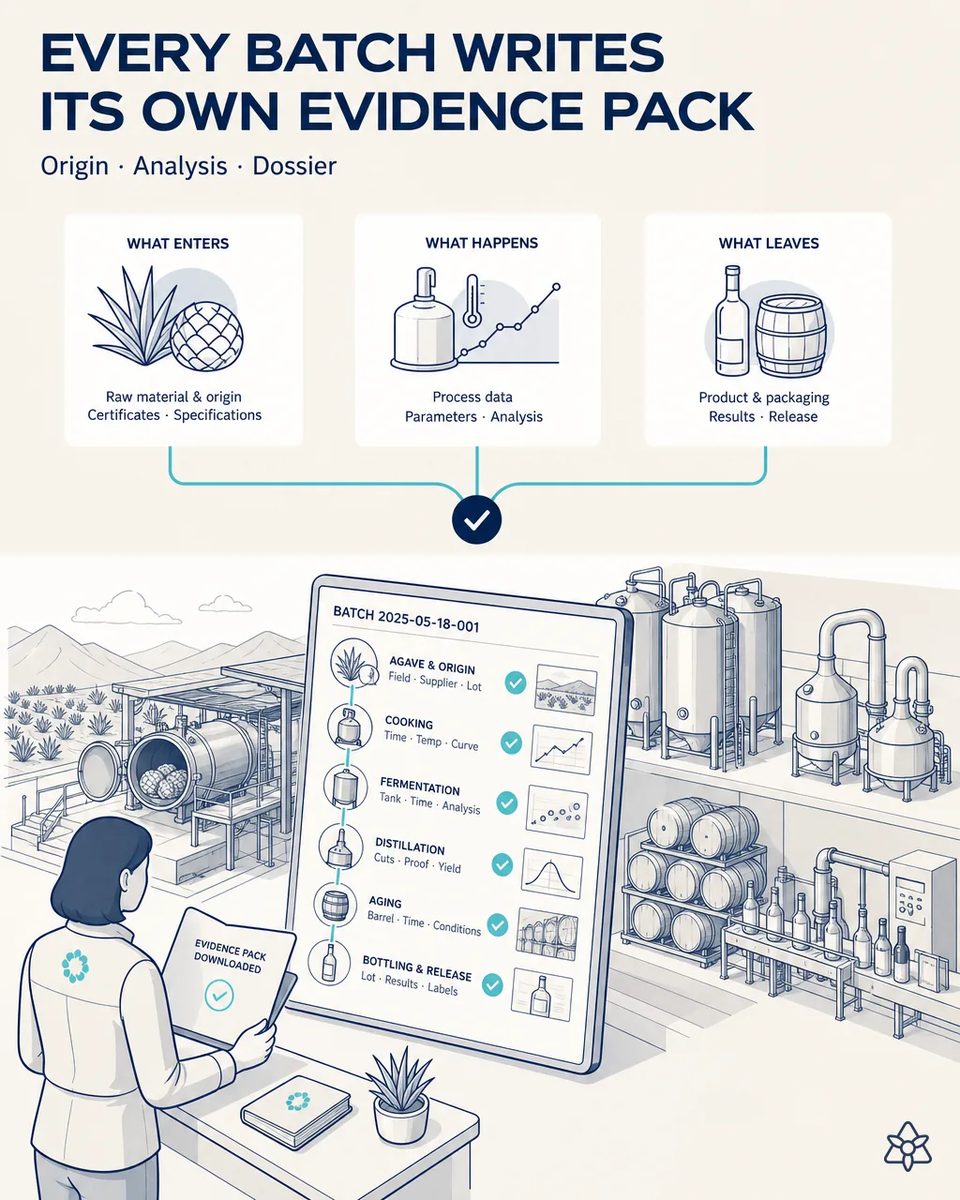
The day the appellation's certifying body turns up, or the day an importer asks for the file behind a shipment, somebody in the plant spends one or two weeks rebuilding traceability by hand. And even then there are gaps, because part of the evidence was never stored. With iLEAN Edge + Agents, every batch generates its own file as it goes, already organized by standard and by audience.
The cost of the inspection is not the inspection.
Certification is batch by batch, and the appellation of origin is the asset that holds up the price of the product. The evidence exists — weigh tickets, field folios, lab sheets, batch logs, bottling records — but scattered across paper, spreadsheets, the ERP and the memory of three people. Every inspection, every brand client audit and every export file forces the same collection work all over again. One or two weeks of a person who does something else the rest of the year. And the bigger risk is not the time: it is a documentary gap turning up exactly when it costs the most, in front of the inspector.
- Certification is batch by batch, and the appellation of origin is the asset that holds up the price of the product. The evidence exists — weigh tickets, field folios, lab sheets, batch logs, bottling records, marbete ranges — but scattered across paper, spreadsheets, the ERP and the memory of three people.
- Every CRT inspection, every brand client audit and every export file forces the same collection work all over again. One or two weeks of a person who does something else the rest of the year.
- The bigger risk is not the time: it is a documentary gap turning up exactly when it costs the most, in front of the inspector.
- And part of the evidence was never stored in the first place, so even two weeks of work leave holes. Those holes are where a nonconformity starts.
Connect and Edge capture; Agents organizes by standard and by audience.
Agents on top of everything Connect and Edge have already captured. Nothing new has to be captured. The flow: 1. Every piece of evidence enters central memory the moment it is produced, with its human signature and its timestamp (cases 1 to 10). 2. Agents organizes it per batch: agave origin with field and folio, cooking curve, must brix and tank curve, physicochemical analysis, cuts and proof, barrel and resting time, bottling order, stamp range and photographs of the critical points. 3. And presents it in the view each audience asks for:
Nothing new has to be captured. Every piece of evidence enters central memory the moment it is produced, with its human signature and its timestamp, and Agents organizes it per batch and presents it in the view each audience asks for. The recipient logs in and downloads; nobody in the plant prepares anything. This is evidence, not a report written after the fact. The master distiller, the quality manager and the receiving manager have already signed each piece; Agents only arranges what they signed.
- the appellation certification file,
- a quality dossier for a contract-production client,
- a labeling and composition file per export market. 4. The recipient logs in and downloads. Nobody in the plant prepares anything. Every piece keeps its signature and its timestamp: this is evidence, not a report generated after the fact.
Today's preparation versus the permanent batch file
| Aspect | Today | With iLEAN Agents |
|---|---|---|
| Preparation per inspection | 1-2 person-weeks | Zero |
| Where the evidence is | Paper, spreadsheets, ERP, memory | One file per batch |
| The CRT, a brand client, an importer | Three separate reconstructions | Same evidence, three views |
| A documentary gap | Found in front of the inspector | Flagged when it should have been produced |
| Signature and timestamp | Lost in the reconstruction | Kept on every piece |
| Who prepares the file | Whoever is free that week | Nobody: it fills itself |
From one or two weeks of reconstruction per inspection to zero. From possible documentary gaps to a file that is complete by construction, because it fills itself as the batch moves.
Impact estimate — to be validated with your numbers.
The block below is an estimate to be validated against your plant's actual data. We put it forward so the committee has an order of magnitude; we refine it during the assessment.
- Continuous protection of the appellation of origin and of the contract-production agreements.
- Estimated payback 6-12 months, depending on inspection frequency, client audits and number of export markets.
- One or two person-weeks per inspection recovered, and the same again for every brand client audit.
- And a file that is complete by construction, because it fills itself as the batch moves.
Continuous protection of the appellation of origin and of the contract-production agreements. Estimated payback 6-12 months depending on inspection frequency, client audits and number of export markets. *Estimate to be validated.*
And the fair question from the production manager
"Isn't this just another document manager?" — the difference is direction. A document manager stores what somebody decides to upload, after the fact, and inherits the same gaps. Here every piece enters the instant it is produced, already tied to its batch by an anchored extraction, where the best models drop below 1.5% error [1], and signed by a person. What Agents does afterwards is reorganize it for whichever standard or client asks. A missing piece — a lab analysis that never arrived for a batch already cut — is flagged the day it should have existed, not the day the inspector asks for it.
[1] OpenAI paper "Why Language Models Hallucinate", 2025 — on the reliability of AI in anchored tasks.
What people ask about the batch evidence pack
What goes into the file?
Agave origin with field and folio, cooking curve, must brix and tank curve, physicochemical analysis, cuts and proof, barrel and resting time, bottling order, marbete range and the photographs of the critical points. Each piece keeps its author and its timestamp, so the file reads as a sequence of signed events, not as a summary.
Does it serve the CRT and the brand clients at once?
Yes, and that is the point: the evidence is the same, what changes is the scheme it is indexed against. That is exactly the work repeated in full today for each audience. The CRT view follows the certification file; the brand client's view follows their quality agreement; the importer's follows the market's labeling rules.
Does it cover the export file?
Yes. The labeling and composition file per export market is one of the views, built from the same batch evidence. When a market changes a labeling requirement, only the view changes; the evidence underneath does not.
Does the inspector get into our systems?
No. They access a view scoped to the batches and period of their inspection, filter and download. What they see is what the plant already had the day the batch closed, nothing assembled for the visit.
What about batches from before?
They stay where they are. The file builds from day one forward; bringing in the history is optional and is done batch by batch if it is worth it. Most plants start with the batches currently in barrel, because those are the ones the next inspection will ask about.
More cases from this series
- Every kilo of agave, accounted for in the bottleFour rings reconciling kilos of agave, liters of must, liters at 40% and stamped bottles, batch by…
- Agave intake traced by photoPhotograph the weigh ticket and the field folios: kilos, field and folio post to the ERP with one tap,…
- The agave truck alert, read at second zeroiLEAN reads the delay or tonnage-change alert from the agave truck, cross-references the cooking…
- The autoclave panel, digitized without touching the machineAn external camera reads the pressure, temperature and time curve of the agave cooking autoclave. No PLC…
- The coder prints what the ERP says, with no typingBrand, batch, category and market travel from the ERP to the coder through the API, and tax stamp…
- The batch log stops dying on paperThe master distiller photographs his batch sheet and the process enters the system structured, with no…
Tell us what you were asked for at your last inspection and how long it took to assemble.
We work on your plant's real data, not ours. Assessment with no commitment.
Request estimated ROI within 48h ‹ See all cases of tequila distilleries See food industry