The batch log stops dying on paper
In a 100% agave tequila distillery, the most valuable document in the house is a sheet of paper. Batch by batch, the master distiller writes down the brix of the must, which tank it went into, the days of fermentation, the proof of the ordinario and — above all — where he cut heads and where he cut tails. That set of decisions is literally the profile of the product. With iLEAN Connect, one photo of that sheet at the close of the batch is enough for the batch to exist in central memory with every field structured, without asking anyone to change notebooks.
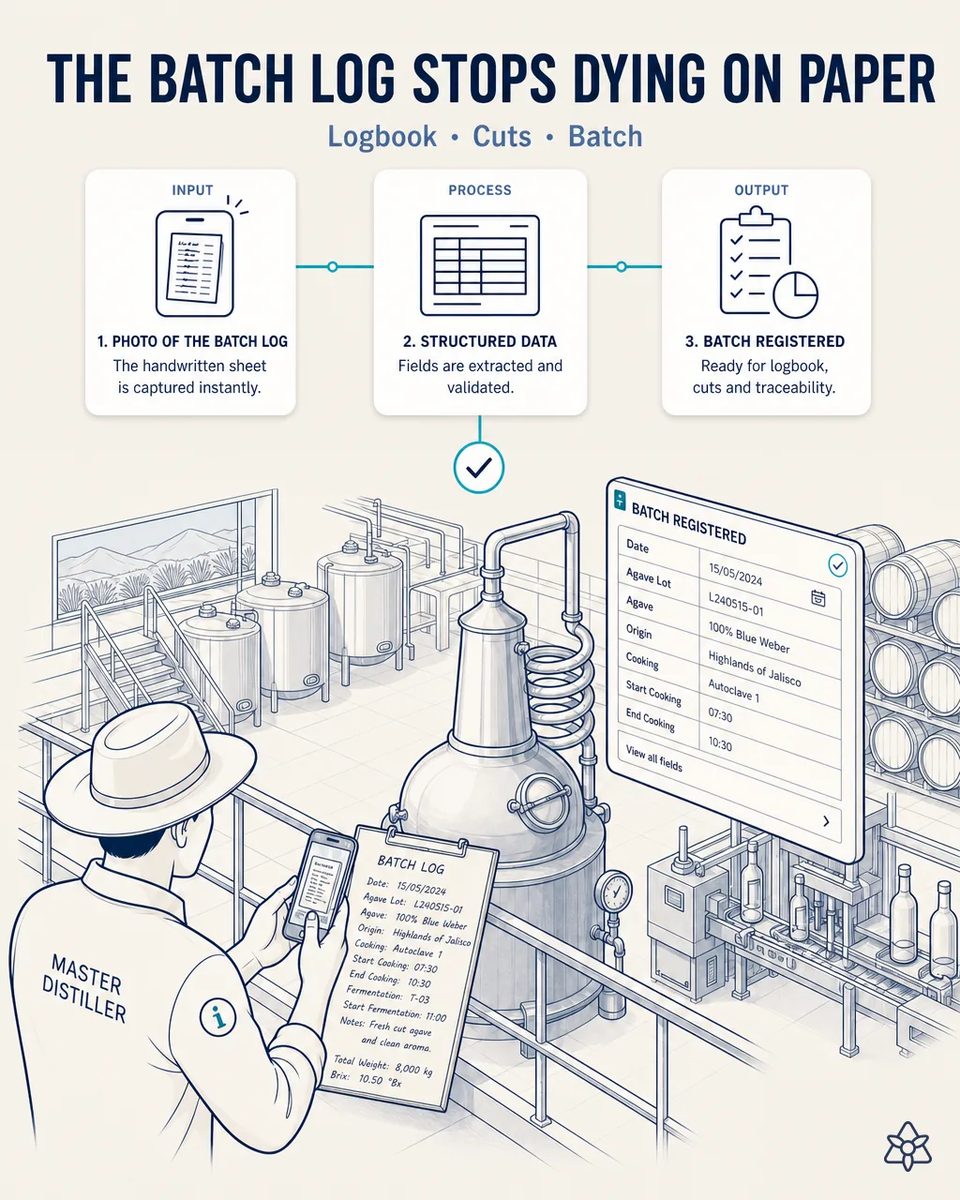
The most valuable document in the house is one sheet of paper.
Tequila production runs in batches, not continuously. Every batch generates one to three handwritten sheets that pass through three pairs of hands — cooking, fermentation, distillation — and end up in a folder in the office. Between the sheet being closed and someone typing it up, days or a week can pass. Sometimes it is never typed at all, and the only thing that survives from the process is the liter total. The real cost shows up months later. When someone has to explain why one particular batch yielded less, or why it came out with a different profile, the fine-grained data is gone: the notebook is there, in the handwriting of whoever wrote it, with no way of cross-referencing it against the cooking curve, the lab analysis or the final liters. The yield conversation stays permanently in the realm of instinct. And there is a larger risk that plants rarely talk about: that knowledge belongs to one person. The day the master distiller retires, it walks out with him.
- Every batch produces one to three handwritten sheets that pass through cooking, fermentation and distillation before ending up in an office folder. The must brix, the tank, the days of fermentation, the proof of the ordinario and the exact point of the heads and tails cut all travel on that paper.
- Between the sheet being closed and somebody typing it up, days or a week go by. Often it is never typed at all, and the only thing that survives is the liter total.
- Months later, when somebody has to explain why one batch yielded less or came out with a different profile, the fine data is unreachable: it cannot be cross-referenced with the autoclave curve, the lab analysis or the final liters at 40%.
- And the knowledge belongs to one person. The day the master distiller retires, thirty years of cut decisions walk out of the plant with him.
Connect in photo mode — the notebook stays exactly where it is.
Connect in photo mode. Step by step:
It asks for no change of habit: the master distiller closes the batch on paper as always and adds one photo. What changes is that the batch now exists in central memory as 15-25 comparable fields instead of a liter total, and his free-text notes — usually the most valuable part of the sheet — are captured with them. No decision is taken away from him. It is usually the first case a distillery approves, because it costs nothing in habit and gives the plant back its own history.
- The master distiller closes the batch as always, on his paper sheet.
- He takes a photo with a phone or an industrial tablet.
- A grounded LLM recognizes the structure of the document — even handwritten, even when each shift fills it in differently — and extracts the fields: batch ID, agave weight and origin, autoclave load number, opening and closing brix, tank, recorded temperature curve, ordinario proof, volume and proof of heads, heart and tails, plus the free-text observations.
- The result is shown on the tablet at the still for human validation (case 5). He confirms with two taps, or corrects.
- Only then does the data cross into central memory, where it is automatically cross-referenced with the autoclave curve (case 2) and the lab analysis (case 6).
Zero habit change: the notebook stays exactly where it is. The only new thing is the photo. And the master distiller's free-text notes — "tank 4 started slow, I nudged it a degree" — are captured just like the numeric fields, because they are usually the most valuable part of the sheet.
The batch on paper versus the batch captured
| Aspect | Today, on paper | With iLEAN Connect |
|---|---|---|
| When the batch exists in a system | Days, a week, or never | Second zero, at the close |
| What survives per batch | The liter total | 15-25 structured fields |
| The heads and tails cut | In the handwriting of whoever cut | Volume, proof and time, queryable |
| Free-text observations | Lost with the folder | Captured and tied to the batch |
| Explaining a low-yield batch | Instinct | Cross-reference with cooking and analysis |
| The master distiller's habit | — | Unchanged: one photo |
From days — or never — of lag to second zero. From a liter total per batch to a batch described by 15-25 fields comparable across batches. From knowledge living in one person to knowledge living in the house, without taking a single decision away from that person.
Impact estimate — to be validated with your numbers.
The block below is an estimate to be validated against your plant's actual data. We put it forward so the committee has an order of magnitude; we refine it during the assessment.
- Estimated payback 4-9 months, depending on batches per week.
- Transcription time recovered in the office, batch after batch, and the folder of closed sheets stops being the only archive the plant has.
- For the first time, process, yield and profile can be correlated across batches on the same table.
- And the knowledge stops living in one person and starts living in the house, without taking a single decision away from that person.
Estimated payback 4-9 months depending on batches per week, from recovered transcription time and, above all, from being able to correlate process ↔ yield ↔ profile for the first time. *Estimate to be validated.*
And the fair question from the production manager
"Every shift writes the sheet differently — will it read the handwriting?" — reading fields from a document with a known structure, even handwritten, is an anchored task, where the best models drop below 1.5% error [1]. And there is a second net: the extracted fields go to the tablet at the still and the distiller confirms or corrects them before anything crosses into central memory.
[1] OpenAI paper "Why Language Models Hallucinate", 2025 — on the reliability of AI in anchored tasks.
What people ask about digitizing the batch log
Do we have to redesign the batch sheet?
No. Vision reads the document structure exactly as it exists today, even when cooking, fermentation and distillation each fill in their part differently. Redesigning the sheet is the fastest way to have it stop being filled in. If the house later wants a cleaner sheet, it can change it whenever it likes: the extraction follows the document, not the other way round.
Which fields does it extract?
Batch ID, agave weight and origin, autoclave load, opening and closing brix, tank, recorded temperature curve, ordinario proof, volume and proof of heads, heart and tails, and the free-text observations. Uncertain readings are highlighted for the distiller rather than guessed.
What happens to the master distiller's notes in the margin?
They are extracted like any other field and tied to the batch. A note such as tank four started slow, or that the agave arrived greener than usual, is exactly what explains a yield difference three months later, and it is the context the numeric fields alone never carry.
Does it decide where the cut goes?
Never. The cut is the master distiller's decision and it stays his. iLEAN records where he cut and lets the house compare that against yield and profile across batches. It gives him the comparison; it does not give him the instruction.
Do we need the ERP connected from the start?
No. The case works from the first batch against iLEAN's central memory, and the push to the ERP is connected afterwards, once there is demonstrated value. Most plants start with the photo alone and add the autoclave curve and the lab analysis to the same batch in the following months.
More cases from this series
- Every kilo of agave, accounted for in the bottleFour rings reconciling kilos of agave, liters of must, liters at 40% and stamped bottles, batch by…
- Every batch writes its own evidence packEvery batch generates its own file: agave origin, cooking curve, analysis, cuts, bottling and stamps,…
- Agave intake traced by photoPhotograph the weigh ticket and the field folios: kilos, field and folio post to the ERP with one tap,…
- The agave truck alert, read at second zeroiLEAN reads the delay or tonnage-change alert from the agave truck, cross-references the cooking…
- The autoclave panel, digitized without touching the machineAn external camera reads the pressure, temperature and time curve of the agave cooking autoclave. No PLC…
- The coder prints what the ERP says, with no typingBrand, batch, category and market travel from the ERP to the coder through the API, and tax stamp…
Tell us how long it takes a closed batch to exist in your system today.
We work on your plant's real data, not ours. Assessment with no commitment.
Request estimated ROI within 48h ‹ See all cases of tequila distilleries See food industry