The lab spreadsheet posts itself into the ERP
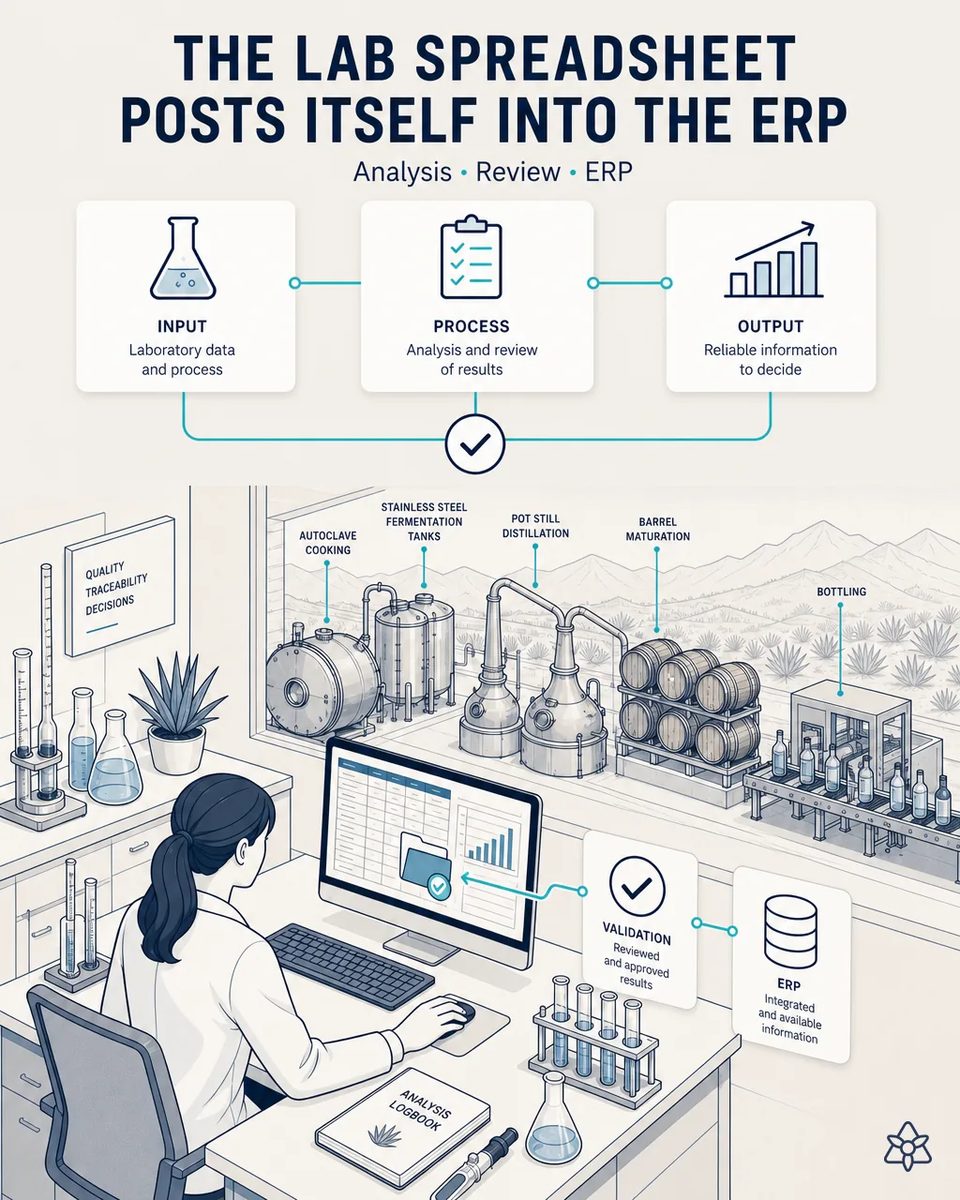
Every tequila distillery has a shared folder with the lab spreadsheet in it: alcoholic strength, methanol, higher alcohols, aldehydes, furfural, dry extract, batch by batch. This is the data the certifying body checks. But the ERP requires someone to key it in again, so it gets transcribed at month end and there is a permanent gap between what the lab knows and what the company system believes. With iLEAN Connect, the system reads the file when it is saved and, once the manager approves, posts it to the ERP on its own.
You pay for an ERP and still operate off a spreadsheet.
Two parallel truths coexist in the plant. The lab's, current and living in a spreadsheet; and the ERP's, weeks behind, which is the one production, administration and management actually see. Transcription costs about half a day a month, and even then, when the inspector asks for one batch's analysis, you go looking in the spreadsheet, not in the system. In other words: you pay for an ERP and still operate off a spreadsheet. And there is a cost almost nobody counts: licenses. If four or five people across lab and quality hold a quality module license purely to enter data, that is four or five recurring annual licenses paid for keystrokes.
- Two parallel truths coexist in the plant. The lab's, current and living in a spreadsheet: alcoholic strength, methanol, higher alcohols, aldehydes, furfural, dry extract, batch by batch. And the ERP's, weeks behind, which is the one production, administration and management actually see.
- Transcription costs about half a day a month, and even then, when the inspector asks for one batch's analysis, you go looking in the spreadsheet, not in the system.
- This is the data the certifying body checks against NOM-006. A batch whose analysis sits in a local file is a batch whose evidence depends on one computer.
- And there is a cost almost nobody counts: if four or five people across lab and quality hold a quality module license purely to enter data, that is four or five recurring annual licenses paid for keystrokes.
Connect in listening-inwards mode — the file, not the person.
Connect in listening-inwards mode. The flow:
iLEAN reads the file when it is saved; it does not watch anybody. Every analyst keeps their own column layout and their own naming, the quality manager validates on the tablet, and only then is the analysis written to the ERP through the API. From that point on, one license is enough: the one held by the person who validates. The lab does not change how it works; the ERP finally reflects what the lab knows.
- iLEAN watches the shared folder: it reads the file when it is saved. It does not watch anybody and does not monitor people's activity.
- It parses it with a grounded LLM, tolerant of every analyst using their own column layout and their own naming.
- It ties the result to its batch and leaves it in central memory.
- The quality manager validates on the tablet (case 5).
- Only then is it written to the ERP through the API.
From that point on, only the manager who validates needs a quality module license. The rest of the lab carries on working in their spreadsheet, which is where they are comfortable.
Today's lab versus the connected lab
| Aspect | Today | With iLEAN Connect |
|---|---|---|
| Gap between lab and ERP | Weeks | Minutes |
| Manual transcription | Half a day a month | Zero |
| Where the inspector's answer is | In a local spreadsheet | In the system, per batch, signed |
| Column layout | Must be respected | Tolerated as is, analyst by analyst |
| Quality module licenses | Four or five | One, the manager who validates |
| Who is watched | — | Nobody: only the file |
From a gap of weeks between real data and ERP data to minutes. From analysis in a local spreadsheet to analysis queryable per batch from the system, with its signature. Half a day a month of transcription freed up.
Impact estimate — to be validated against your actual ERP invoice.
The block below is an estimate to be validated against your plant's actual data. We put it forward so the committee has an order of magnitude; we refine it during the assessment.
- 💰 CFO angle: direct saving on ERP quality/lab module licenses, typically −50% to −80% in this sub-sector (from 4-5 licenses to 1), recurring every year.
- Estimated payback 3-7 months: one of the fastest in the catalog, because the saving is contractual and shows up on next year's invoice.
- Half a day a month of transcription freed up in the lab, and the month-end rush to key results before the close disappears with it.
- And the analysis the certifying body checks becomes queryable per batch from the system, with its signature, instead of from somebody's computer.
Direct saving on ERP quality/lab module licenses: typical sub-sector ratio −50% to −80% (from 4-5 licenses to 1), with recurring annual savings in the low thousands depending on the vendor's pricing. Estimated payback 3-7 months: one of the fastest in the catalog because the saving is contractual and shows up on next year's invoice. *Estimate to be validated against the actual ERP invoice.*
And the fair question from the production manager
"Three analysts have been changing that spreadsheet for years — does it hold up?" — that is the anticipated case: parsing does not depend on fixed positions, it interprets columns, units, merged cells and margin notes without asking anyone to standardize anything. It is an anchored task, where the best models drop below 1.5% error [1], and the quality manager validates on the tablet before anything is written to the ERP.
[1] OpenAI paper "Why Language Models Hallucinate", 2025 — on the reliability of AI in anchored tasks.
What people ask about connecting the lab spreadsheet
Do we have to standardize the spreadsheet?
No, and it is better not to. Asking the lab to change its sheet is the fast route to the system going unused. iLEAN reads the one that exists, in the format it has today.
Which parameters does it read?
Whatever the lab records per batch: alcoholic strength, methanol, higher alcohols, aldehydes, furfural, dry extract and any house-specific column. New columns are picked up as they appear, and units and decimal formats are normalized on the way in, so a value in the wrong column is caught rather than posted.
Can licenses really be reduced?
It depends on your ERP contract, which is why it is framed as an estimate to validate against last year's invoice. The logic is simple: anyone logging in purely to type stops needing to. In most sub-sector contracts the quality module is priced per named user, which is what makes the arithmetic straightforward.
Does it help at an inspection?
It is one of the biggest time savers: the analysis for any batch is in the system, signed, on the day it is asked for, instead of being hunted down in a folder. The same applies to a brand client asking for the analysis behind a shipment.
Does it watch the folder or the analysts?
The folder. The file is read when it is saved; there is no tracking of who opens what or how long they spend on it. The lab does not even see a new screen; it keeps saving the spreadsheet where it always has.
More cases from this series
- Every kilo of agave, accounted for in the bottleFour rings reconciling kilos of agave, liters of must, liters at 40% and stamped bottles, batch by…
- Every batch writes its own evidence packEvery batch generates its own file: agave origin, cooking curve, analysis, cuts, bottling and stamps,…
- Agave intake traced by photoPhotograph the weigh ticket and the field folios: kilos, field and folio post to the ERP with one tap,…
- The agave truck alert, read at second zeroiLEAN reads the delay or tonnage-change alert from the agave truck, cross-references the cooking…
- The autoclave panel, digitized without touching the machineAn external camera reads the pressure, temperature and time curve of the agave cooking autoclave. No PLC…
- The coder prints what the ERP says, with no typingBrand, batch, category and market travel from the ERP to the coder through the API, and tax stamp…
Tell us how many people log into the ERP today purely to enter lab results.
We work on your plant's real data, not ours. Assessment with no commitment.
Request estimated ROI within 48h ‹ See all cases of tequila distilleries See food industry