Damaged tomatoes out before processing
The quality of a sauce or tomato purée starts on the sorting belt. At peak-season speed, the human eye cannot check all the fruit. iLEAN Edge places an AI camera over the belt that detects burst, moldy or green tomatoes, leaves, stems and foreign material, marks each piece for removal and counts rejects per supplier.
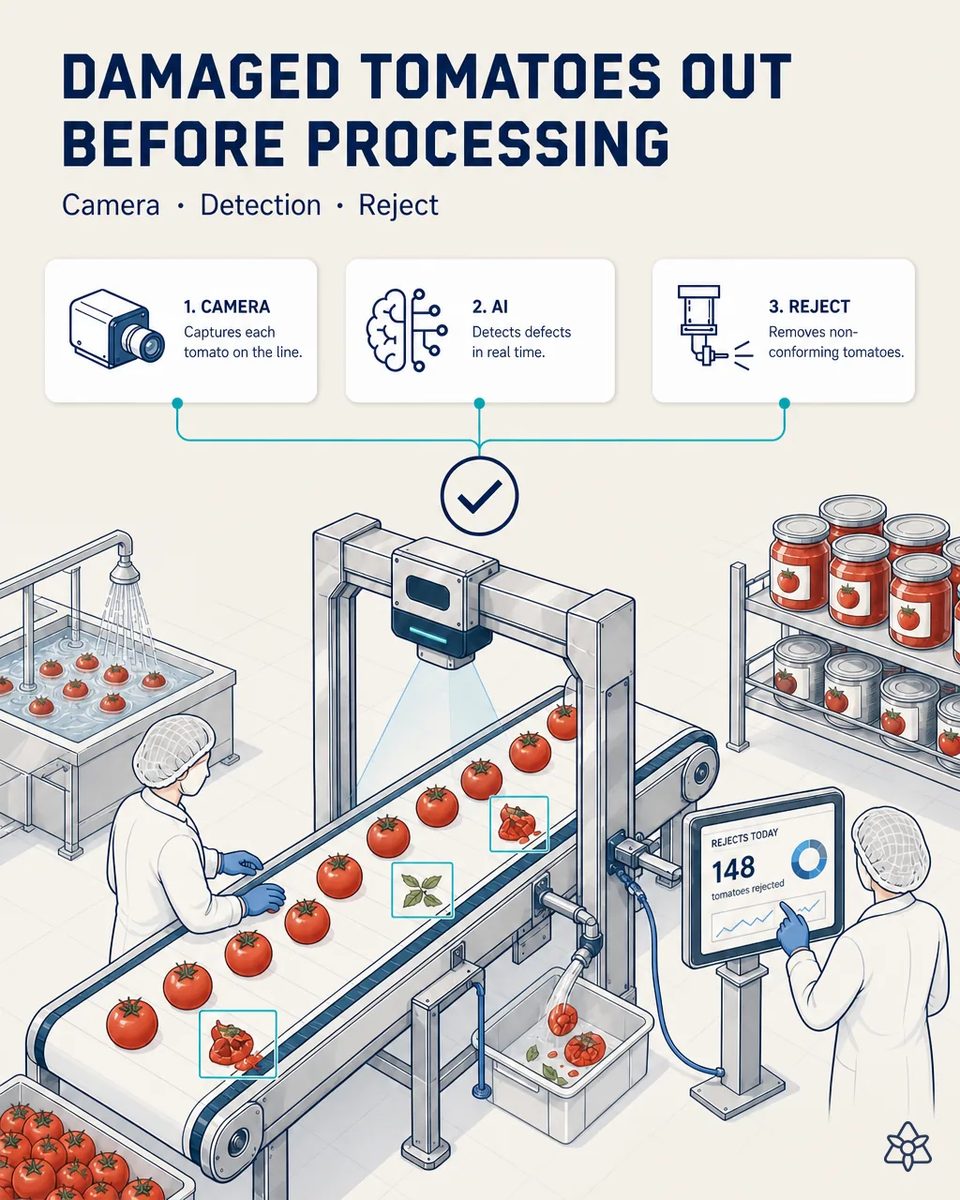
At peak-season speed, the sorters' eyes cannot keep up with the belt.
In season the sorting belt moves tons per hour. Sorters remove what they can, but fatigue and speed let damaged fruit and foreign material through. What slips through is paid for later: color and flavor variation, rework, X-ray rejects or a foreign body reaching final inspection. And there is no objective quality figure for each supplier against the kilos paid.
- In season the sorting belt moves tons of tomatoes per hour. Sorters remove what they can, but fatigue and speed let burst, moldy and green fruit through.
- Leaves, stems and foreign material from the field slip past as well, especially in the last hours of a long shift.
- What gets through is paid for later: color and flavor variation, rework, X-ray rejects or a foreign body found at final inspection.
- And there is no objective quality figure per grower against the kilos paid on the scale ticket, so every negotiation runs on perception.
Edge on the sorting belt — local inference in milliseconds, sorters still in command.
iLEAN Edge.
The neural network is trained on the plant's own good and damaged tomatoes, runs on a device at the belt and marks or ejects each defective piece in milliseconds. The sorters stop hunting and start acting where the screen points. And every reject is counted against the grower whose scale ticket brought it in. At the end of the season, the plant knows which fields sent the cleanest fruit and which sent the most rework.
- Industrial camera over the belt on a sanitary gantry.
- Neural network trained on examples of good and defective fruit from the plant itself.
- Local inference in milliseconds.
- Visual marking or automatic ejection of each defective piece.
- Reject count per supplier matched with scale kilos. Sorters stay in command and the system shows them where to act.
Sorting by eye versus optical sorting with Edge
| Aspect | Today | With iLEAN Edge |
|---|---|---|
| Share of the belt inspected | What the sorters can see | 100% of the fruit |
| Burst and moldy tomatoes | Missed late in the shift | Marked or ejected |
| Leaves, stems and foreign material | Caught by chance | Detected on the belt |
| Rejects per grower | A feeling | Counted against scale kilos |
| Where the decision runs | — | A local device, in milliseconds |
| Doubtful fruit | Goes through | Shown to the sorter |
Before: partial inspection due to fatigue, supplier quality based on perception. After: 100% of fruit inspected, rejects measured per supplier.
Impact estimate — to be validated with your current reject rate.
The block below is an estimate to be validated against your plant's actual data. We put it forward so the committee has an order of magnitude; we refine it during the assessment.
- Estimated payback 5-12 months, depending on current rejects.
- It comes from less rework downstream and from a better negotiating position with growers.
- Inspection goes from partial, limited by fatigue, to every tomato on the belt.
- And grower quality stops being a matter of perception: rejects are measured per grower and matched with the kilos paid. Cleaner fruit at the hopper also means steadier color and Brix in the finished sauce.
Estimated payback of 5 to 12 months depending on current rejects, from less rework and better supplier negotiation. Estimate to be validated.
And the fair question from the production manager
"What if it throws good tomatoes into the reject bin?" — a false reject is the real risk of any vision system, which is why the model is trained on your own fruit, under the light of your belt, not on a generic dataset. Telling a sound tomato from a burst or moldy one against a known catalog of defects is an anchored task, where the best models stay under 1.5% error [1]. The threshold is set with quality, doubtful fruit is shown to the sorter rather than ejected blindly, and every reject can be reviewed. Reviewed rejects feed back into training, so the optical sorting gets sharper as the season advances.
[1] OpenAI paper "Why Language Models Hallucinate", 2025 — on the reliability of AI in anchored tasks.
What people ask about vision on the tomato sorting belt
Does it replace the sorters on the belt?
No. They stay in command; the system shows them where to act and can drive an ejector where one exists. Most plants keep the same crew and get a cleaner belt from it. On belts with no ejector, each defective tomato is highlighted for the nearest sorter.
Can it tell a green tomato from a ripe one under the belt lights?
Yes, color and ripeness are among the classes trained on your own fruit and lighting. Green, burst, moldy, leaves, stems and foreign material are each a separate class, so the count tells you what kind of reject each grower sends. New classes, such as a pest damage that appears mid-season, can be added with fresh examples.
How are rejects tied to a grower?
The belt knows which field lot is running from the hopper record, and the lot carries the grower and the scale ticket. Rejects are counted against it, so the season ends with a figure per grower against kilos paid. That figure is what turns the next price conversation with each grower into a discussion about data.
Does the camera survive the washing and splashing at the belt?
It sits on a sanitary gantry in a washdown-rated housing, above the splash zone. Cleaning follows the same routine as the rest of the belt. The lens is protected and its cleanliness is checked automatically before each shift starts.
What does it need to be trained before the season starts?
Real examples of good and damaged fruit from your plant, ideally from the previous season or the first days of the new one. A video of your belt is enough for us to assess detection before committing. Accuracy keeps improving with the fruit seen during the first weeks of the season.
More cases from this series
- Food safety audit ready, nothing to rebuildEvery cleaning, thermal cycle and release produces its evidence; iLEAN Agents organizes it by standard…
- True packaging OEE, no hidden stoppagesConnect, Edge and Agents working together to measure true OEE, anticipate stoppages and connect the…
- Case and pallet labels, always matchingLot, best-before date and codes travel from the ERP to the case labeler and palletizer; iLEAN…
- Field alerts arrive before the problem doesiLEAN reads grower and carrier alerts from WhatsApp or email, matches them with the production plan and…
- From the lab spreadsheet to the ERP, no retypingiLEAN reads the quality lab spreadsheet, has the lead validate it and posts it to the ERP. Fewer…
- Paperless order start at the hopperA photo of the bin label and weighing ticket puts the real consumption of each production order into the…
Send us a video of your sorting belt and we will assess detection.
We work on your plant's real data, not ours. Assessment with no commitment.
Request estimated ROI within 48h ‹ See all cases of sauces and canned vegetables See food industry