From the lab spreadsheet to the ERP, no retyping
In the lab of a sauce and canned food plant, Brix, pH, acidity, consistency, color, vacuum and drained weight are recorded in a spreadsheet each shift, and the ERP receives them days later by manual retyping. iLEAN Connect reads the file when it is saved, the lead validates and results enter the ERP via API. CFO angle: from several quality module licenses to one.
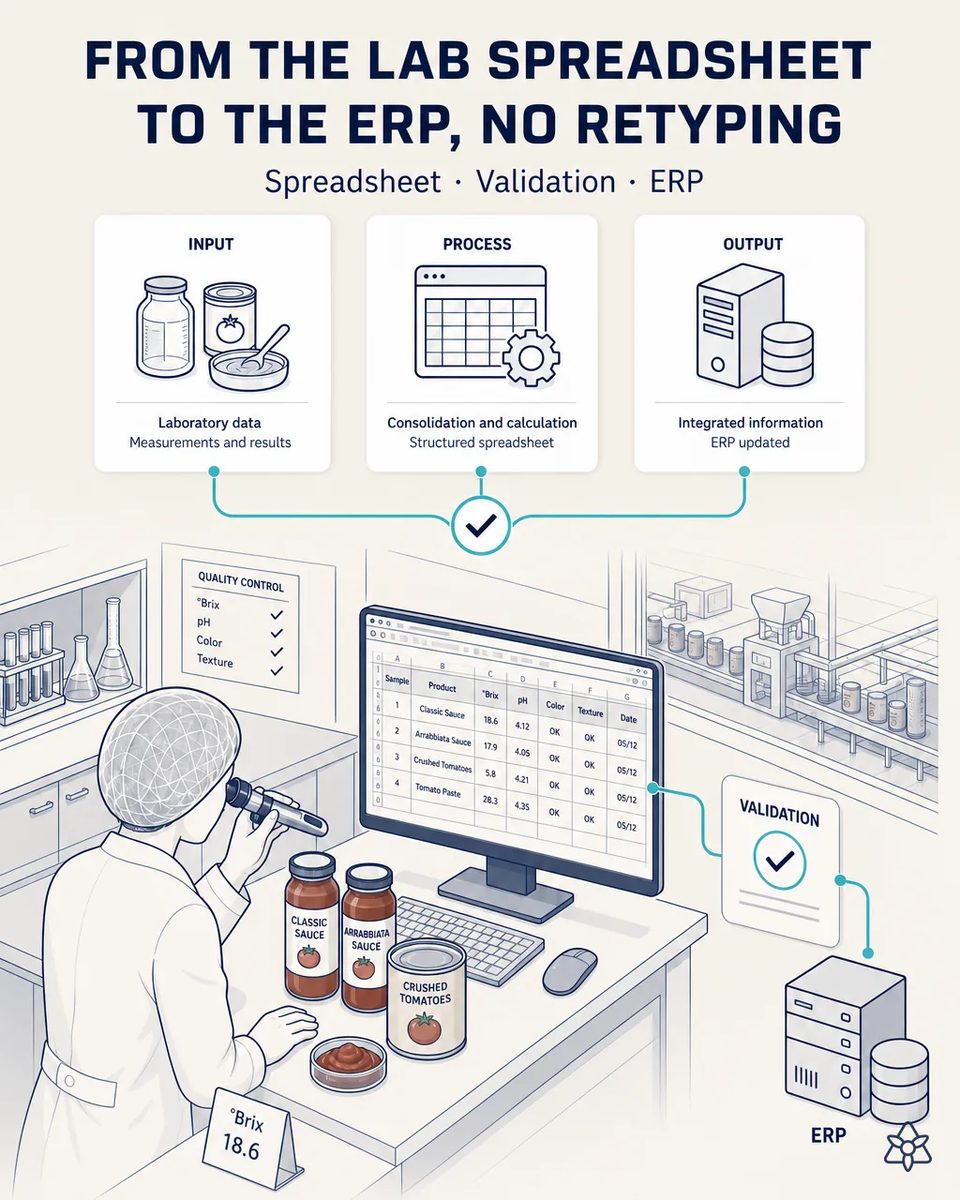
The lab and the ERP tell two versions of the same lot.
The lab works in spreadsheets because they are fast and flexible. The ERP requires those results to be retyped, with days of lag, copy errors and several active licenses used only for data entry. The result is two truths: the spreadsheet the plant uses and the ERP that management and the auditor see. Releasing a lot with cross-checked data means consulting both.
- Every shift the lab records Brix, pH, acidity, consistency, color, vacuum and drained weight in a spreadsheet, because it is fast and flexible.
- The ERP needs those results retyped, and they arrive days later, with copy errors and several active licenses used only for data entry.
- The result is two truths: the spreadsheet the plant works from and the ERP that management and the auditor see.
- Releasing a lot of paste or diced tomato with cross-checked data means opening both and hoping they agree.
Connect listening inward — the shared lab folder, read the moment a file is saved.
iLEAN Connect in inward-listening mode.
The lab keeps its spreadsheet and its habits. iLEAN reads only what changed, works out columns and units, ties each result to its lot and order, and waits for the quality lead's validation before posting to the ERP quality module. One truth, the same day, without anyone retyping. The release decision for a lot of paste or diced tomato is taken on data that both the lab and management see the same way.
- iLEAN observes the lab shared folder.
- When the file is saved, it reads the delta.
- It interprets columns and units with a grounded model and links each result to lot and order.
- The quality lead validates.
- iLEAN posts to the ERP quality module via API.
- CFO angle: if five lab staff need an ERP license today only to record results, with iLEAN only the validating lead needs one. A typical 50 to 80 percent reduction in quality module licenses.
Two truths about each lot versus one, posted from the lab file
| Aspect | Today | With iLEAN Connect |
|---|---|---|
| Lag between lab and ERP | Days | Minutes after validation |
| Brix of paste and concentrate | In a tab nobody queries | On the lot, in the ERP |
| Vacuum and drained weight of cans | Retyped at week end | Posted per lot |
| Units and decimal commas | A frequent copy slip | Interpreted by the model |
| Releasing a lot | Two systems compared by hand | One record |
| ERP licenses in the lab | One per technician | Only the validating lead |
Before: days of lag between spreadsheet and ERP, manual retyping, several licenses. After: results in the ERP within minutes, zero retyping, one license.
Impact estimate — to be validated against your vendor's license pricing.
The block below is an estimate to be validated against your plant's actual data. We put it forward so the committee has an order of magnitude; we refine it during the assessment.
- Recurring saving of 50-80% in ERP quality module licenses, depending on vendor pricing.
- Plus an estimated payback of 4-9 months from recovered transcription time.
- CFO angle: if five lab staff hold an ERP license today only to record results, with iLEAN only the validating lead needs one.
- And results reach the ERP within minutes instead of days, with zero retyping. Lot release no longer waits for someone to reconcile two systems.
Recurring savings of 50 to 80 percent in ERP quality module licenses depending on vendor pricing, plus an estimated payback of 4 to 9 months from recovered transcription time. Estimate to be validated.
And the fair question from the production manager
"What if it puts a Brix value in the pH column?" — reading a spreadsheet whose columns your own lab defined is an anchored task, where the best models stay under 1.5% error [1]. On top of that, each parameter has a physical range for each product: a pH of 12 on a tomato sauce or a Brix of 80 on diced tomatoes is flagged instead of posted. And the quality lead validates every set of results before anything reaches the ERP. Nobody in the lab has to open the ERP for that to happen.
[1] OpenAI paper "Why Language Models Hallucinate", 2025 — on the reliability of AI in anchored tasks.
What people ask about posting lab results from the spreadsheet
Will the lab have to rebuild its spreadsheet?
No. It is read as it is, with merged cells, extra tabs and the notes column included. If the template changes mid-season, the new layout is learned. Technicians keep the shortcuts and formulas they already rely on.
How is each result linked to the right lot and order?
From the lot code the technician already writes in the row, cross-checked with the ERP. When a row has no lot or an unknown one, it is flagged for the quality lead instead of being guessed. Repeated rows for the same lot, a common thing when a sample is retested, are kept as separate readings with their times.
Does it cover results from a micro or residue lab outside the plant?
Yes, if they arrive as a file in the shared folder or by email. They enter the same flow, wait for the same validation and attach to the lot they belong to, not to the day they arrived. A late micro result can then be traced to the shipped lot without searching through mailboxes.
Where does the 50-80% license saving come from?
From the people who log into the ERP today only to record lab results. With iLEAN only the lead who validates needs a seat. The final figure depends on your vendor's pricing, and we estimate it with your numbers. It is a typical range, not a promise.
Does it help when a customer asks for Brix or drained weight on a lot?
Yes: the values are already in the ERP against the lot, so the answer is a lookup. The same data feeds the certificate of analysis when one is requested. The answer is sent in minutes instead of after a search through weekly files.
More cases from this series
- Food safety audit ready, nothing to rebuildEvery cleaning, thermal cycle and release produces its evidence; iLEAN Agents organizes it by standard…
- True packaging OEE, no hidden stoppagesConnect, Edge and Agents working together to measure true OEE, anticipate stoppages and connect the…
- Case and pallet labels, always matchingLot, best-before date and codes travel from the ERP to the case labeler and palletizer; iLEAN…
- Field alerts arrive before the problem doesiLEAN reads grower and carrier alerts from WhatsApp or email, matches them with the production plan and…
- Paperless order start at the hopperA photo of the bin label and weighing ticket puts the real consumption of each production order into the…
- The sterilizer panel, finally connectedAn external camera reads the sterilizer or evaporator panel and digitizes the thermal curve of every…
Bring your lab spreadsheet and we will show you how it would reach the ERP.
We work on your plant's real data, not ours. Assessment with no commitment.
Request estimated ROI within 48h ‹ See all cases of sauces and canned vegetables See food industry