Paperless order start at the hopper
In a sauce and canned food plant, every order starts when a bin of tomatoes or a pallet of premix is emptied into the hopper. Today that consumption is written on paper and reconciled hours later. With iLEAN Connect the operator photographs the label and the weighing ticket, iLEAN extracts material, lot and kilos, and after a two-tap validation the real consumption is linked to the active order.
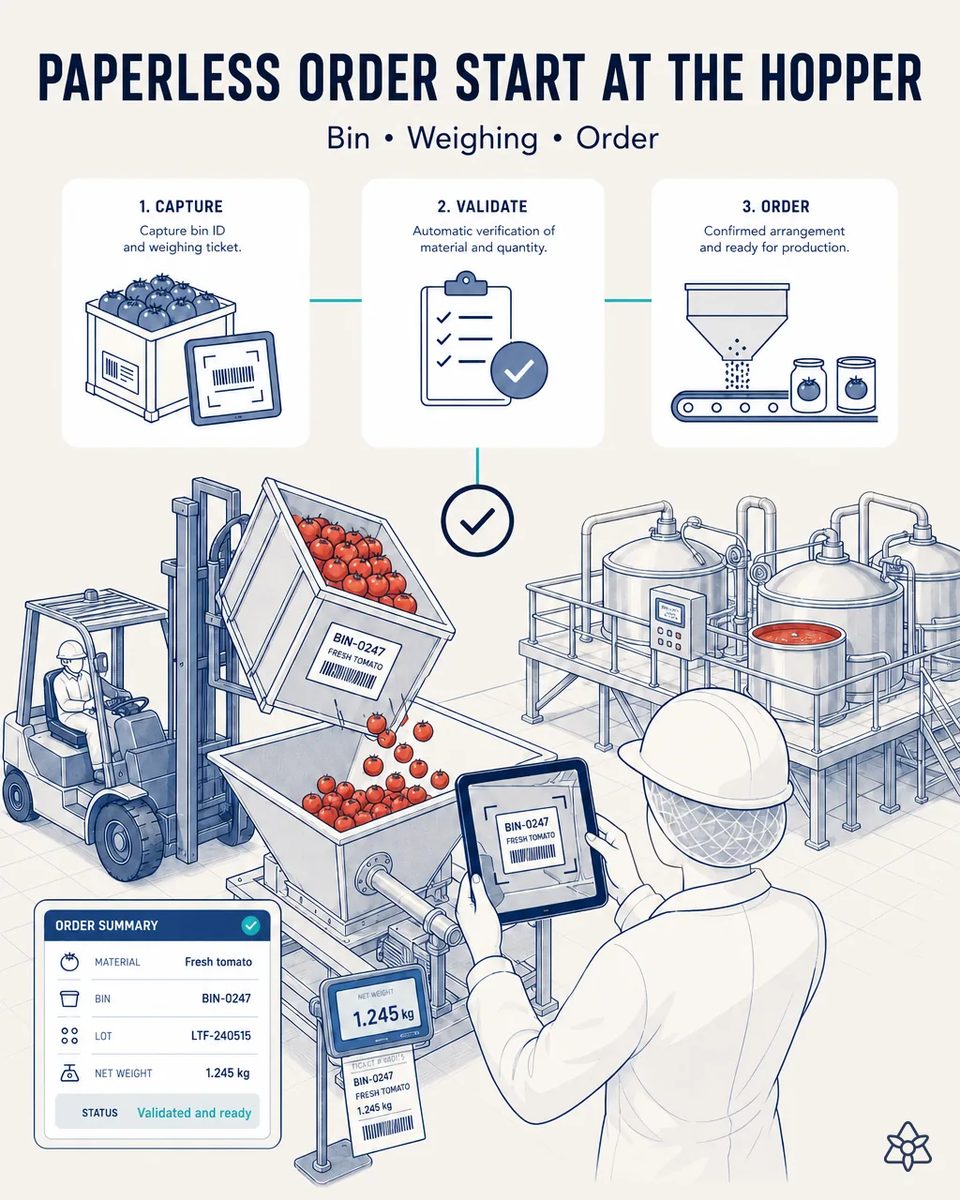
The first record of every order is written with one hand on the forklift.
Emptying bins of perishable raw material and pallets of premix is the first record of the production order, and the most fragile one. The operator writes material, supplier lot and weight on a sheet while handling the forklift and the hopper. That sheet reaches the ERP hours later, when someone retypes it. Meanwhile the order runs with no real consumption: raw-material yield is only known at closing, and if a supplier reports a problem with a lot, tracing which kettle and which order it went into means going through several shifts of paperwork.
- In season every production order starts at the hopper: a bin of field tomatoes or a pallet of premix is tipped in, and that is the moment consumption actually happens.
- The operator notes material, supplier lot and kilos on a clipboard between forklift trips, often from a scale ticket already damp with tomato juice.
- That sheet is retyped hours later, so the order runs all shift with no real consumption and raw-material yield is only known at closing.
- If a grower later reports a problem with one field lot, finding which kettle and which order it went into means going back through several shifts of paper.
Connect in photo mode — the bin label and the scale ticket, one picture each.
iLEAN Connect in photo mode.
The operator keeps tipping bins exactly as before; the only new gesture is two photos and two taps. In exchange, every order carries its real kilos of tomato and premix from the first bin, and the field lot that went into each kettle is known while the kettle is still cooking. Yield stops being a month-end surprise and becomes a number the shift lead can read before the shift ends.
- The operator photographs the bin or pallet identification label and the scale ticket with a tablet or phone.
- iLEAN reads the document structure with a grounded model and extracts material, lot, kilos and time.
- It matches the active order in the ERP.
- It shows a summary on the tablet and the operator validates with two taps.
- Only then does the consumption enter the ERP as an order movement. Humans in command: nothing goes in unsigned.
Hopper consumption on a clipboard versus consumption booked per bin
| Aspect | Today, on a clipboard | With iLEAN Connect |
|---|---|---|
| Kilos tipped per order | Totaled at shift end | Booked bin by bin |
| Field lot of each bin | Copied by hand, sometimes skipped | Read from the bin label |
| Raw-material yield | Known at month closing | Visible shift by shift |
| Premix pallets at the hopper | A separate sheet | Same photo flow, same order |
| Field lot to kettle | Rebuilt across shifts of paper | One lookup |
| What changes at the hopper | — | Two photos, two taps |
Before: consumption written by hand and reconciled at shift end, yield known at month end, lot-to-kettle traceability rebuilt by hand. After: real consumption per order in seconds, yield shift by shift, traceability available instantly.
Impact estimate — to be validated with your hopper loads per shift.
The block below is an estimate to be validated against your plant's actual data. We put it forward so the committee has an order of magnitude; we refine it during the assessment.
- Estimated payback 4-9 months, depending on orders and hopper loads per shift.
- It comes from transcription time recovered and from yield losses caught early, while the order is still running rather than at closing.
- Consumption goes from written by hand and reconciled at shift end to booked against the active order in seconds.
- And lot-to-kettle traceability stops being a manual reconstruction: it is available the moment a grower calls. Shift by shift, the plant sees how many kilos of fruit each order really needed.
Estimated payback of 4 to 9 months depending on orders and hopper loads per shift, from recovered transcription time and yield losses caught early. Estimate to be validated.
And the fair question from the production manager
"What if it reads 1,245 kg as 1,425 on a wet scale ticket?" — extracting material, lot and kilos from a ticket and a bin label whose layout never changes is an anchored task, and on anchored tasks the best models stay under 1.5% error [1]. Then the summary appears on the hopper tablet and the operator checks it against the scale display in front of them before it touches the order. A ticket too smudged to read is flagged, and the operator retakes the photo before the next bin goes in. The scale display and the photographed ticket must agree, or the summary says so.
[1] OpenAI paper "Why Language Models Hallucinate", 2025 — on the reliability of AI in anchored tasks.
What people ask about booking consumption at the hopper
Does it read the scale ticket our weighbridge already prints?
Yes. The model learns the layout of the ticket you print today, with its gross, tare and net fields. Nothing changes at the scale, and no new printer or label is needed. A ticket from a second scale with a different layout is learned from a handful of examples.
How is each bin tied to the right production order?
iLEAN asks the ERP which order is active on that hopper at that minute and books the consumption against it. If two orders overlap at a changeover, the operator picks one on the tablet with a single tap. The choice is logged, so the record shows who assigned the bin and when.
Does it handle premix pallets as well as field bins?
Yes. A premix pallet label is read the same way as a bin label, so tomato, vegetables and premix all land on the same order. The yield calculation then sees every input, not only the fruit.
What happens when a grower reports a problem with a field lot?
You query that lot and see every order and kettle it went into, with time and kilos. What used to take several shifts of paperwork becomes a lookup made while the grower is still on the phone.
Does the hopper area need wifi coverage for this?
It needs a connection where the tablet stands, which is usually available near the hopper. If coverage drops, the photos are queued on the device and sent when it returns, with their original time.
More cases from this series
- Food safety audit ready, nothing to rebuildEvery cleaning, thermal cycle and release produces its evidence; iLEAN Agents organizes it by standard…
- True packaging OEE, no hidden stoppagesConnect, Edge and Agents working together to measure true OEE, anticipate stoppages and connect the…
- Case and pallet labels, always matchingLot, best-before date and codes travel from the ERP to the case labeler and palletizer; iLEAN…
- Field alerts arrive before the problem doesiLEAN reads grower and carrier alerts from WhatsApp or email, matches them with the production plan and…
- From the lab spreadsheet to the ERP, no retypingiLEAN reads the quality lab spreadsheet, has the lead validate it and posts it to the ERP. Fewer…
- The sterilizer panel, finally connectedAn external camera reads the sterilizer or evaporator panel and digitizes the thermal curve of every…
Tell us how many bins go into your hopper on a peak-season shift.
We work on your plant's real data, not ours. Assessment with no commitment.
Request estimated ROI within 48h ‹ See all cases of sauces and canned vegetables See food industry