Field alerts arrive before the problem does
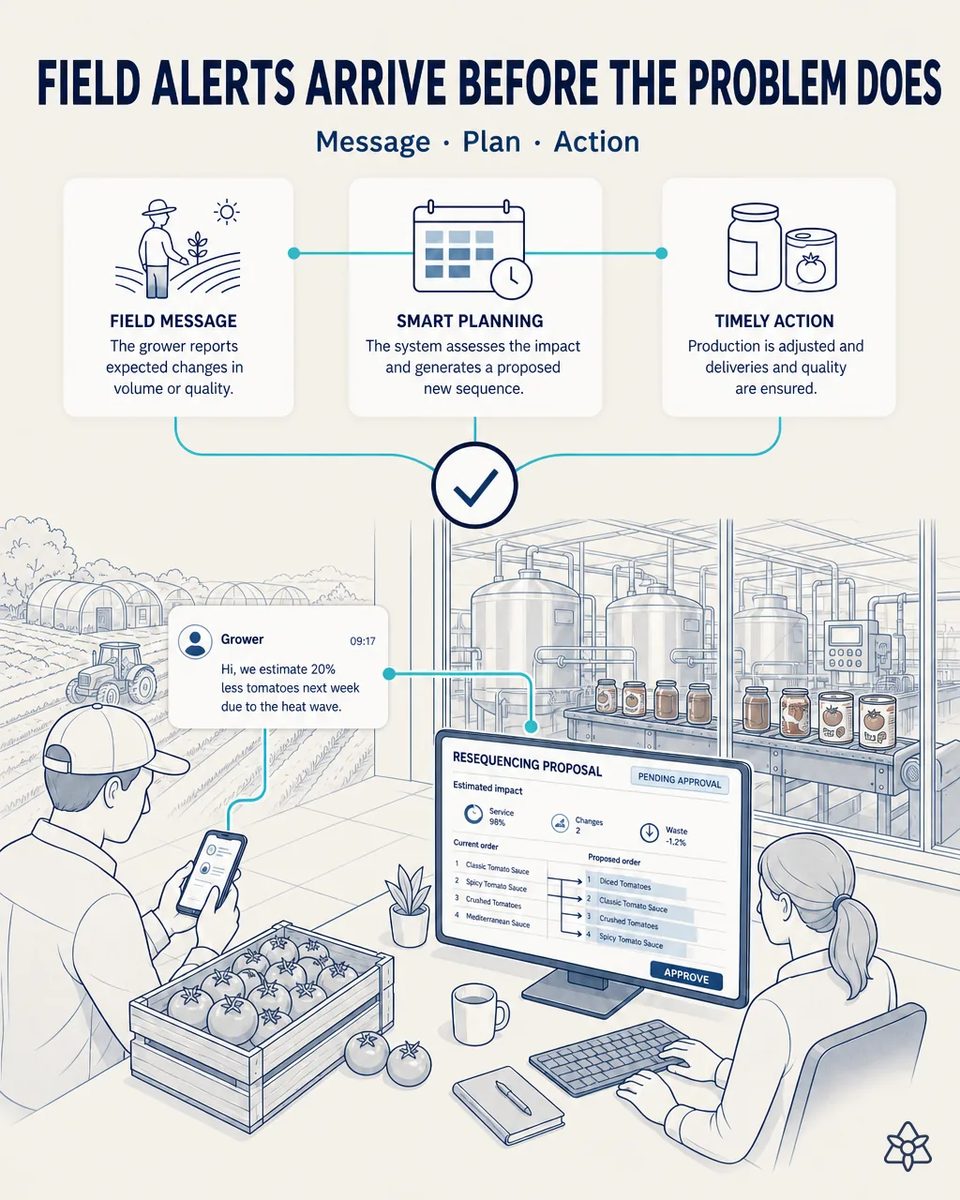
Sauce and canned food plants depend on agricultural raw material whose arrival changes with weather and harvest. Alerts come by WhatsApp or email to someone who reads them late. With iLEAN Connect in copy, each alert is read on arrival, matched against the plan and ERP inventory, and reaches the planner as a concrete resequencing proposal.
In season the plan is decided by whoever happens to read the phone.
During the season the plant receives dozens of messages a day from growers, collection centers and carriers. Some are critical: a delayed harvest, a load rejected at origin, a truck stopped on the road. Those messages are read when the person has a moment. By then the line is set up, the kettle is waiting and the plan change is improvised, with stoppages, extra recipe changes and out-of-sequence product.
- From the first harvest week the plant gets dozens of messages a day from growers, collection centers and carriers, in WhatsApp groups, voice notes and email.
- Most are routine. A few break the plan: a harvest delayed by rain, a load rejected at origin, a field truck stopped on the highway.
- Those messages are read when someone has a minute. By then the line is set up and the kettle is waiting for tomatoes that will not arrive until the afternoon.
- The plan change is improvised on the floor: an unplanned stoppage, an extra recipe change and product run out of sequence.
Connect in chaotic-sources mode — a WhatsApp Business number and a mailbox, read on arrival.
iLEAN Connect in chaotic-sources mode.
Growers keep writing the way they always have. What changes is that each alert is read the second it lands, compared with the planned orders and with the tomato and premix actually in stock, and arrives at the planner as a sequence already worked out. The planner still decides; they just decide with the facts, and hours earlier. Over a season, that is the difference between a plan that bends and one that breaks every time it rains in the fields.
- Dedicated mailbox and WhatsApp Business number in copy.
- The model extracts intent, supplier, material, quantities and times.
- Match against planned orders and premix and raw-material inventory in the ERP.
- Concrete resequencing proposal to the planner.
- The planner approves or corrects; only then does the plan change.
Field messages in season today versus messages read on arrival
| Aspect | Today, on the phone | With iLEAN Connect |
|---|---|---|
| Gap between alert and decision | Hours | Minutes |
| A load rejected at origin | Found out when the truck does not come | Flagged against the orders it feeds |
| Premix and tomato on hand | Checked by walking to the warehouse | Read from ERP inventory |
| Resequencing | Improvised at the line | Proposed with the alternative order |
| Messages in WhatsApp groups | Scrolled past | Classified by intent and grower |
| Who signs off the new sequence | Whoever was at the line | The planner, after approving |
Before: hours between alert and decision, improvised plan changes. After: minutes between alert and a concrete proposal, decisions based on real inventory.
Impact estimate — to be validated with your critical alerts per season.
The block below is an estimate to be validated against your plant's actual data. We put it forward so the committee has an order of magnitude; we refine it during the assessment.
- Estimated payback 3-7 months, depending on how often critical alerts arrive and on the cost of each stoppage for missing raw material.
- Time between alert and decision goes from hours to minutes until a concrete proposal.
- Plan changes stop being improvised: they rest on real inventory of tomato and premix, not on memory.
- And each avoided stoppage also avoids the extra recipe change and the out-of-sequence product that came with it.
Estimated payback of 3 to 7 months depending on the frequency of critical alerts and the cost of each stoppage for missing raw material. Estimate to be validated.
And the fair question from the production manager
"Growers write half in slang, half in voice notes. Can it really follow them?" — pulling intent, grower, material, quantity and time out of a short message is an anchored task, because the possible answers are bounded by your growers, materials and orders; there the best models stay under 1.5% error [1]. A message it cannot classify with confidence goes to the planner as it is, flagged. And nothing changes in the plan until the planner approves or corrects the proposal.
[1] OpenAI paper "Why Language Models Hallucinate", 2025 — on the reliability of AI in anchored tasks.
What people ask about reading grower and carrier alerts in season
Will our growers have to stop using their WhatsApp groups?
No. The plant adds a WhatsApp Business number and a mailbox in copy; growers and carriers keep writing to the people they already write to. Nobody outside the plant has to install anything. Messages from personal phones are not read; only the traffic copied to the dedicated number and mailbox.
Can it transcribe a voice note recorded in the middle of a field?
Yes, voice notes are transcribed and then parsed like a text message. Wind or tractor noise can lower confidence; in that case the planner gets the audio with the transcript and a flag. Voice notes in Spanish or English are handled the same way, which matters when growers and carriers do not share a language with the planner.
How does it know which orders a delayed field truck affects?
It matches the material and expected kilos against planned orders and current ERP inventory. The proposal lists which orders run short, when, and which order could move forward with what is already in stock. It also flags when a missing load would force an extra recipe change, so the planner sees the real cost of each option.
Does it reply to the grower on its own?
No. iLEAN proposes and the planner decides; any answer to a grower or carrier is sent by a person. The tool only removes the hours between the message and the decision. If the planner wants, a draft reply can be prepared for them to send, but it never leaves on its own.
Does a message sent at 4 a.m. from the field wait until someone wakes up?
It is read the same minute, and the proposal waits for the planner at the start of the shift. In tomato season, when harvest starts at dawn, that is often the difference between a plan that already accounts for the delay and one that finds out at seven.
More cases from this series
- Food safety audit ready, nothing to rebuildEvery cleaning, thermal cycle and release produces its evidence; iLEAN Agents organizes it by standard…
- True packaging OEE, no hidden stoppagesConnect, Edge and Agents working together to measure true OEE, anticipate stoppages and connect the…
- Case and pallet labels, always matchingLot, best-before date and codes travel from the ERP to the case labeler and palletizer; iLEAN…
- From the lab spreadsheet to the ERP, no retypingiLEAN reads the quality lab spreadsheet, has the lead validate it and posts it to the ERP. Fewer…
- Paperless order start at the hopperA photo of the bin label and weighing ticket puts the real consumption of each production order into the…
- The sterilizer panel, finally connectedAn external camera reads the sterilizer or evaporator panel and digitizes the thermal curve of every…
Tell us which field alerts broke your plan last season.
We work on your plant's real data, not ours. Assessment with no commitment.
Request estimated ROI within 48h ‹ See all cases of sauces and canned vegetables See food industry