True packaging OEE, no hidden stoppages
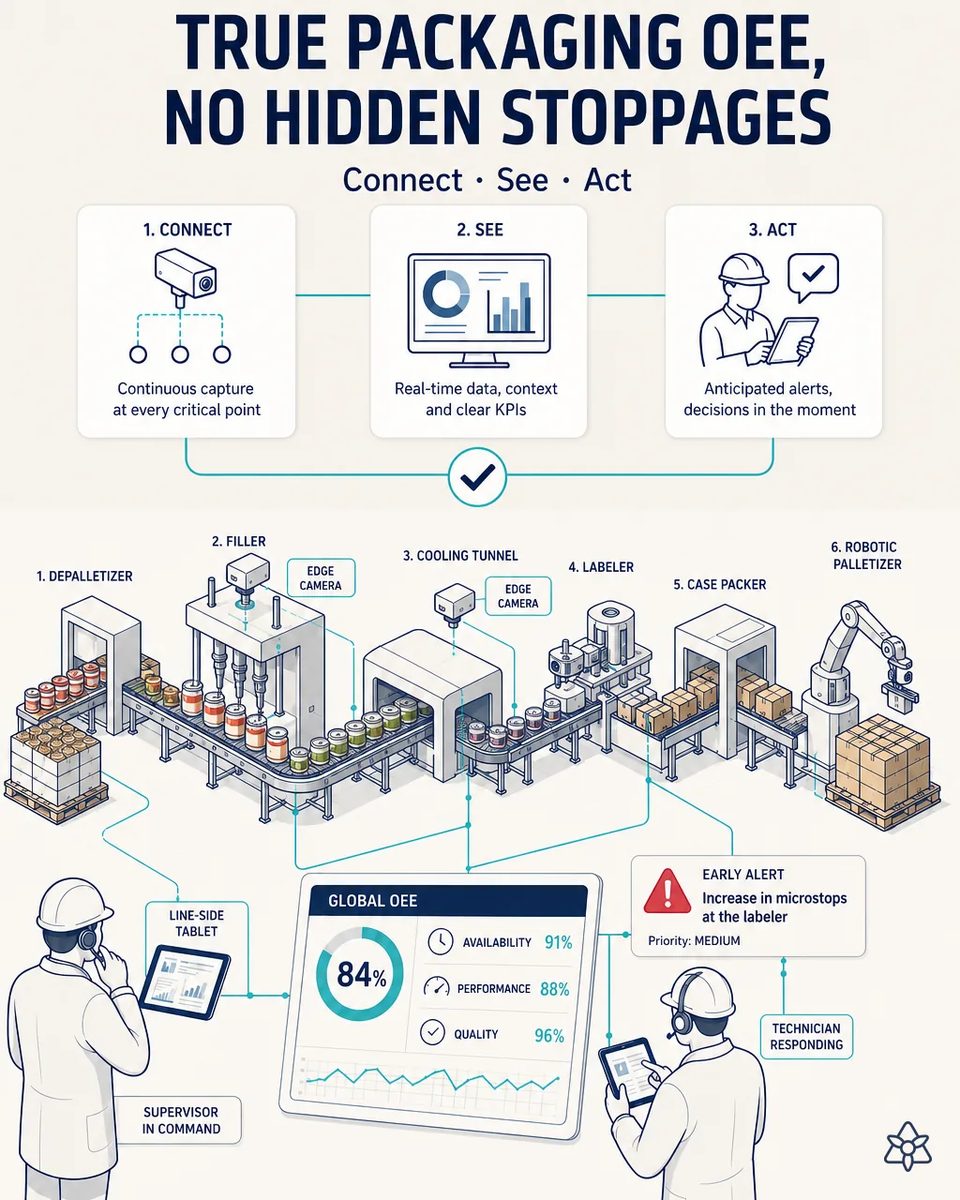
The core pain of a sauce and canned food plant is the capacity lost to stoppages and micro-stops nobody records, with an OEE that does not add up and data that never reaches the ERP. The iLEAN flagship coordinates every piece: Connect captures, Edge counts and sees jams without touching PLCs, the tablet validates and Agents anticipates stoppages and opens maintenance notifications in the ERP.
The line loses its capacity in events too small for anyone to write down.
A can and jar packaging line loses capacity in small, repeated events: can or cap jams, screen saturation, uneven peeler loading, cleaning overruns, waiting for raw material. None looks serious on its own; together they are OEE points. OEE is calculated from manual records that do not match real output. Causes are not categorized and maintenance arrives late. And while a new ERP is being rolled out, shop-floor data still has no clean path in.
- A can and jar packaging line loses capacity in small, repeated events: can or cap jams, screen saturation, uneven peeler loading, cleaning overruns, waiting for raw material.
- None looks serious on its own. Together they are OEE points lost every shift of the season.
- OEE is calculated from manual records that do not match real output, causes are not categorized and maintenance arrives late.
- And while a new ERP is being rolled out, shop-floor data still has no clean path in.
The iLEAN flagship — Connect, Edge and Agents on one line, humans in command.
iLEAN flagship, every piece coordinated.
Connect captures the hopper, the sterilizer panel, receiving, the lab and the supervisor's voice. Edge counts cans and jars with an external camera and sees jams and load levels without touching a PLC. The tablet validates, and Agents turns it all into real-time OEE, a loss tree that fills itself and maintenance notifications opened before the stoppage. JIDOKA AI stops the line on a serious anomaly; SMED AI shortens the changeovers. The OEE on the screen is finally the one the floor recognizes.
- Connect: order start at the hopper, retort panel, supervisor voice, receiving and lab.
- Edge: can and jar counting with an external camera, detection of jams and of load level at peelers and screens, without touching PLCs.
- Human verification on a tablet before any write to the ERP.
- Agents: real-time OEE with availability, performance and quality, loss tree, early alerts and maintenance notifications in the ERP.
- JIDOKA AI stops the line on a serious anomaly and SMED AI shortens changeovers. Humans in command at every step.
What each block contributes to true OEE
| Block | Which cases it draws on | What it adds to OEE |
|---|---|---|
| Connect | Hopper (1), sterilizer panel (2), supervisor voice (4), lab (6), receiving (7) | Real consumption, thermal cycles and dictated causes |
| Edge | Can and jar counting, jam and load-level detection | Real output and hidden stoppages, without touching PLCs |
| Human verification | Two-tap tablet (5) | Only validated data reaches the ERP |
| Agents | Real-time OEE and loss tree | Availability, performance and quality by cause |
| JIDOKA AI | Serious anomalies on the line | Stops before defects pile up |
| SMED AI | Recipe and format changeovers | Shorter, measured changeovers |
Before: manual OEE that does not add up, invisible micro-stops, reactive maintenance. After: objective real-time OEE, categorized losses, anticipated stoppages and clean data in the ERP.
Impact estimate — to be validated with each line's volume and margin.
The block below is an estimate to be validated against your plant's actual data. We put it forward so the committee has an order of magnitude; we refine it during the assessment.
- Estimated gain of 5-12 OEE points on the packaging line.
- Estimated payback 6-12 months, depending on line volume and margin.
- OEE stops being a manual figure that does not add up: availability, performance and quality are measured objectively, in real time.
- And maintenance moves from reactive to anticipated, with notifications opened in the ERP from validated data.
Estimated gain of 5 to 12 OEE points on the packaging line and a payback of 6 to 12 months depending on line volume and margin. Estimate to be validated with each plant's data.
And the fair question from the production manager
"Isn't this one more OEE dashboard fed by the same bad data?" — no, because the source changes: output is counted by a camera, stoppages are seen rather than remembered, and causes come from the supervisor's dictation and the loss tree. Counting containers and reading known panels are anchored tasks where the best models stay under 1.5% error [1], and JIDOKA AI stops on a verifiable anomaly, not on a model's doubt. Humans validate every write to the ERP. And every figure on the dashboard can be traced back to the count or the dictation behind it.
[1] OpenAI paper "Why Language Models Hallucinate", 2025 — on the reliability of AI in anchored tasks.
What people ask about true OEE on the packaging line
Which piece goes first on a sauce and canned vegetable line?
Usually the hopper start or can and jar counting with Edge, because they give real consumption and real output soonest. Each piece pays on its own, so the order follows your biggest loss. The rest of the pieces are added layer by layer as each one proves its value.
How can a camera count cans without touching the PLC?
It watches the conveyor from outside and counts containers passing a point, the way an operator would but without blinking. No wire goes to the PLC and no machine program changes. The same camera sees jams and accumulation, which tells you where the line is starving or blocked.
Why does our OEE look better on paper than on the floor?
Because micro-stops under a few minutes are rarely written down and output is often taken from the plan, not from a count. When both are measured, the figure usually drops at first; the 5-12 points are recovered from there. That first drop is not a loss; it is the hidden stoppage finally being counted.
Does it open maintenance notifications in the ERP by itself?
Agents prepares them from early alerts, such as a rise in micro-stops at the labeler, and they go through the same validation as any other write. Maintenance receives them before the stoppage, not after. The technician gets the context with the notification: equipment, trend and the dictated observations behind it.
Does peak tomato season distort the OEE?
It makes it more honest: waiting for raw material, peeler loading and cleaning overruns are categorized as their own losses, so a bad harvest day is not confused with a line problem. The season's OEE then shows what the line can really do when the field delivers.
More cases from this series
- Food safety audit ready, nothing to rebuildEvery cleaning, thermal cycle and release produces its evidence; iLEAN Agents organizes it by standard…
- Case and pallet labels, always matchingLot, best-before date and codes travel from the ERP to the case labeler and palletizer; iLEAN…
- Field alerts arrive before the problem doesiLEAN reads grower and carrier alerts from WhatsApp or email, matches them with the production plan and…
- From the lab spreadsheet to the ERP, no retypingiLEAN reads the quality lab spreadsheet, has the lead validate it and posts it to the ERP. Fewer…
- Paperless order start at the hopperA photo of the bin label and weighing ticket puts the real consumption of each production order into the…
- The sterilizer panel, finally connectedAn external camera reads the sterilizer or evaporator panel and digitizes the thermal curve of every…
Pick one packaging line and we will measure its true OEE together.
We work on your plant's real data, not ours. Assessment with no commitment.
Request estimated ROI within 48h ‹ See all cases of sauces and canned vegetables See food industry