Case and pallet labels, always matching
In a sauce and canned food plant, the case labeler and the palletizer are modern machines with communications, yet at every order change someone types lot and date by hand. iLEAN Connect stitches them to the ERP via API: order data travels on its own and each case label is cross-checked against its pallet label before it leaves the plant.
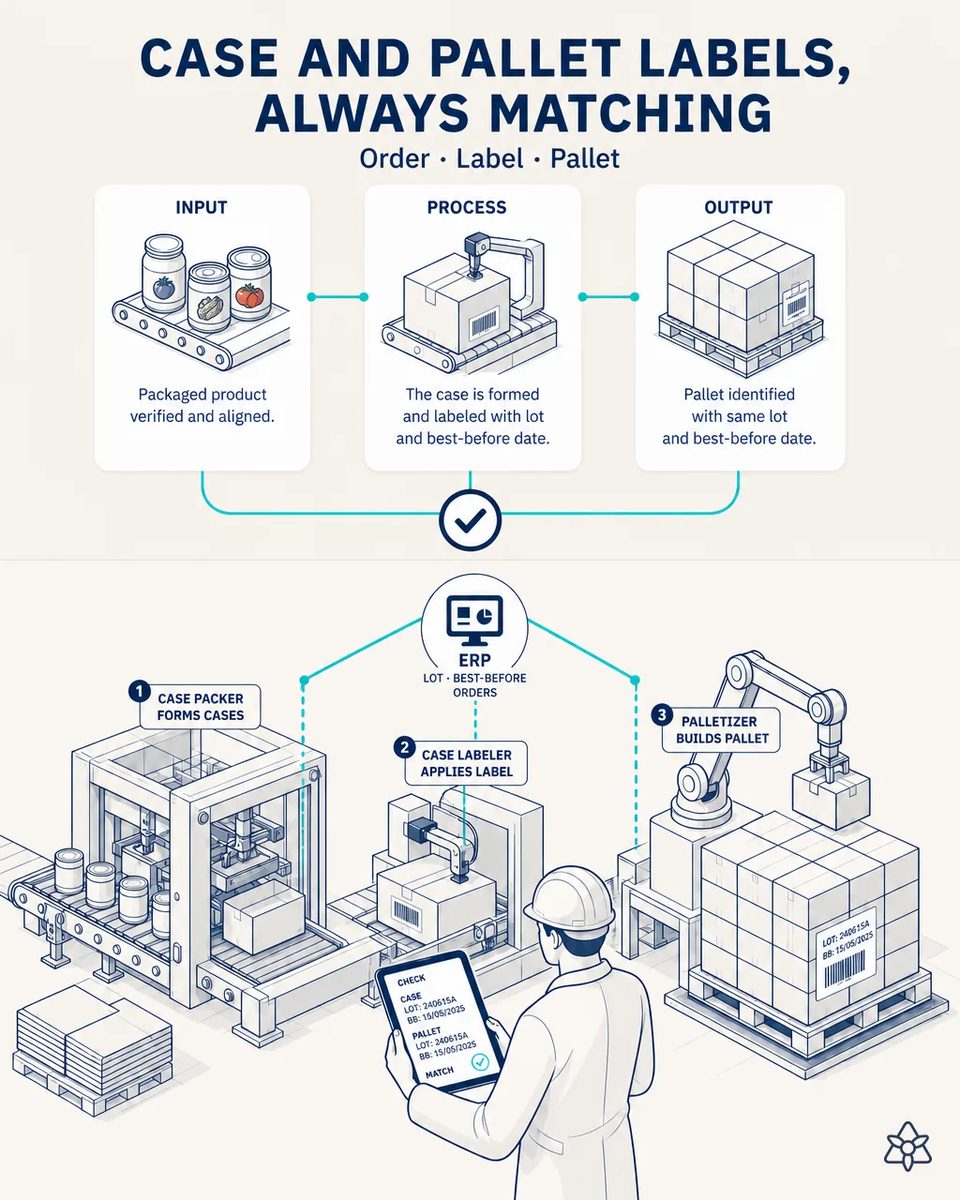
Two machines with communications, and a keypad between them.
Case and pallet coding is the last check before the customer. A lot or date error means relabeling, holding or, in the worst case, withdrawing product from the distribution center. Even so, manual typing on the labeler panel is still common because integrating it properly with the ERP was never a priority.
- Case and pallet labels are the last check before the customer: the distribution center reads them, not the jar.
- The case labeler and the palletizer are modern machines with communications, yet at every order change someone types lot and best-before date on each panel.
- A typo on one and not the other means a pallet whose label disagrees with its cases: relabeling, a hold, or in the worst case product withdrawn from the distribution center.
- Integrating them properly with the ERP was never a priority, so the risk returns at every changeover of the season.
Connect in integration mode — the order publishes, the line prints, iLEAN cross-checks.
iLEAN Connect in integration mode.
When the order starts in the ERP, lot, best-before date and product codes go to both machines on their own. iLEAN then reads what was actually printed, compares case label, pallet label and active order, and stops the pallet before stretch wrapping if something disagrees. Finished pallets are reported back to the ERP. Nobody types at the changeover, and nothing leaves the dock with a label that disagrees with its cases.
- When the order starts in the ERP, iLEAN publishes lot, best-before date and product codes to the case labeler and the palletizer.
- It reads what was actually printed.
- It cross-checks case label, pallet label and active order.
- If something does not match, it alerts the operator before stretch wrapping.
- It reports finished pallets to the ERP.
Labels typed at each changeover versus labels fed by the order
| Aspect | Today | With iLEAN Connect |
|---|---|---|
| Lot and best-before at order change | Typed on two panels | Published from the ERP |
| Case label versus pallet label | Assumed to match | Cross-checked on every pallet |
| A mismatch | Found at the distribution center | Caught before stretch wrapping |
| Relabeling | After every human slip | Eliminated at the source |
| Finished pallet report | Typed at shift end | Sent to the ERP automatically |
| Labeler and palletizer hardware | — | Kept as they are |
Before: typing at every order change, relabeling due to human error. After: zero typing, mismatches caught on the line.
Impact estimate — to be validated with your relabeling and hold history.
The block below is an estimate to be validated against your plant's actual data. We put it forward so the committee has an order of magnitude; we refine it during the assessment.
- Estimated payback 3-6 months.
- It comes from eliminating relabeling and reducing the risk of holds at the distribution center.
- Typing at every order change goes to zero, and mismatches are caught on the line instead of at the customer.
- And the ERP knows every finished pallet the moment it is wrapped, not at the end of the shift. Stock and shipping work from real finished pallets, not from the plan.
Estimated payback of 3 to 6 months from eliminating relabeling and reducing the risk of holds at the distribution center. Estimate to be validated.
And the fair question from the production manager
"What if the camera misreads a printed lot and stops a good pallet?" — data travels to the machines by API, with no interpretation, so there is no model error on that leg. Reading the printed case and pallet labels back is an anchored task, with known fields in known positions and barcodes decoded rather than guessed, where the best models stay under 1.5% error [1]. A doubtful read is shown to the operator, who confirms in seconds; a false stop costs a glance, a wrong pallet costs a hold. The operator always has the final word before the pallet is wrapped.
[1] OpenAI paper "Why Language Models Hallucinate", 2025 — on the reliability of AI in anchored tasks.
What people ask about matching case and pallet labels
Do our labeler and palletizer need to be from the same vendor?
No. Each is integrated through its own interface; mixed vendors are the norm. We check models and firmware with you before committing to anything. If one machine lacks an open interface, we tell you before any commitment and look at the alternatives.
How is the printed label read back?
With a fixed camera at the labeler and another at the pallet label station, reading text and barcodes. The read is compared with what the order says should have been printed. Barcodes are decoded, so a smudged character in the human-readable text does not trigger a false alarm.
Is the best-before date calculated or typed?
Calculated from the shelf life defined for the product in the ERP and the production date, then published. Customer-specific date formats are set once and applied every time. A product with a shorter shelf life carries its own value in the ERP, and both labels follow it.
What happens when a mismatch is detected?
The operator is alerted before stretch wrapping, with the case and pallet labels shown side by side. The pallet is corrected on the spot, and the event is logged with its cause. Over time, the log shows which changeovers and which shifts produce the most mismatches.
Does it work for both jar and can cases?
Yes. The container changes the case size and the labeler settings, not the data flow from the order. Lot and date arrive identical for either. A mixed pallet of jars and cans is handled as long as the order defines it.
More cases from this series
- Food safety audit ready, nothing to rebuildEvery cleaning, thermal cycle and release produces its evidence; iLEAN Agents organizes it by standard…
- True packaging OEE, no hidden stoppagesConnect, Edge and Agents working together to measure true OEE, anticipate stoppages and connect the…
- Field alerts arrive before the problem doesiLEAN reads grower and carrier alerts from WhatsApp or email, matches them with the production plan and…
- From the lab spreadsheet to the ERP, no retypingiLEAN reads the quality lab spreadsheet, has the lead validate it and posts it to the ERP. Fewer…
- Paperless order start at the hopperA photo of the bin label and weighing ticket puts the real consumption of each production order into the…
- The sterilizer panel, finally connectedAn external camera reads the sterilizer or evaporator panel and digitizes the thermal curve of every…
Tell us which labeler and palletizer you run and we will show you the integration.
We work on your plant's real data, not ours. Assessment with no commitment.
Request estimated ROI within 48h ‹ See all cases of sauces and canned vegetables See food industry