Hygienic line release with evidence
In a sauce and canned food plant, every recipe change requires releasing the line: kettles, pipes, filler and nozzles clean. Today it is signed on paper with no objective evidence. With iLEAN Edge, fixed cameras compare each critical point with its clean reference and JIDOKA AI does not allow a start until everything is green and quality signs off.
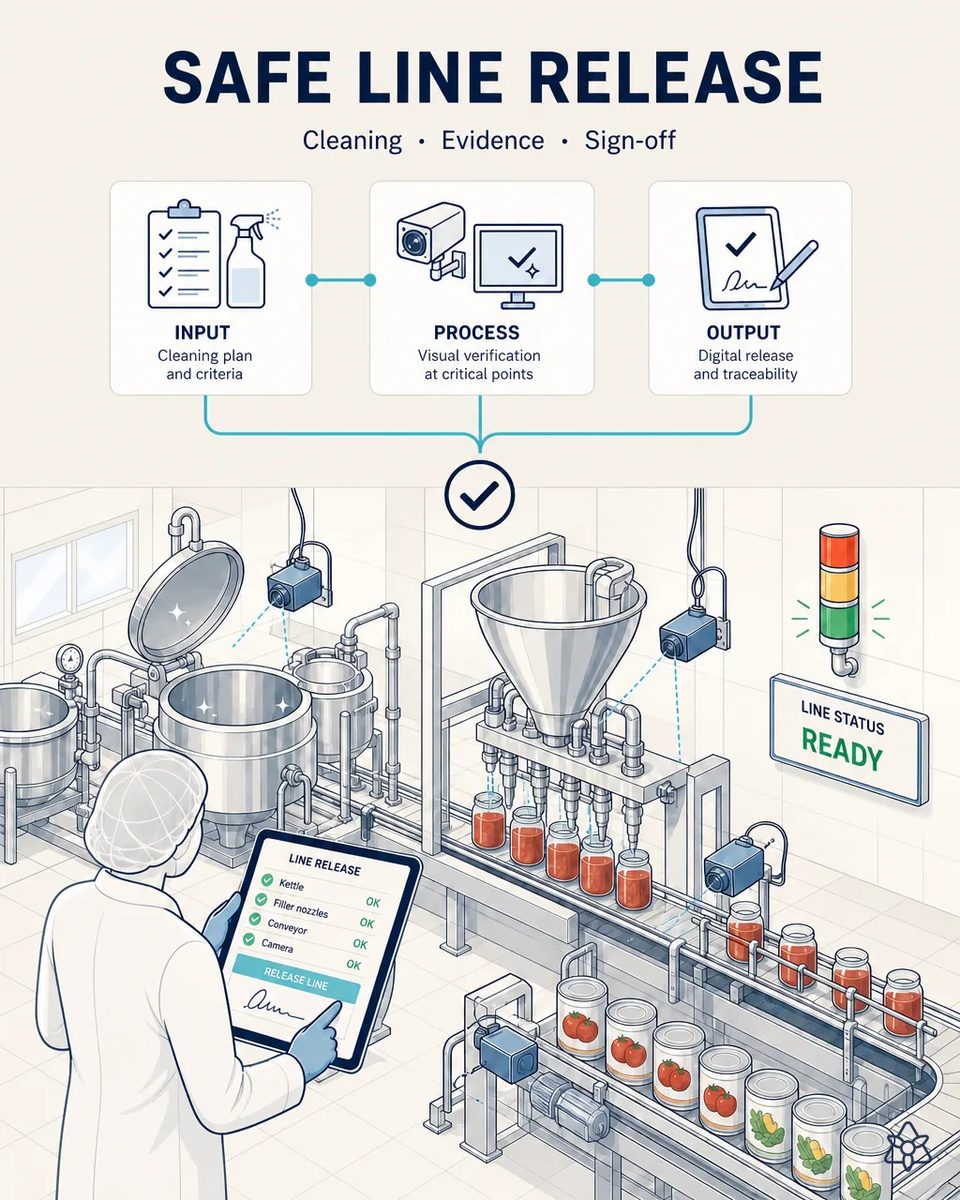
A multi-product line changes recipe often and releases it on a signature.
Recipe changes are frequent in a multi-product plant: heat level, allergens, color, container format. Each one requires cleaning and a hygienic release before starting. That release relies today on a visual inspection and a signature, with no recorded evidence. The risk is twofold: starting with residue and contaminating the first lot, or extending cleaning as a precaution and losing capacity.
- Recipe changes are frequent in a multi-product plant: heat level, allergens, color and container format can all change in the same day.
- Each change requires cleaning kettles, pipes, filler and nozzles, and a hygienic release before the first jar.
- Today that release is a visual inspection and a signature on paper, with no recorded evidence of what was actually seen.
- The risk is double: start with residue and contaminate the first lot, or extend cleaning as a precaution and lose capacity in the middle of the season.
Edge with JIDOKA AI and SMED AI — evidence per point, a locked start and a timed changeover.
iLEAN Edge + JIDOKA AI + SMED AI.
Fixed cameras compare each critical point with its clean reference and the tablet shows the status point by point. The line does not start until everything is green and the quality lead signs. Because every step of the changeover is timed, SMED AI also shows where the minutes go, so the release gets shorter without getting looser. And every release leaves its photos, ready for the next audit.
- Fixed cameras at the critical points of the line.
- Comparison with each point's clean reference state.
- Tablet with point-by-point status.
- Start lock until every point is green and the quality lead signs.
- Timing of each changeover step to shorten it with SMED AI.
The paper release versus the release backed by cameras
| Aspect | Today | With iLEAN Edge |
|---|---|---|
| Basis for the hygienic release | A signature | Each critical point against its clean reference |
| Kettle interior after a hot salsa | Checked by eye | Under a fixed camera |
| Filler nozzles | The last thing anyone checks | Green or red on the tablet |
| Start of the next recipe | When someone says ready | Locked until all green and signed |
| Changeover duration | Unknown, padded | Timed step by step |
| Cleaning extended as a precaution | Common | Replaced by evidence |
Before: sign-off without evidence, cleaning extended as a precaution. After: release with evidence per critical point, shorter and measured changeovers.
Impact estimate — to be validated with your recipe changes per week.
The block below is an estimate to be validated against your plant's actual data. We put it forward so the committee has an order of magnitude; we refine it during the assessment.
- Estimated payback 6-12 months.
- It comes from a 15-30% reduction in recipe changeover time and a lower cross-contamination risk.
- Release moves from a signature without evidence to evidence recorded per critical point.
- And cleaning stops being extended just in case: the margin added for lack of proof turns back into production time. In peak season, those recovered minutes per changeover add up to extra lots run on the same line.
Estimated payback of 6 to 12 months, from a 15 to 30 percent reduction in recipe changeover time and lower cross-contamination risk. Estimate to be validated.
And the fair question from the production manager
"Can a camera really tell a clean nozzle from one with a film of red sauce?" — the comparison is anchored: same point, same angle, same lighting, against a clean reference state approved by quality, and there the best models stay under 1.5% error [1]. The system never declares the line clean by itself: an ambiguous point stays red and goes to the quality lead. A false hold costs minutes; a false release costs the first lot of the next recipe. Reference images are approved by quality, not by the system, and can be updated when a part of the line is replaced.
[1] OpenAI paper "Why Language Models Hallucinate", 2025 — on the reliability of AI in anchored tasks.
What people ask about hygienic line release by camera
How many cameras does a kettle-to-filler line need?
It depends on where residue stays: typically kettle interiors, a pipe inspection point, the filler bowl and the nozzles. We map them with your team on the line, and the map is reviewed when a new format joins. Points that need a person to bend or climb to inspect are exactly where a camera adds most.
Does it replace swabs or ATP tests?
No. Swabs and ATP tests stay where your hygiene plan puts them. The cameras add visual evidence at every point, at every change, which is the part that depends on memory today. Swab results can be attached to the same release record when they come back.
How does SMED AI shorten the changeover?
Every step of the changeover is timed against the camera states, so you see which step takes longest and varies most. The 15-30% reduction comes from attacking those steps with data, not from rushing the cleaning. Often the biggest gain is in waiting time between steps, not in the cleaning itself.
Can quality release the line with a point still red?
Yes, with a signed exception and its reason, recorded with the images. What disappears is a start with no trace of who decided. The exception ends up in the audit evidence like any other release.
Does it matter whether the next recipe is a hot salsa or a mild one?
Yes, and the reference set can vary by transition: going from hot to mild, or from a recipe with an allergen to one without it, can require stricter points than the reverse. Those rules are set with quality at commissioning. The line then applies the right set automatically, based on the order that comes next.
More cases from this series
- Food safety audit ready, nothing to rebuildEvery cleaning, thermal cycle and release produces its evidence; iLEAN Agents organizes it by standard…
- True packaging OEE, no hidden stoppagesConnect, Edge and Agents working together to measure true OEE, anticipate stoppages and connect the…
- Case and pallet labels, always matchingLot, best-before date and codes travel from the ERP to the case labeler and palletizer; iLEAN…
- Field alerts arrive before the problem doesiLEAN reads grower and carrier alerts from WhatsApp or email, matches them with the production plan and…
- From the lab spreadsheet to the ERP, no retypingiLEAN reads the quality lab spreadsheet, has the lead validate it and posts it to the ERP. Fewer…
- Paperless order start at the hopperA photo of the bin label and weighing ticket puts the real consumption of each production order into the…
Pick your most critical recipe change and we will design its control points.
We work on your plant's real data, not ours. Assessment with no commitment.
Request estimated ROI within 48h ‹ See all cases of sauces and canned vegetables See food industry