Receiving field trucks in minutes
In season, a sauce and canned food plant receives dozens of trucks of tomatoes, chiles or sweet corn a day. With iLEAN Connect the receiving lead photographs the scale ticket and the plate; iLEAN extracts supplier, kilos, origin lot and unloading times, and after one tap the goods receipt is in the ERP. CFO angle: fewer receiving module licenses and less waiting in the yard.
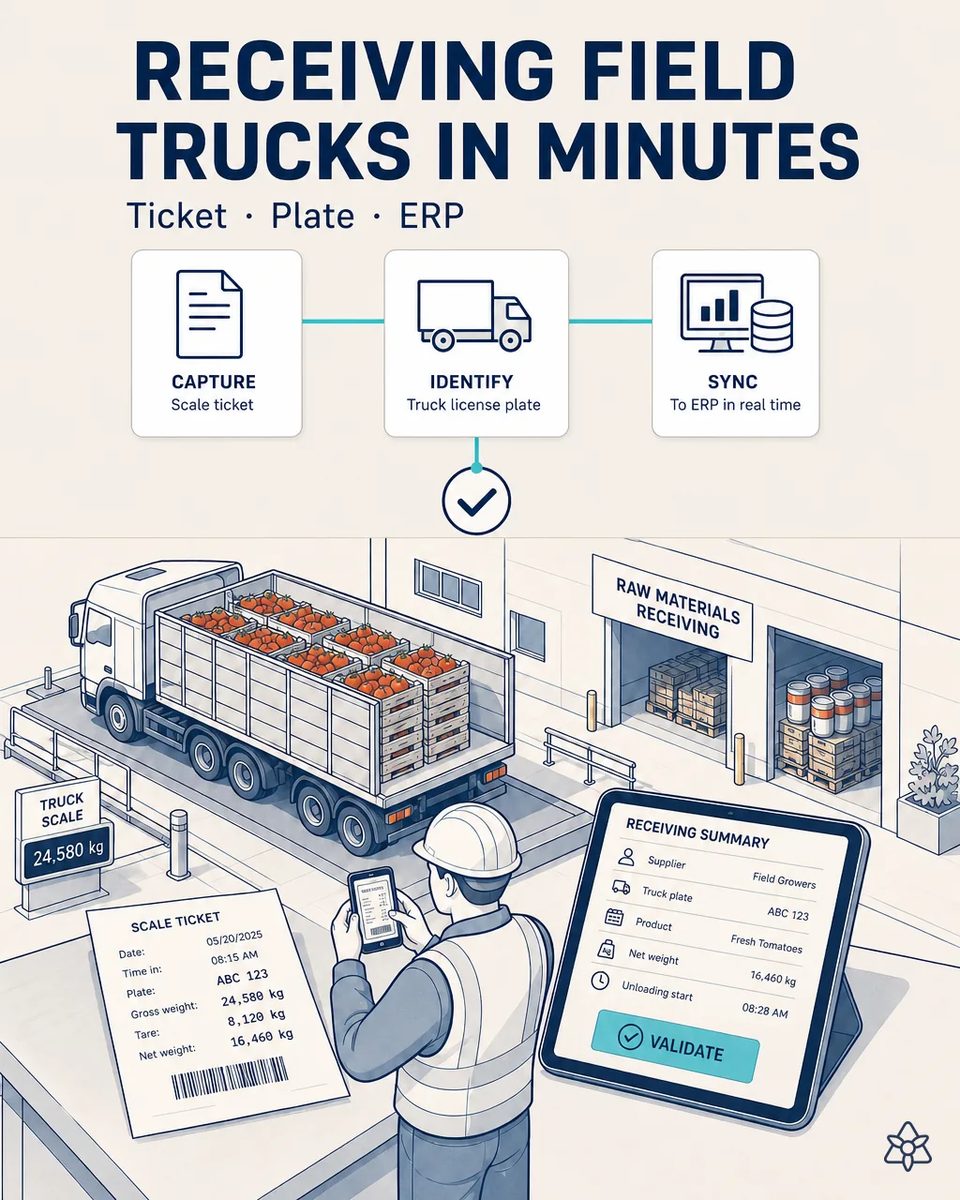
At harvest peak, every typed scale ticket adds a truck to the queue on the road.
Receiving agricultural raw material is a seasonal bottleneck. Every truck requires logging the scale ticket, plate, supplier, origin lot, unloading times and operator safety conditions. If everything is typed, the yard fills up and trucks wait. If it is logged in a hurry, origin lots are poorly traced and reconciling kilos received with kilos processed gets harder.
- In season the plant receives dozens of trucks a day loaded with tomatoes, chiles or sweet corn, many arriving in the same few hours after the morning harvest.
- Each one needs the scale ticket, plate, supplier, origin lot, unloading start and end and the operator's protective equipment logged.
- Typed one by one, the yard fills up, carriers wait and demurrage starts to run.
- Logged in a hurry, origin lots are poorly traced and kilos received stop reconciling with kilos processed at the hopper.
Connect in photo-to-ERP mode — the ticket and the plate, one tap to the goods receipt.
iLEAN Connect in photo-to-ERP mode.
The receiving lead photographs two things already in front of him. iLEAN extracts supplier, gross and net kilos and origin lot, logs unloading times and checks protective equipment visually, and the goods receipt is in the ERP after one tap. The truck leaves sooner and the field lot is right from the start. At the hopper, the kilos received and the kilos tipped finally reconcile.
- Photo of the scale ticket and the license plate.
- Extraction of supplier, material, gross and net kilos, origin lot.
- Automatic logging of unloading start and end and a visual check of the operator's protective equipment.
- Summary on a tablet and one-tap validation.
- Goods receipt posted to the ERP via API.
- CFO angle: the receiving module usually needs two or three active licenses; with iLEAN only the receiving lead validates. A typical 50 to 70 percent reduction in module licenses, plus less carrier demurrage.
Field trucks typed one by one versus received from a photo
| Aspect | Today | With iLEAN Connect |
|---|---|---|
| Logging a truck | Typed ticket by ticket | Minutes, from a photo |
| Gross, tare and net kilos | Copied from the ticket | Read and cross-checked |
| Origin field lot | Sometimes left blank | Extracted and validated |
| Unloading start and end | Estimated afterwards | Logged automatically |
| Protective equipment at unloading | A box ticked | Checked visually |
| Receiving module licenses | Two or three active | Only the receiving lead |
Before: truck-by-truck typing, congested yard, incomplete origin traceability. After: logging in minutes with a photo, full traceability, one license.
Impact estimate — to be validated with your peak-season truck count.
The block below is an estimate to be validated against your plant's actual data. We put it forward so the committee has an order of magnitude; we refine it during the assessment.
- Recurring saving of 50-70% in receiving and warehouse module licenses, depending on vendor pricing.
- Plus an estimated payback of 3-8 months from less waiting in the yard.
- CFO angle: the receiving module usually needs two or three active licenses; with iLEAN only the receiving lead validates, and carrier demurrage drops.
- And origin traceability is complete, so kilos received reconcile with kilos tipped at the hopper. Each grower's season closes with kilos received, kilos processed and rejects in one place.
Recurring savings of 50 to 70 percent in receiving and warehouse module licenses depending on vendor pricing, plus an estimated payback of 3 to 8 months from less waiting in the yard. Estimate to be validated.
And the fair question from the production manager
"Scale tickets come out of a dot-matrix printer in the rain. Will it read them?" — reading a ticket whose layout your own weighbridge prints, and a license plate, is an anchored task where the best models stay under 1.5% error [1]. Net kilos are also checked against gross minus tare, so a misread digit does not add up and is flagged. And the receiving lead sees the summary and validates with one tap before the goods receipt exists. A blurred photo is simply retaken while the truck is still on the scale.
[1] OpenAI paper "Why Language Models Hallucinate", 2025 — on the reliability of AI in anchored tasks.
What people ask about receiving field trucks from a photo
Does the weighbridge software have to be replaced or integrated?
No. iLEAN reads the ticket the weighbridge already prints. If it is integrated later, so much the better, but the case works from the first truck with a phone. The weighbridge keeps printing as it does today, and the clerk keeps the paper copy.
How is the origin field lot captured when the ticket does not show it?
From the grower's delivery document or crate label, photographed in the same step, or chosen on the tablet from the lots that grower has open. Either way it is validated before the receipt is posted. A truck carrying several growers' fruit is split into its lots in the same summary.
What is the protective equipment check exactly?
A visual check, from the same photos or a fixed camera at the unloading bay, that the driver or operator wears the required gear. It is logged with the truck as a safety record, not as a sanction. What is checked is defined with your safety team, and nobody's face is stored beyond what the record needs.
Does it work for chiles and sweet corn as well as tomatoes?
Yes. The material comes from the ticket or the grower's document; the flow is the same for any field crop the plant receives in season. The same flow serves for premix, cans and jars when they arrive by truck outside the harvest months.
What if the ticket's kilos and the grower's document disagree?
The discrepancy is shown on the tablet before validation. The receiving lead can accept with a note or hold the receipt, so any claim with the grower starts from a recorded fact. Over a season, those notes also show which growers or carriers disagree most often.
More cases from this series
- Food safety audit ready, nothing to rebuildEvery cleaning, thermal cycle and release produces its evidence; iLEAN Agents organizes it by standard…
- True packaging OEE, no hidden stoppagesConnect, Edge and Agents working together to measure true OEE, anticipate stoppages and connect the…
- Case and pallet labels, always matchingLot, best-before date and codes travel from the ERP to the case labeler and palletizer; iLEAN…
- Field alerts arrive before the problem doesiLEAN reads grower and carrier alerts from WhatsApp or email, matches them with the production plan and…
- From the lab spreadsheet to the ERP, no retypingiLEAN reads the quality lab spreadsheet, has the lead validate it and posts it to the ERP. Fewer…
- Paperless order start at the hopperA photo of the bin label and weighing ticket puts the real consumption of each production order into the…
Photograph a real scale ticket and see what iLEAN extracts.
We work on your plant's real data, not ours. Assessment with no commitment.
Request estimated ROI within 48h ‹ See all cases of sauces and canned vegetables See food industry