Zero recalls for labeling, denomination or allergen — iLEAN’s 4 coordinated rings in your processed cheese plant.
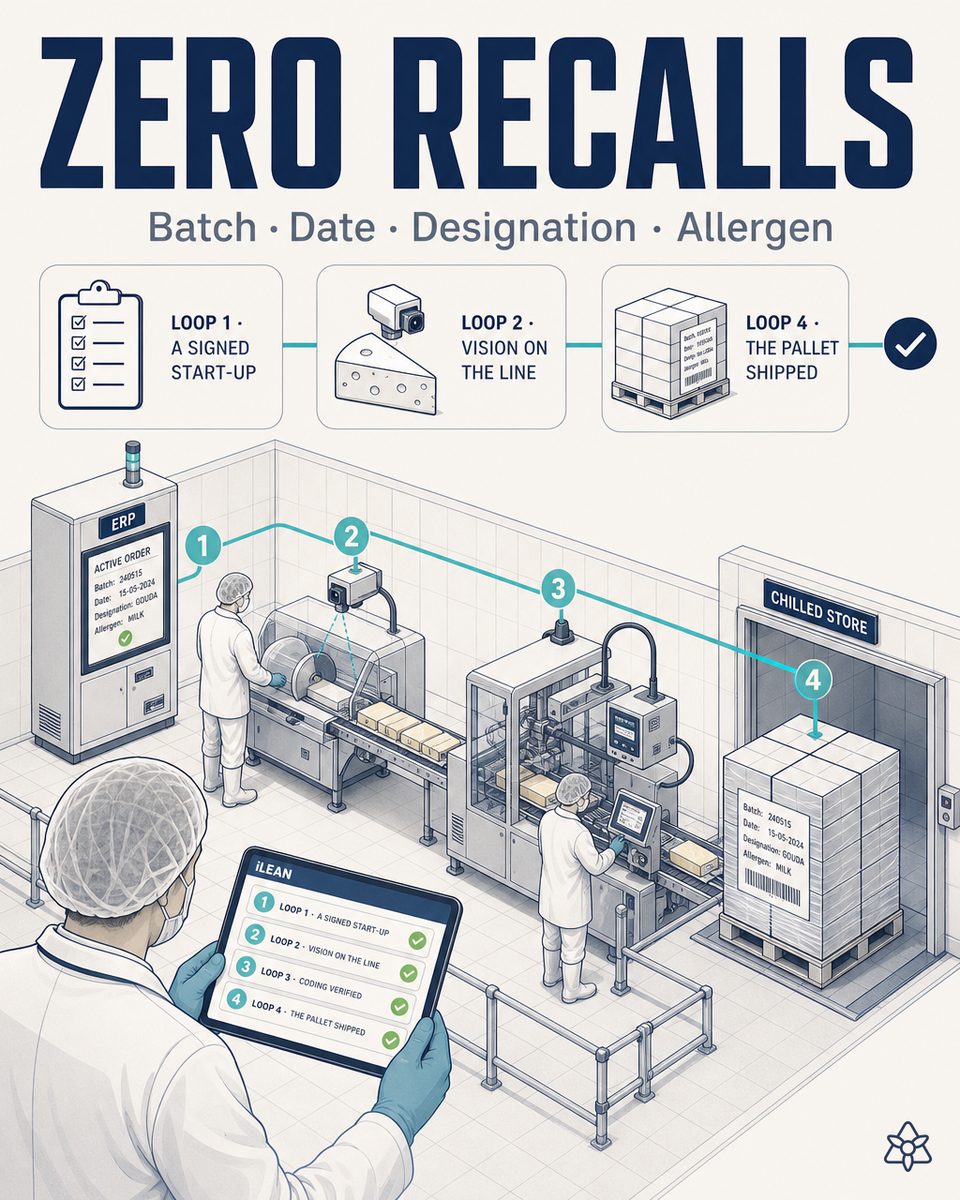
The capital pain of a dairy processing plant serving large retail is the same everywhere: zero recalls for batch, date, PDO designation or allergen. iLEAN coordinates four verification rings that cross-check each other from the startup paper to the shipped pallet — each ring witnesses the previous one, and the line does not release product until all four agree.
A private label recall is not a quality incident: it is a relationship crisis with the retailer.
In dairy processing for large retail, the reference is almost always private label: the cheese carries the retailer's brand, not yours. That completely changes what a labeling error means. It is not "a batch to recall": it is a recall across thousands of points of sale executed under the retailer's protocol, with contractual chain penalties that trigger automatically, and with the later conversation where the buyer decides whether to keep trusting your plant with the private label contract or take it to another supplier.
The error is almost never in the cheese. It is in the coherence between four points that should say the same thing and sometimes do not: what the ERP activates in the work order, what the coder actually prints, what the pack leaving the slicer declares, and what stays documented when the pallet ships. A mismatch at any of those four points — a batch, a date, a PDO designation, an allergen — is indistinguishable from the rest until someone reads it on the shelf or, worse, until the retailer itself detects it.
The real cost of a private label recall is not the chain penalty: it is the product recovered from thousands of points of sale, the reverse transport, the destruction, and above all, the very real possibility of losing the private label contract — a multi-year relationship that took years to build and that the retailer can reassign to another supplier at the next negotiation.
The 4 coordinated rings — the heart of the system.
No ring closes the risk on its own. What shields the plant is that the four cross-check each other: each one verifies what the previous one said, and none lets a pallet through without the other three agreeing.
- Ring 1 · ERP. The active work order in the ERP defines, as the single source of truth, the batch, the designation (generic or PDO), the expiry date, the declared allergens, the target weight and the destination customer/retailer. Everything happening afterwards on the line is measured against this work order, not against anyone's memory.
- Ring 2 · Coder + checkweigher + slicer. The line equipment prints and signs exactly what the ERP has just published, via API — with nobody having to type the batch, the date or the designation a second time. Zero intermediate typing means zero point where a correct data point in the ERP becomes an incorrect one on the package.
- Ring 3 · Edge. An overhead camera over the line reads the final pack — label, date, batch, designation — and crosses it in real time against Ring 1's active work order. If it does not match, JIDOKA AI blocks the pack before it reaches the pallet: there is no need to wait for the error to pile up across a hundred units to detect it.
- Ring 4 · Evidence pack. Every pallet leaves the plant with a dossier crossing the three previous rings — the ERP's work order, the coder/checkweigher/slicer's print record and the Edge verification — plus the photo of the printed batch, the responsible person's signature and the trip's cold chain curve. If the retailer asks, the answer already exists; it does not have to be reconstructed.
A fifth element is not a ring, it is what keeps the four from penalizing productivity: SMED AI speeds up the change between batches and references (generic ↔ PDO, one private label customer ↔ another) so that coordinating four verification points does not mean a slower line. The coordination protects without braking.
A plant without coordinated rings vs. a plant with iLEAN's 4 rings
| Aspect | Without coordinated rings | With the 4 iLEAN rings |
|---|---|---|
| The work order | Read on paper or screen, transcribed by hand to the line equipment | Ring 1 (ERP) publishes batch, designation, date and allergens via API |
| Coder / checkweigher / slicer | The operator types or selects the corresponding program | Ring 2 prints and signs automatically what the ERP publishes — zero typing |
| Verifying the final pack | Manual visual sampling, every N units | Ring 3 (Edge): 100% of packs against the active work order, JIDOKA AI blocks on mismatch |
| PDO designation vs. generic | Depends on the operator remembering the reference change | A mandatory field in the work order, verified by Edge on every pack |
| The pallet's shipping dossier | Rebuilt by hand if the retailer asks, days or weeks | Ring 4 (evidence pack): an automatic dossier with photo, signature and cold chain |
| Incidents/year with partial recall risk | 1-3 per year | Zero — detection on the line, not at the retailer |
Impact estimate for your plant — to be validated with your own numbers.
The block below is an estimate to be validated against your plant's actual data. We put it forward so the committee has an order of magnitude; we refine it during the assessment.
- Dairy processing plant with multi-reference slicing/portioning lines, a mix of generic and PDO product, serving several retailers in private label.
- Pilot on the highest-risk line with the 4 rings coordinated — ERP, coder/checkweigher/slicer, Edge with JIDOKA AI and a per-pallet evidence pack. First value within a few weeks starting with the Edge ring.
- The hard lever is the protection against a single impact above €100,000 per private label recall — product recovered from thousands of points of sale, reverse transport, destruction, the chain penalty — plus preserving a multi-year relationship with the retailer and the private label contract itself.
- Indicative payback between 6 and 12 months, counted against the first recall avoided. With a single serious recall, the system pays for itself.
And the fair question: "what if the system itself errs?"
The quality manager's right question. Two answers that hold each other up. The technical one: hallucination is a problem of free generation, not of anchored tasks — reading a sliced pack and comparing it with the active work order is as anchored a task as they come. In tasks of this kind, the best models brought the error below 1.5% [1]. The architectural one: the system is built on the three IRIS safety rings — Connect transports, the Agents decide, the person signs. And since the case's 4 rings cross-check each other, an isolated failure in one is exposed by the other three before becoming an incident. It is not that everything passes through a person; it is that the system allows it where it matters, and here it matters.
[1] OpenAI paper "Why Language Models Hallucinate", 2025 — on the reliability of AI in anchored tasks.
What people ask about iLEAN's 4-ring system in processed cheese
What percentage of dairy recalls are for incorrect labeling or designation?
According to RASFF (the European food alert system) and the Spanish food safety agency AESAN, undeclared or misdeclared allergens are, alongside microbiological contamination, the leading cause of dairy product recalls in Europe. In cheese processing there is an added, specific risk: the incorrect designation — a PDO batch labeled or sliced as generic, or the reverse — which in private label retail triggers the same recall protocol as a misdeclared allergen. Adding up date, batch, allergen and designation, the label/information block clearly outweighs actual manufacturing failures. The product is well made: what fails is the coherence between what the ERP says, what the line prints and what leaves on the pallet.
Do the 4 rings have to be installed at once, or can you start with one?
You can start with the ring that hurts most and grow from there — in fact that is the recommended path. The most common sequence is: first Ring 3 (Edge), because it catches the error just before it leaves the line; then Ring 1 (ERP), so the work order automatically activates batch, designation, date and allergens with no typing; then Ring 2 (the coder, checkweigher and slicer), so they print exactly what the ERP publishes; and finally Ring 4 (the evidence pack), which closes the circle with the per-pallet dossier. Each ring adds value alone, but the zero recalls effect appears when the four cross-check each other — each ring witnesses the previous one.
How is it guaranteed that the system itself does not err?
Two answers, one technical and one architectural. Technical: hallucination is a problem of free generation, not of anchored tasks. Reading a sliced pack and crossing it against the active work order is an anchored task — the best recent study (OpenAI 2025 paper) puts the best models' error in anchored tasks below 1.5%. Architectural: the system is built on the three IRIS safety rings — the critical verification never executes alone, there is always a person who signs. Connect transports, the Agents decide, the person signs before the pallet leaves the plant. And since the case's 4 rings cross-check each other (ERP against coder, coder against Edge, Edge against the evidence pack), an isolated failure in one ring is exposed by the other three before becoming an incident.
How long until the complete system is operational in a plant?
The standard iLEAN method — a 3-5 day immersion with a mixed team (your plant's people + embedded industrial AI engineers), applying the Pareto, first value within a few weeks on the most urgent ring, and a pilot line with the 4 rings coordinated typically in 3-4 months. The rollout to the remaining lines and references is replicated by your own people, trained during the pilot. Starting with a single ring (usually Edge) gives measurable value in weeks; coordinating all 4 is the complete project, but there is no need to wait for everything to start reducing risk.
What sets the PDO apart from other designations within this system?
The PDO adds a risk layer other designations lack: it is not enough for the allergen and the date to be correct, the protected designation of origin requires that specific batch to meet the specification (the milk's origin, aging time, processing area) and that the package, the slicing and the labeling declare it unambiguously. A PDO batch sliced or packed as generic — or vice versa — is labeling fraud before the designation's regulatory body, not just a retailer risk. That is why Ring 1 (ERP) publishes the designation as a mandatory field of the work order, and Ring 3 (Edge) verifies that the final pack declares it exactly as the active work order does — the system treats the designation with the same rigor as the allergen.
More cases from this series
- The audit always ready — zero manual reconstruction in the processed cheese plant.Every critical changeover and every cold chain event generates an auditable dossier ready by standard.…
- Three machines stitched to the ERP — one tap changes the SKU on all threeiLEAN stitches the coder, the dynamic checkweigher and the slicer to the ERP via API. An SKU change in…
- From the laboratory’s Excel to the ERP, without transcribing — and with license savingsiLEAN Connect reads the laboratory’s Excel, validates on screen and feeds the ERP. Typical saving of -50…
- Nothing enters the system without a human having seen it — the tablet at the line asks for a two-tap signature before the data crosses into the ERP.An industrial tablet at the line. iLEAN shows a visual summary, the operator signs with two taps and…
- Receiving stops blocking the manager for an hour — the truck waits while the delivery note and the GS1-128 labels are typed by hand into the ERP.iLEAN Connect digitizes the delivery note and GS1-128 labels at cheese base receiving. Fewer carrier…
- Line startup in a dairy processing plant — the order and the shift checklist live on paper until someone keys them in.iLEAN Connect captures by photo the work order and the line startup checklist in a dairy processing…
Shield your plant against the labeling recall.
We work on your plant's real data, not ours. Assessment with no commitment.
Request estimated ROI within 48h ‹ See all 12 processed cheese cases See food industry