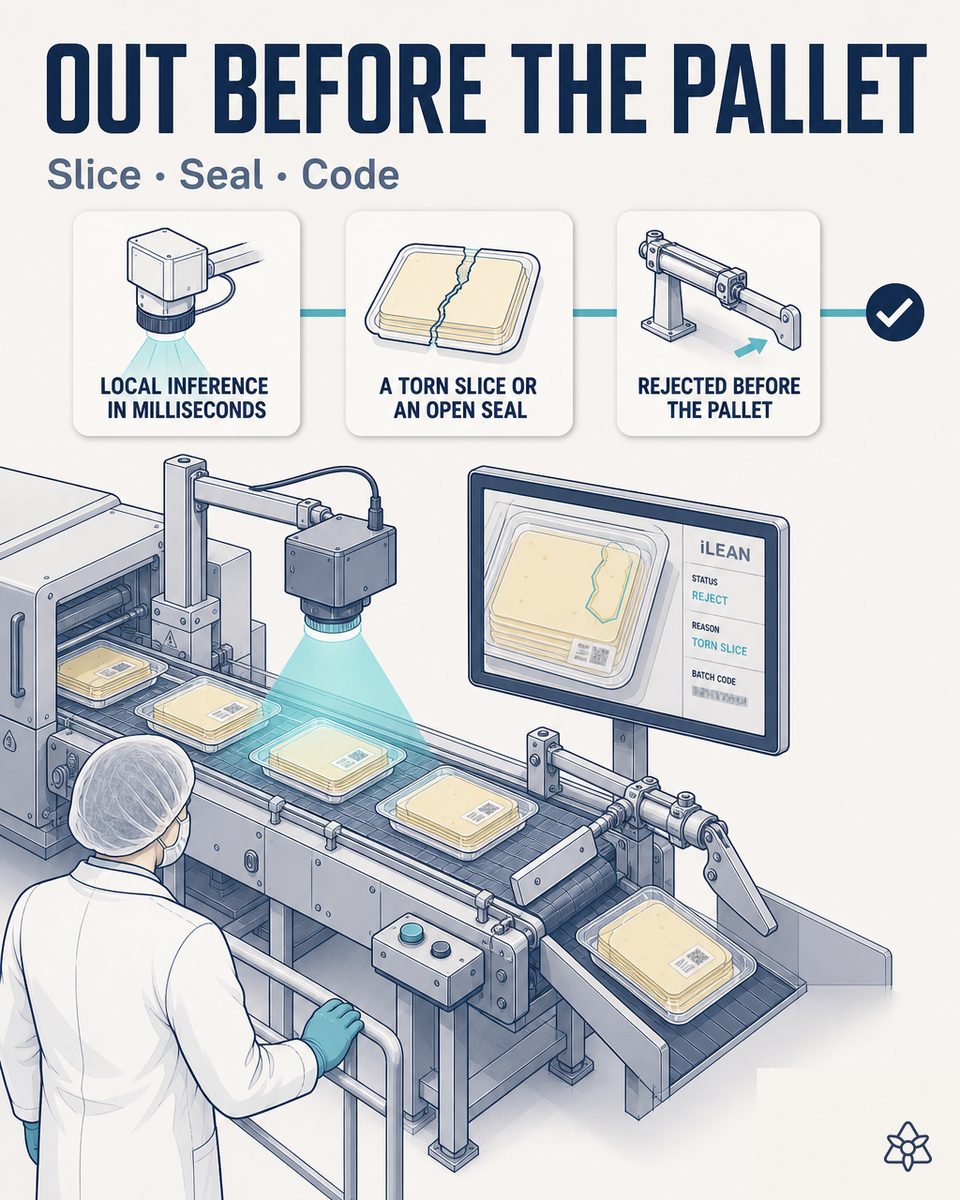
Edge vision that ejects the defective pack before the pallet — over the cheese slicer and packing machine.
At 200 packs/minute the human eye tires and lets through broken slices, badly closed seals, excess surface mold or blurred batch codes. iLEAN Edge infers in milliseconds with a local CNN and ejects the defective pack before it reaches the pallet.
The 1-2% sampling does not see the pack that reaches the shelf.
In a dairy processing plant that slices and packs cheese — a line with a high-speed slicer and a VFFS/HFFS packing machine downstream — the running process is stable: once started, packs come out at 200 packs/minute with few visible incidents. The problem is that at that pace human quality control can only sample a minimal fraction of what crosses the belt.
- 1-2% sampling — the inspector takes one pack from each run, opens it, looks at it. The remaining 98-99% passes with nobody checking, and that is where the broken slice, the badly closed seal or the blurred code slips through.
- The gap reaches the shelf — the end consumer finds the defect, or worse, the retailer's quality control detects it at their own receiving.
The consequence is not one lost pack: it is a retailer complaint, a full-pallet return and, frequently, a penalty on the next order — the retailer cuts volume or demands an extra audit from a supplier that has already failed once. Sampling at 1-2% works on perfect product, but lets through exactly what should not pass on the day the slicer starts tearing or the sealing loses pressure.
iLEAN Edge — an overhead camera, a local CNN and ejection before the pallet.
The problem is not one of judgment — the quality manager knows perfectly well what a defective pack is — it is one of pace and sustained attention, exactly where machine vision wins. iLEAN Edge replicates the veteran inspector's judgment at the packing machine's speed, pack by pack, without fatigue.
Edge sees every pack at the exit of the slicer and the packing machine. The local CNN tells apart a broken slice, a badly closed seal, surface mold and a blurred code. The pneumatic ejector takes it off the belt before the pallet. It works without a network. The line does not notice — the bad pack simply stops getting through.
iLEAN's concrete piece for a sliced and packed cheese line:
- Edge — a physical terminal with an overhead industrial camera installed over the slicer's exit and the VFFS/HFFS packing machine's mouth, before palletizing. It carries a CNN trained with good and bad examples of the house's format. It inspects broken slices, badly closed seals, excess surface mold and blurred batch or expiry codes. Inference is local, no cloud: on detecting a defect, it fires a pneumatic ejector that takes the pack off the belt into the scrap bin.
- Connect — captures the work order and the running batch, whether from the ERP, the vertical MES or the shift manager's production sheet. So when Edge detects a defect spike, it is known in the same second which batch, which film reel and which shift it corresponds to.
- Agent — lives in Central and crosses Edge's history (how many defective packs per hour, by defect type, by shift) with Connect's batch and work order. If badly closed seals spike every time a specific film reel comes in, it does not send an email at midnight: it alerts the quality manager with the hypothesis already cross-checked. The person validates and decides.
Human sampling control vs. inspection with iLEAN Edge
| Aspect | Human sampling control | Inspection with iLEAN Edge |
|---|---|---|
| Inspection coverage | 1-2% sampling, one pack per run | 100% of packs, at 200/min |
| A broken slice inside the pack | Depends on the inspector opening exactly that pack | A local CNN on every pack, no exception |
| A badly closed seal / vacuum leak | Hard to spot without opening the package | Detected by vision before the pallet |
| A blurred batch/expiry code | Discovered on the shelf or at the customer's receiving | Detected in line, before palletizing |
| Retailer complaints | They happen; a pallet return, an order penalty | Drastic reduction (estimate to be validated) |
| Traceability by batch | Rebuilt by hand, weeks later | Per-pack history, automatic |
Impact estimate for your plant — to be validated with your own numbers.
The block below is an estimate to be validated against your plant's actual data. We put it forward so the committee has an order of magnitude; we refine it during the assessment.
- Dairy processing plant with a high-speed slicer and a VFFS/HFFS packing machine, a line running at 200 packs/minute.
- Edge pilot over the exit of the slicer and the packing machine — an overhead camera + pneumatic ejector, no construction work on the machine. First value expected within a few weeks.
- Indicative payback between 5 and 12 months, depending on the current retailer complaint ratio and the average cost of a pallet return. Estimate to be validated.
- Expected reduction of complaints for visual defects ≥30% in the first months. (Conservative range — estimate to be validated.)
- The hard lever is one pallet return avoided: reverse transport, rework or destruction, the next order's penalty. One return pays for the pilot.
And the fair question from the quality manager
"What if the AI errs and lets through a pack with a broken slice?" — hallucination is a problem of free generation, not of anchored tasks. In tasks where the AI limits itself to classifying an image against known patterns (this pack matches the "good" pattern or the "defect" pattern), the best models brought the error below 1.5% [1]. And even then, it is not decided in a vacuum: the quality manager sees each shift's history, validates the false positives in Edge's own interface and retrains the model when needed. The line does not stop while it trains. The person provides the judgment; the machine keeps the cycle turning.
[1] OpenAI paper "Why Language Models Hallucinate", 2025 — on the reliability of AI in anchored tasks.
What people ask about sliced cheese quality control with Edge
Which specific defects does iLEAN Edge detect on the cheese slicer and packing machine?
The defects an inspector would recognize instantly but that at the line's pace nobody can follow pack by pack: a broken or split slice inside the package, a badly closed seal or one with a vacuum leak, excess surface mold visible on the slice, and a blurred or unreadable batch code or expiry date in the packing machine's print. The overhead camera covers the slicer's exit and the VFFS/HFFS's mouth at the same control point, without duplicating terminals.
At what real pace does Edge run without becoming the line's bottleneck?
At the packing machine's own pace. With lines moving 200 packs/minute — more than 3 packs per second — the local CNN infers in milliseconds: the bottleneck is never the vision, it is the physical actuator. The pneumatic ejector fires the moment it receives the defect signal, before the pack reaches the palletizing area. The line does not slow down; the bad pack simply stops getting through.
How is the CNN trained on the plant's own format?
With real examples of the house's format, not a generic library. The quality manager marks good packs and packs with each defect type — broken slice, badly closed seal, surface mold, blurred code — and the CNN learns the specific visual pattern of that product, that weight and that package. When the plant changes format or film supplier, it retrains with the new samples; the previous model keeps working while the new one is validated, so the line does not stop.
What happens if the plant loses its network?
It keeps working the same. Edge is a physical on-premise terminal with the CNN loaded on the device itself: if the plant loses WiFi or fiber, or the provider's cloud fails, Edge keeps inspecting every pack and firing the ejector on the electrical cabinet's power. The critical thing — that a pack with a broken slice or a badly closed seal not reach the pallet — cannot depend on connectivity. When the network returns, the history uploads to be crossed with batch and work order.
How does Edge integrate with the batch and work order information?
Edge's detection history — how many defective packs, of which type, in which time slot — is crossed with the batch and work order the plant already manages, whether from the ERP, the vertical MES or a production sheet. So, if surface mold spikes on one specific batch or the badly closed seal coincides with a film reel change, the system does not send an email at midnight: it presents the already cross-checked hypothesis to the quality manager, who validates and decides.
More cases from this series
- The audit always ready — zero manual reconstruction in the processed cheese plant.Every critical changeover and every cold chain event generates an auditable dossier ready by standard.…
- Three machines stitched to the ERP — one tap changes the SKU on all threeiLEAN stitches the coder, the dynamic checkweigher and the slicer to the ERP via API. An SKU change in…
- From the laboratory’s Excel to the ERP, without transcribing — and with license savingsiLEAN Connect reads the laboratory’s Excel, validates on screen and feeds the ERP. Typical saving of -50…
- Nothing enters the system without a human having seen it — the tablet at the line asks for a two-tap signature before the data crosses into the ERP.An industrial tablet at the line. iLEAN shows a visual summary, the operator signs with two taps and…
- Receiving stops blocking the manager for an hour — the truck waits while the delivery note and the GS1-128 labels are typed by hand into the ERP.iLEAN Connect digitizes the delivery note and GS1-128 labels at cheese base receiving. Fewer carrier…
- Line startup in a dairy processing plant — the order and the shift checklist live on paper until someone keys them in.iLEAN Connect captures by photo the work order and the line startup checklist in a dairy processing…
Keep the defect from leaving your line — we will send within 48h the estimated ROI of this AI project for your slicer and packing machine.
We work on your plant's real data, not ours. Assessment with no commitment.
Request estimated ROI within 48h ‹ See all 12 processed cheese cases See food industry