The line does not start until Edge and quality give OK — the critical changeover in a processed cheese plant.
A dairy processing plant with a lactose-free line and a lactose line shares machines. A single minimal residue between cleanings contaminates the first new batch and loses the lactose-free seal. Same between PDO and non-PDO. iLEAN Edge + JIDOKA AI do not let the line start until the cameras give OK and quality signs on visual evidence.
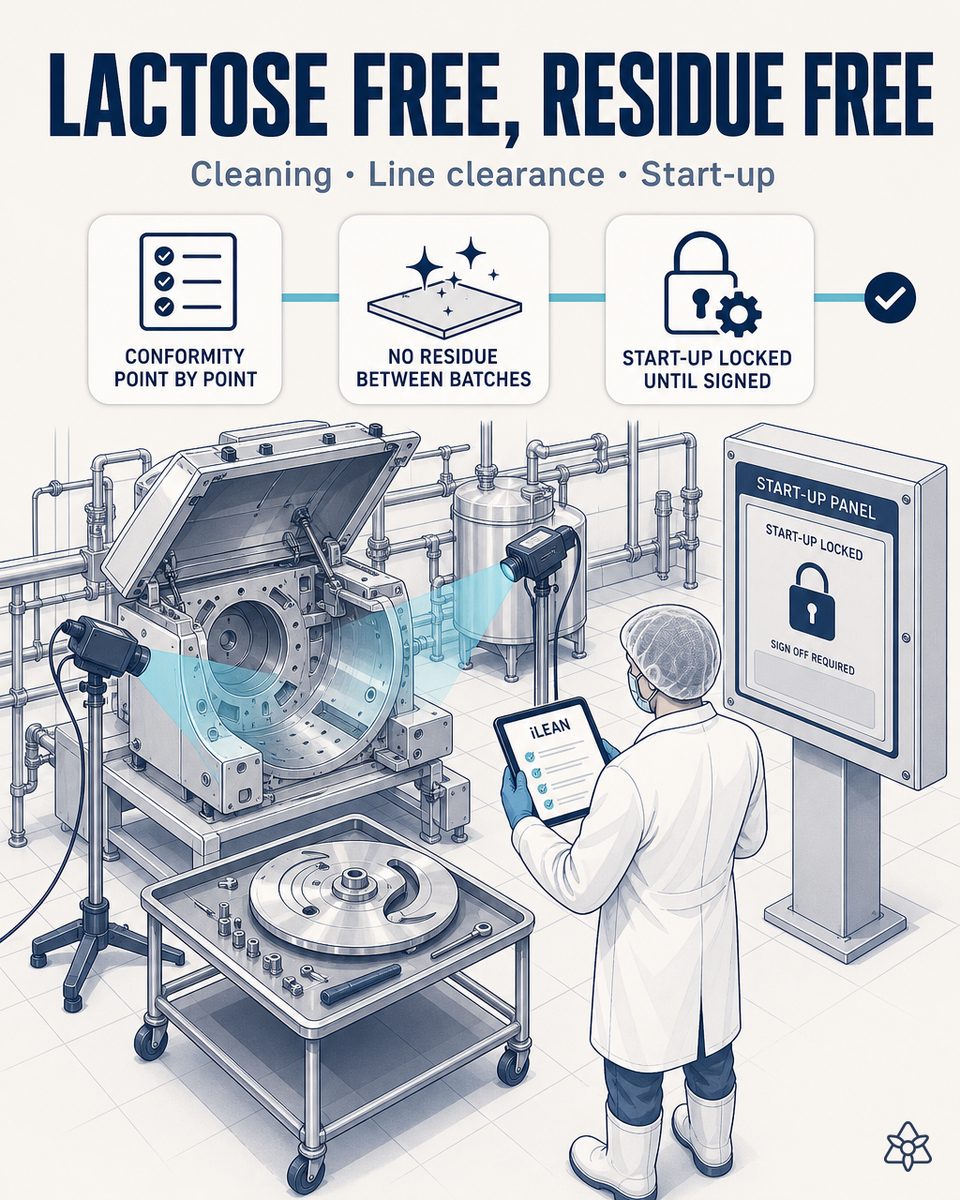
The critical changeover is where the seal is at stake, not steady-state production.
In a dairy processing plant sharing machines between a lactose-free line and a lactose line — or between PDO and non-PDO product — the running process is stable. The risk concentrates in the critical changeover: the moment the same slicer, the same packing machine or the same thermoformer switches from one product to another and everything depends on the cleaning and the material change having been perfect.
- The lactose-free certification — worth gold commercially, and today it hangs on a human signature with no objective visual evidence: the quality manager signs that the cleaning is OK because the protocol was followed, not because they could check every critical point with their own eyes.
- The PDO certification — requires that the package, the label and the format correspond exactly to the designation at every SKU change. A mismatch is not just a labeling error; it is a non-compliance before the PDO certifier.
- A single minimal residue between cleanings — a trace on a cutting guide, a remnant at the thermoformer's mouth — contaminates the new product's first batch before anyone notices.
Cross-contamination or a PDO mismatch translate into the same thing: a recall, a sanction from the relevant certifier and, in the case of the lactose-free seal or the protected designation, the end of that certification for the plant. A seal built over years can be lost in one badly verified shift change.
Edge gives the OK point by point — JIDOKA AI does not let the line start until everyone has said yes.
The critical changeover is not solved with a longer checklist for the quality manager: it is solved by giving them objective visual evidence of each point before they sign the release, and by making the line physically unable to start while that evidence is incomplete. That combination is Edge plus JIDOKA AI.
Edge looks at every critical point of the changeover — cleaning, guides, packing, thermoforming. JIDOKA AI does not release the startup until every camera gives OK. Quality signs on the visual evidence, not blind.
The iLEAN pieces applied to the critical changeover in a processed cheese plant:
- Edge — fixed cameras at the changeover's critical points: the slicer's infeed belt, the cutting guides, the packing room, the thermoformer's mouth and a final camera on packed product. Each camera learns that point's reference state — clean for the lactose changeover, set to the correct format for the PDO/non-PDO changeover — and compares against it at every batch change.
- JIDOKA AI — receives each camera's verdict and acts as the startup gate: while a single critical point is not OK, the line stays held. It is not an alert someone can ignore under shift pressure; it is an active block of the startup until the evidence is complete.
- Quality's signature on evidence — when every camera gives OK, the quality manager receives the summary with the photos of each critical point and signs the release. The signature remains human and remains mandatory — what changes is that it is no longer signed blind, it is signed seeing the evidence backing each point.
- The changeover dossier archived — the photo of each critical point, Edge's verdict and quality's signature are archived per batch change, ready for the IFS/BRC auditor or the PDO certifier with nobody having to reconstruct anything weeks later.
A blind signature vs. a signature on visual evidence per critical point
| Aspect | Blind signature | Signature on visual evidence |
|---|---|---|
| Verifying the cleaning between lactose and lactose-free | By eye, per protocol, no objective evidence | AI vision at every critical point, with an archived photo |
| Verifying the PDO / non-PDO changeover | Trust that the operator loaded the right material | A camera validates label, mold and format before starting |
| Quality's release signature | Blind — signed with no visual evidence of each point | On point-by-point visual evidence, in front of the manager |
| The line's startup | Depends on judgment and the shift's pace | JIDOKA AI holds it until every camera gives OK |
| A failed camera or missing reading | Assumed OK if nobody says otherwise | Block maintained — the absence of data is not a green light |
| The file for the auditor or certifier | Rebuilt by hand after the incident | A per-changeover dossier: photo + verdict + signature, archived |
Impact estimate for your plant — to be validated with your own numbers.
The block below is an estimate to be validated against your plant's actual data. We put it forward so the committee has an order of magnitude; we refine it during the assessment.
- Dairy processing plant with machines shared between a lactose-free line and a lactose line, or between PDO and non-PDO product, with several critical changeovers per week.
- Edge + JIDOKA AI pilot on the priority changeover's critical points (cameras + startup gate + integration with quality's signature). First value expected within a few weeks.
- What is protected is the revenue tied to the lactose-free seal and the PDO designation — in many plants counted in hundreds of thousands of euros per product segment. A single seal loss or a single recall compromises that entire volume, not only the affected batch.
- The payback is a function of the lactose-free/PDO mix's weight in your plant: the higher the share of certified production on shared machines, the sooner the pilot pays off. Estimate to be validated with your data.
- The hard lever is a single certification loss avoided: the recall, the certifier's sanction, the rework and the time — months or years — it takes to recover a lost seal.
And the fair question from the quality manager
"What if the camera gives OK to a point that actually is not, or the reverse, blocks the line for no real reason?" — hallucination is a problem of free generation, not of anchored tasks. In tasks where the AI limits itself to comparing a critical point's current image against its previously validated reference state — which is exactly what Edge does here — the best models brought the error below 1.5% [1]. And even then, nothing critical is decided alone: JIDOKA AI holds the startup and the person signs, seeing the evidence backing each point. iLEAN's three safety rings are there precisely for this — the AI proposes, the quality manager decides.
[1] OpenAI paper "Why Language Models Hallucinate", 2025 — on the reliability of AI in anchored tasks.
What people ask about the critical changeover with Edge and JIDOKA AI in processed cheese
What exactly is JIDOKA AI and how does it block the line's startup?
JIDOKA AI is the orchestration layer that turns the Edge cameras' verdict and quality's signature into a physical or logical block of the startup. It takes its name from the classic jidoka principle — stop at the anomaly instead of letting it advance — but applied by AI to a critical changeover: until it receives the OK from all cameras at their critical points and the quality manager's signature on that evidence, JIDOKA AI keeps the line held. Nobody needs to remember to check anything; the gate does not open just because the estimated cleaning time has passed.
How many cameras are needed and where are they placed?
It depends on your line's critical-point plan, but the usual range is 5-6 fixed cameras at the points where the critical changeover leaves a visible trace: the slicer's infeed belt, the cutting guides, the packing room, the thermoformer's mouth and a final camera on packed product. Each camera learns that point's reference state — clean or set as appropriate to the changeover type (lactose/lactose-free, PDO/non-PDO, SKU) — and compares against it at every batch change, not just once a day.
What if a camera fails or gets dirty?
The system is designed to fail closed, not open. If a camera stops giving a valid reading — from a dirty lens, a connection failure or a framing misalignment — JIDOKA AI does not interpret the silence as OK: it records "point without a valid reading — block maintained" and keeps the line held until someone repairs the camera or validates that point manually with a signature. The absence of data never translates into a green light; it translates into more verification, not less.
How is a "good" cleaning visually told from an "insufficient" one?
Each camera compares the current image against that point's validated reference state — the exact look of that surface when correctly clean or set for the next changeover. The comparison looks for concrete indicators: remnants of the previous product, wet or dry residue on joints and guides, or a label/package not matching the new SKU in the packing area. When the difference against the reference state exceeds the confidence threshold, the point is marked non-conforming; in borderline cases, no automatic decision is forced — it is flagged for manual verification with a signature before the point is accepted.
And the PDO vs. non-PDO mismatch, beyond the lactose cleaning?
It is a different case and JIDOKA AI treats it as such: the line being clean is not enough, the package, label and format must correspond to the correct designation. In the packing room and at the thermoformer's mouth, the cameras verify that the incoming material — label, mold or format — matches the PDO or non-PDO SKU due in that changeover. If it detects a package of the previous designation entering the new one's cycle, JIDOKA AI holds the startup just as with a cleaning residue: the risk to the seal is not only microbiological, it is documentary before the PDO certifier, and there a timestamped photo is worth as much as a lab analysis.
More cases from this series
- The audit always ready — zero manual reconstruction in the processed cheese plant.Every critical changeover and every cold chain event generates an auditable dossier ready by standard.…
- Three machines stitched to the ERP — one tap changes the SKU on all threeiLEAN stitches the coder, the dynamic checkweigher and the slicer to the ERP via API. An SKU change in…
- From the laboratory’s Excel to the ERP, without transcribing — and with license savingsiLEAN Connect reads the laboratory’s Excel, validates on screen and feeds the ERP. Typical saving of -50…
- Nothing enters the system without a human having seen it — the tablet at the line asks for a two-tap signature before the data crosses into the ERP.An industrial tablet at the line. iLEAN shows a visual summary, the operator signs with two taps and…
- Receiving stops blocking the manager for an hour — the truck waits while the delivery note and the GS1-128 labels are typed by hand into the ERP.iLEAN Connect digitizes the delivery note and GS1-128 labels at cheese base receiving. Fewer carrier…
- Line startup in a dairy processing plant — the order and the shift checklist live on paper until someone keys them in.iLEAN Connect captures by photo the work order and the line startup checklist in a dairy processing…
Tell us your case and we will send within 48h the estimated ROI of Edge + JIDOKA AI for your processed cheese plant's critical changeover.
We work on your plant's real data, not ours. Assessment with no commitment.
Request estimated ROI within 48h ‹ See all 12 processed cheese cases See food industry