The earpiece that returns the shift’s knowledge to the system
The shift lead of a dairy plant spends seven hours a day walking with their hands busy. Nobody asks them anything because they cannot type. iLEAN Connect in earpiece mode listens, structures the incident linked to the active SKU, batch, line and shift, and returns support by voice in seconds.
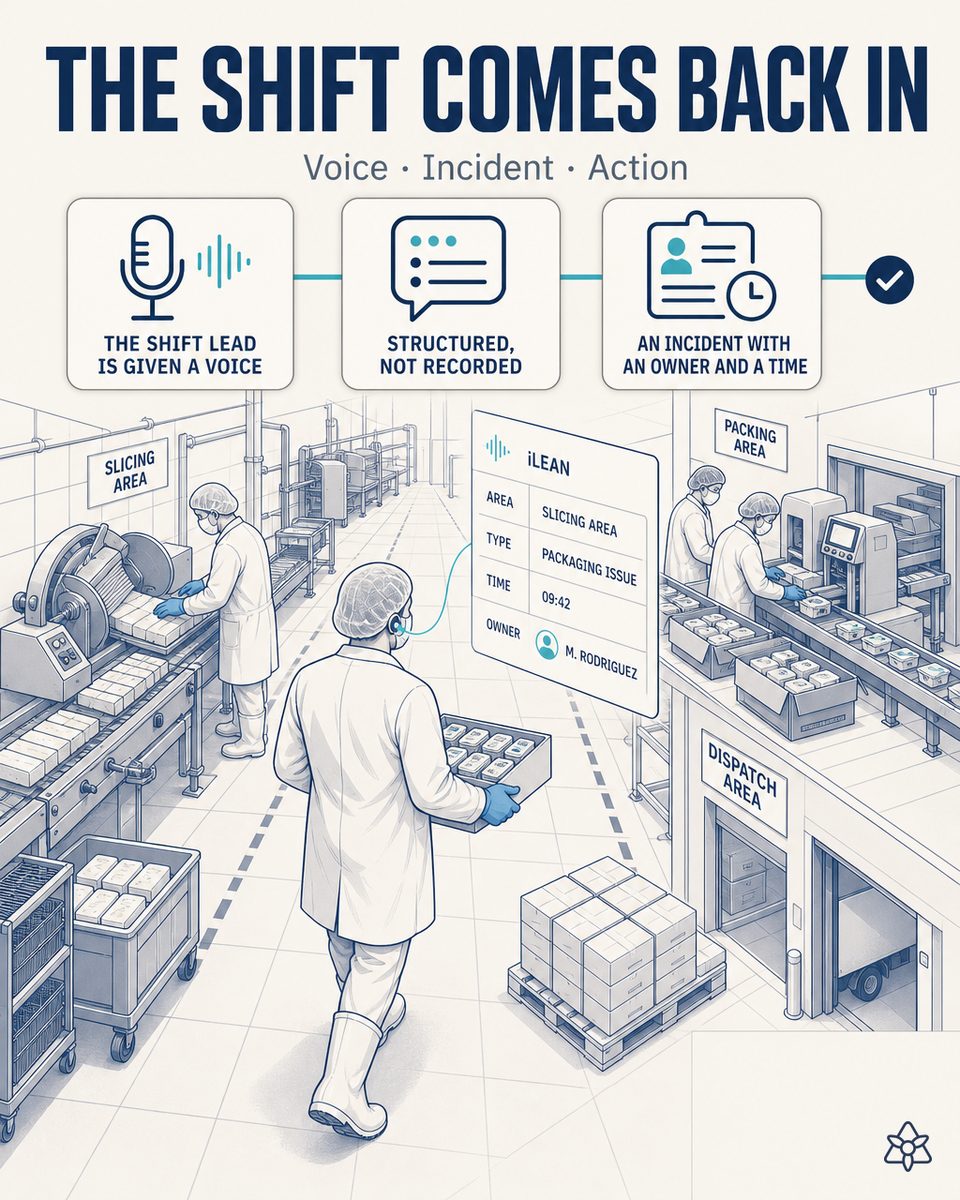
The shift's knowledge lives in the shift lead's head and dies when the shift ends.
In a dairy processing plant, the shift lead is not sitting in front of a screen: they are walking, hands busy, between the slicer, the packing machine and the cold room, for seven or eight hours straight. They are the person who first sees, first smells and first knows when something starts going wrong:
- Scrap at the slicer — a batch starting to give more trim than usual, long before the data shows up in any end-of-shift report.
- Reinforcement needed at a station — an operator falling behind at packing who needs support before the backlog piles up.
- A temperature drift in the cold room — something they notice walking past, with nobody having asked and nowhere to note it at that moment.
Nobody asks them anything because they cannot type while walking. That critical knowledge stays in their head until the end of the shift — and often does not even make it there: it dilutes between the shift change, the handover and the next urgency. The continuous improvement plans then depend on a weekly meeting where someone tries to remember what happened, with no data, from memory.
Connect in earpiece mode — the shift lead takes notes by voice, without freeing their hands.
The earpiece is not a system that listens to the shift lead all day: it is a tool that the shift lead activates when they want to note something down. They decide when they speak and what they say. Connect structures it, links it to the plant's active context and returns it in seconds.
The shift lead says "iLEAN, note this". They dictate the incident in their own words, while walking. Connect structures it and links it to the active SKU, batch, line and shift. Seconds later, the answer arrives by voice to the earpiece or as a notice on the tablet.
How Connect operates in earpiece mode in a dairy processing plant:
- A custom wake word — the shift lead opens the dictation with their own phrase, "iLEAN, note this", which only they say deliberately. Outside that phrase, the earpiece neither transcribes nor sends anything.
- Free dictation, no forms — they speak in their own words, just as they would tell a colleague: "batch 4 on the slicer giving more trim than normal for the last half hour".
- The LLM structures the incident — Connect turns the dictation into an incident with clear fields, automatically linked to the SKU, batch, line and shift active at that moment, without the shift lead having to say or remember that data.
- A voice reply in seconds — the answer arrives at the same earpiece or, if more context is needed, as a notice on the nearest tablet: "quality confirms at 12:15, want me to remind you?". The shift lead keeps walking, the incident already recorded.
- A history available for continuous improvement — every dictated incident stays linked to its batch and its line, available for whoever needs it later, instead of being lost when the shift ends.
Knowledge in the shift lead's head vs. knowledge in the system
| Aspect | Knowledge in someone's head | Knowledge in the system with Connect |
|---|---|---|
| An incident spotted while walking | Stays in the head until the shift ends, if it gets there | Dictated on the spot, hands free |
| Link to SKU, batch, line and shift | Depends on someone remembering it later | Automatic, the system already knows what is active |
| Support or confirmation | The shift lead physically looks for someone | A voice reply on the earpiece in seconds |
| The shift-change meeting | A memory exercise about what happened | A review of incidents already recorded |
| Continuous improvement plan (WCM/TPM) | Fed by recollections at the weekly meeting | Fed by real data captured on the floor |
| The incident's record | Does not exist, or only if someone wrote it by hand | Linked to batch and line, available afterwards |
Impact estimate for your plant — to be validated with your own numbers.
The block below is an estimate to be validated against your plant's actual data. We put it forward so the committee has an order of magnitude; we refine it during the assessment.
- Dairy processing plant with shift leads walking most of the day between slicing, packing and cold rooms, hands busy and with no practical access to a keyboard.
- Connect pilot in earpiece mode on one shift or one line — without changing the shift lead's role, without adding administrative tasks.
- The return is not an accounting saving of hours: it is enabling WCM, TPM and Lean with real data instead of memory reconstructions at the weekly meeting.
- The impact estimate on detected incidents and on the quality of the improvement plans is validated with the plant's continuous improvement team, not invented here as a generic figure.
And the fair question from the plant manager
"Doesn't this end up being a system that monitors what my shift lead says?" — no. It is exactly the other way around: the earpiece hears nothing until the shift lead themselves activates it with their wake word. There is no background recording, no continuous transcription, nobody listening to their conversation with an operator. The only thing entering the system is what they themselves decide to dictate as an incident — because they want it on the record, not because someone above is asking. The tool works for them, not on them.
[1] OpenAI paper "Why Language Models Hallucinate", 2025 — on the reliability of AI in anchored tasks.
What people ask about the shift lead's earpiece in a dairy plant
How does the earpiece avoid triggering by mistake with the wake word?
The system uses a custom wake word ("iLEAN, note this") that the shift lead says deliberately to start dictating. Outside that specific phrase, the earpiece neither transcribes nor sends anything — there is no continuous listening or background recording. The dictation opens with the wake word and closes with a pause or a closing phrase ("done" / "that's it"), so a normal hallway conversation or an instruction to an operator does not slip in as an incident. It is the shift lead themselves who decides when something enters the system, never the other way around.
What if the plant noise interferes with the dictation?
The earpiece is designed for the real noise of a slicing or packing room, not for a quiet office. The voice model is trained on plant conditions (compressors, running lines, cold rooms) and prioritizes the signal close to the proximity microphone over ambient noise. When the transcription's confidence drops below a threshold, Connect does not invent the missing word: it asks a short voice confirmation ("did you say batch 4 or batch 14?") before structuring the incident. Better one extra question than a data point linked to the wrong SKU or batch.
Who can later consult what the shift lead has dictated?
What is dictated is structured as an incident linked to SKU, batch, line and shift, not as a free audio recording anyone can listen to out of context. Access is defined by the plant per its usual organization chart: quality, maintenance and the shift lead themselves see their area's incidents; management sees the aggregate for continuous improvement. It is not a record of what the person does or says during the shift — it is the record of the incident they themselves decided to note, with their name because they sign the data, just as they would sign a paper report.
Does the earpiece replace the shift meetings or complement them?
It complements them — it does not replace them. Today the shift-change meeting or the weekly continuous improvement committee depends on someone remembering what happened: Tuesday's scrap at the slicer, the reinforcement a station needed, cold room 2's temperature drift. With Connect, those incidents are already in the system at the moment they occurred, linked to their batch and their line. The meeting stops being a memory exercise and becomes a review of data already captured — shorter and with fewer things left out by forgetfulness.
How does this relate to WCM or TPM?
The pillars of World Class Manufacturing and TPM — autonomous maintenance, focused improvement, early quality — depend on having real plant data, not the after-the-fact reconstruction of what someone thinks they remember. The shift lead's operational knowledge is precisely what feeds those pillars: what fails, where, how often, on which SKU. By entering structured and linked to batch/line/shift in real time, that knowledge becomes available as the starting data for the continuous improvement teams, instead of being lost every time a shift ends.
More cases from this series
- The audit always ready — zero manual reconstruction in the processed cheese plant.Every critical changeover and every cold chain event generates an auditable dossier ready by standard.…
- Three machines stitched to the ERP — one tap changes the SKU on all threeiLEAN stitches the coder, the dynamic checkweigher and the slicer to the ERP via API. An SKU change in…
- From the laboratory’s Excel to the ERP, without transcribing — and with license savingsiLEAN Connect reads the laboratory’s Excel, validates on screen and feeds the ERP. Typical saving of -50…
- Nothing enters the system without a human having seen it — the tablet at the line asks for a two-tap signature before the data crosses into the ERP.An industrial tablet at the line. iLEAN shows a visual summary, the operator signs with two taps and…
- Receiving stops blocking the manager for an hour — the truck waits while the delivery note and the GS1-128 labels are typed by hand into the ERP.iLEAN Connect digitizes the delivery note and GS1-128 labels at cheese base receiving. Fewer carrier…
- Line startup in a dairy processing plant — the order and the shift checklist live on paper until someone keys them in.iLEAN Connect captures by photo the work order and the line startup checklist in a dairy processing…
Let the shift's knowledge stop getting lost — tell us your case and we will send within 48h the estimated ROI of this AI project for your dairy processing plant.
We work on your plant's real data, not ours. Assessment with no commitment.
Request estimated ROI within 48h ‹ See all 12 processed cheese cases See food industry