From sampling to one hundred percent of containers
At the cadence of a beer packaging line, tens of thousands of containers pass every hour and the human eye cannot keep up. Low fill level, a badly crimped cap, a peeling label, a dented can and a chipped or contaminated returnable bottle can only be sampled. iLEAN Edge places cameras at the critical points, infers in milliseconds and rejects the defective container before case packing, without slowing the line.
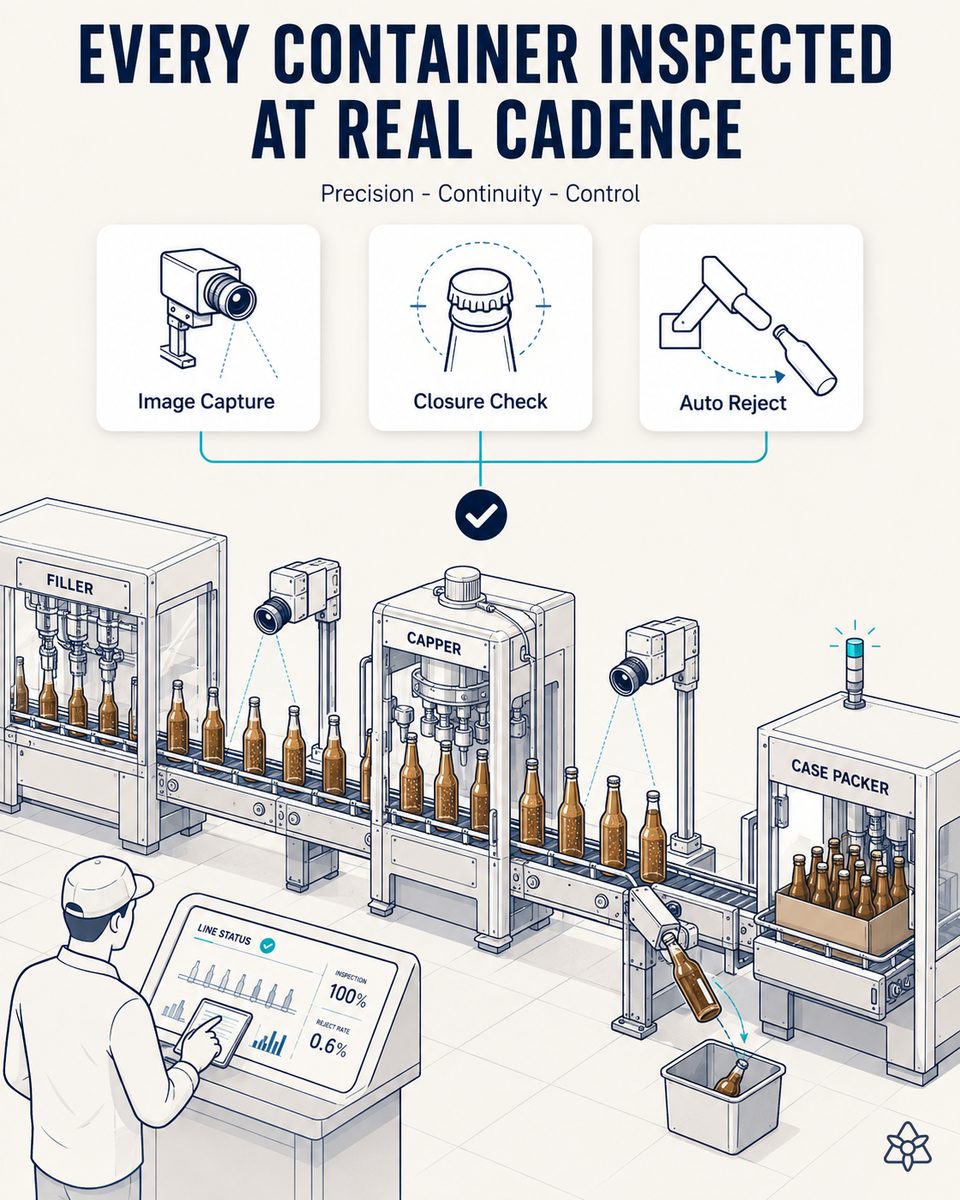
At real cadence the human eye cannot keep up, and sampling leaves gaps by definition.
One hundred percent human visual control is impossible at real cadence, and sampling inspection leaves gaps by definition. In beer a closure defect is not a cosmetic complaint: it is oxidation, loss of carbonation and the risk of non-conforming product reaching the consumer. With returnable glass the problem is worse, because the container has already been in the market and comes back with wear, chips or foreign bodies; the washer does its job, but it does not catch everything.
- Low fill level, badly crimped cap, peeling label, dented can — at tens of thousands of containers an hour they can only be sampled.
- A closure defect is not cosmetic: it is oxidation, loss of carbonation and the risk of non-conforming product reaching the consumer.
- With returnable glass the problem is worse: the container has already been in the market and comes back with wear, chips or foreign bodies. The washer does its job, but it does not catch everything.
Edge — AI vision running inside the plant, not in the cloud.
Edge, AI vision running inside the plant. Step by step: (1) industrial cameras at the critical points — filler and capper outfeed, labeler outfeed, case packer infeed; (2) inference on a local Edge GPU: at this cadence you cannot send images to the cloud, not for latency, not for cost, not for bandwidth; (3) a CNN trained on the plant's own container, brand by brand and format by format, learning from its good ones and its bad ones, not from a generic catalog; (4) rejection of the defective container before case packing; (5) every rejection is recorded with its image and feeds the auditable dossier.
At this cadence you cannot send images to the cloud: not for latency, not for cost, not for bandwidth. Inference happens on a GPU inside the plant, in milliseconds, and the defective container is rejected before case packing without slowing the line.
- Industrial cameras at the critical points — filler and capper outfeed, labeler outfeed and case packer infeed.
- Inference on a local Edge GPU, inside the plant. It is a technical requirement, not an architectural preference.
- A network trained on the plant's own container, brand by brand and format by format, learning from its good ones and its bad ones, not from a generic catalog.
- Rejection of the defective container before case packing, which is the last moment it is still cheap.
- Every rejection is recorded with its image and feeds the batch's auditable dossier.
Sampling control vs. one hundred percent inspection
| Aspect | Sampling control | With iLEAN Edge |
|---|---|---|
| Coverage | A fraction of containers | 100% |
| Where the defect is found | Sometimes, at the customer | On the line, before case packing |
| Defect evidence | None | An image for every rejection |
| Chipped returnable bottle | Whatever the washer catches | Inspected container by container |
| Impact on cadence | None, but no coverage either | None: inference in milliseconds |
| Learning | The inspector's experience | Your own plant's good and bad ones |
Sampling a fraction to controlling 100% of containers. Defect found by the customer to defect found and rejected on the line. No defect evidence to an image for every rejection.
Impact estimate for your plant — to validate against your numbers.
The block below is an estimate to be validated against your plant's actual data. We put it forward so the committee has an order of magnitude; we refine it during the assessment.
- High-cadence packaging line mixing returnable glass, new glass, can and keg.
- Pilot on one line and one critical point, with the plant's real container as training material.
- Indicative payback between 5 and 12 months, depending on the current defect rate and rework cost.
- What gets counted is avoided claims and non-conforming product in the market, which is where the big cost sits and the one that appears in no plant indicator.
Estimated payback 5-12 months depending on the current defect rate and rework cost, counting avoided claims and non-conforming product in the market. *Estimate to validate*.
And the fair question from the production manager
“What if the model rejects good containers?” — the false positive rate is measured from day one of the pilot and it is a tunable parameter, not a mystery: the threshold is calibrated with your own plant's good and bad ones. A model trained on a generic catalog does tend to over-reject; one trained on your container, your label and your lighting does not. That is why we ask for real examples from one week before promising anything.
[1] OpenAI paper "Why Language Models Hallucinate", 2025 — on the reliability of AI in anchored tasks.
What people ask about AI vision on the packaging line
Why does inference have to be local rather than in the cloud?
For three reasons that stack up at this cadence. Latency: the rejection decision has to be made in milliseconds, and a round trip to the cloud does not fit that time budget. Cost: uploading video from several cameras at tens of thousands of containers an hour is an absurd recurring expense. Bandwidth: most plants do not have the uplink, and even if they did, they would share it with everything else. That is why Edge runs inside the plant.
Does the line have to slow down to inspect?
No. The cameras work over the running line at its normal cadence and rejection uses the existing mechanism or one installed for the purpose, before the case packer. If the system had to slow the line down to look, it would not be applicable to beer packaging and we would not propose it.
How is it trained on our container?
With real examples from your plant: good containers and containers with the defects that actually appear, collected over a week of normal production. It matters that they are yours, because a model trained on a generic catalog does not know your label, your cap format, your lighting or the specific look of your returnable bottle after several market cycles.
Does it work equally for can, new glass and returnable?
They are different problems and they are treated as such. The can has denting and closure defects; new glass has fill level and label; returnable adds accumulated wear, chips and the foreign bodies the washer does not always remove. The model is trained per format and per brand — there is no single classifier that covers everything.
What happens with rejections for audit purposes?
Every rejection is recorded with its image and anchored to the batch. That changes the conversation with the auditor: today there is no evidence of the defects that were detected and set aside, and with Edge the full record exists. That material feeds the batch evidence pack directly.
More cases from this series
- The audit dossier that builds itselfPre/post photos, pasteurization curve, lab results and signatures, organized by standard. The audit…
- Zero pallets shipped unreleased and without verified markingOrder, marking, Edge vision and yard cross-referenced before loading. If the batch is not released or…
- Marking stops depending on somebody typingBatch, expiry and destination market travel from the ERP to marking through the API, on container and on…
- Lab sheets enter the ERP on their owniLEAN reads the control sheet when it is saved and, after validation, pushes it to the ERP. Up to 80%…
- Line startup stops living on a sheet of paperThe packaging order and the startup checklist captured with a photo: the batch exists in the central…
- The twenty-year-old panel that finally speaksAn external camera reads pasteurization units off the isolated panel and cross-references them with the…
Send us good and bad examples from one week and we will train the model on your container.
We work on your plant's real data, not ours. Assessment with no commitment.
Request estimated ROI within 48h ‹ See all cases of industrial brewery See food industry