Line startup stops living on a sheet of paper
Every packaging line in a brewery starts on paper: the order stating which brand, format and batch is due, the startup checklist signed by hand, and the shift report with real downtime scribbled in the margin. That paper is the only source that knows why the line did what it did, and today it is retyped late and selectively, or lost. With iLEAN Connect the line lead takes two photos at startup and the packaging batch exists in the central system at second zero.
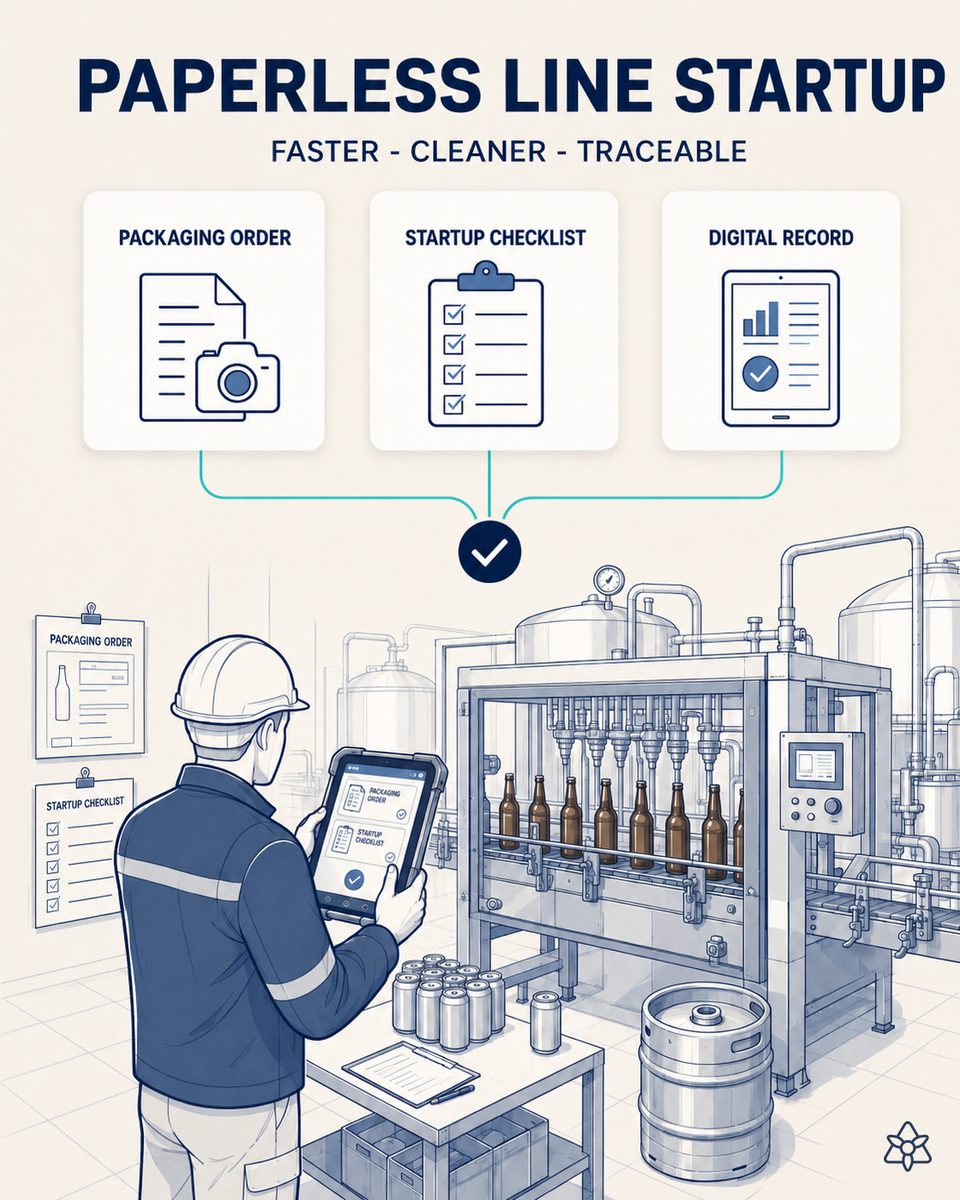
The startup paperwork is the only source that knows why the line did what it did.
With several packaging lines running three shifts, a plant generates dozens of startup documents and shift reports a day. A clerk retypes them twenty-four to seventy-two hours later, keeping only what fits the boxes on the OEE report. The result is that the system records forty minutes of downtime but not why: the cause, handwritten in the margin by the operator who was standing at the machine, never reaches continuous improvement. The whole improvement cycle feeds on generic categories filled in after the fact instead of observed causes.
- Packaging order — which brand, which format and which batch are due on this line and this shift. It comes down from planning on paper, sometimes with a change scribbled in pen.
- Startup checklist — signed by hand by the line lead. It is the proof that what had to be checked was checked before releasing the first container.
- Shift report — the real downtime, with the cause written in the margin by whoever was standing at the machine. It is the most valuable of the three and the first one lost.
Connect in photo-the-analog mode — the line lead's phone digitizes the paper without touching the machine.
Connect in photo-the-analog mode. Step by step: (1) the line lead photographs the packaging order and the checklist with a phone or industrial tablet at startup; (2) an anchored LLM recognizes the document structure and extracts brand, format, batch, line, shift, start time, checklist signature and the handwritten causes and durations; (3) the result goes to the early human verification tablet at the line, where the supervisor confirms with two taps; (4) only then does it cross into central memory, anchored to the packaging batch. Zero habit change and zero training: the operator already knows how to take a photo.
Two photos at startup. Connect extracts brand, format, batch, shift, signature and the handwritten causes. The supervisor confirms with two taps and the batch exists in the central system. The line no longer depends on somebody retyping it later.
- Photo of the packaging order — the line lead takes it with the phone or industrial tablet at startup. Connect extracts brand, format, batch, line, shift and start time.
- Photo of the signed checklist — the evidence of who checked what and when stays anchored to the packaging batch, not to a binder.
- Handwritten text is read — an anchored LLM recognizes the document structure and recovers the causes and durations written in the margin, which is exactly what never reaches analysis today.
- Human verification before entry — the result appears on the tablet at the line; the supervisor confirms with two taps or corrects. Only then does it cross into central memory.
- Zero habit change — the operator already knows how to take a photo. No app to learn, no new screen to install, no PLC to touch.
Startup retyped after the fact vs. startup captured at second zero
| Aspect | Startup with clerical retyping | With iLEAN Connect |
|---|---|---|
| Data latency | 24-72 h until somebody types it | Second zero |
| What gets captured | Only what fits the report fields | The whole document, handwriting included |
| Micro-stop cause | Lost in the margin of the report | Anchored to the batch and available for analysis |
| OEE analysis | Generic categories filled in later | Causes observed by whoever was there |
| Checklist evidence | Paper binder, hard to retrieve | Signed photo anchored to the packaging batch |
| Clerical workload | Several person-days a month per plant | Two confirmation taps per startup |
Latency of 24-72 h to second zero. Selective retyping by form field to the full handwritten text anchored to the batch. Micro-stop causes lost to real causes available for OEE analysis.
Impact estimate for your plant — to validate against your numbers.
The block below is an estimate to be validated against your plant's actual data. We put it forward so the committee has an order of magnitude; we refine it during the assessment.
- Brewery with several packaging lines on three shifts: dozens of startup documents and shift reports a day.
- Connect pilot on a single line, with the phone or tablet the line lead already carries. No construction work and no downtime.
- Indicative payback between 4 and 9 months, depending on lines and shifts.
- The hard lever is not the clerical saving: it is that the improvement cycle starts feeding on real causes instead of categories filled in after the fact.
Estimated payback 4-9 months depending on the number of lines and shifts, through recovered clerical retyping time and, above all, through the quality of OEE analysis. *Estimate to validate*.
And the fair question from the production manager
"What if the OCR misreads a handwritten cause and pollutes the analysis?" — hallucination is a problem of free generation, not of anchored tasks. Here the AI only moves a specific data point from one medium to another, and in that kind of task the best models dropped below 1.5% error [1]. And even so, nothing enters the system without the supervisor seeing it: early human verification sits before the master record, not after it.
[1] OpenAI paper "Why Language Models Hallucinate", 2025 — on the reliability of AI in anchored tasks.
What people ask about line startup in a brewery
Does the line lead have to change their routine?
No. The gesture is the one everybody already makes: taking a photo with the phone or the industrial tablet they already carry. There is no app to learn, no menus, no fields to type and no new screen to install on the line. The real learning curve on the floor is one shift, because there is nothing new to learn: there is something that stops happening, which is retyping.
What about what is handwritten in the margin of the report?
That is exactly what we most want to recover. Today the clerk only retypes what fits the boxes on the OEE report, so the system ends up recording that there were forty minutes of downtime but not why. Connect reads the full document, handwriting included, and anchors that cause to the batch. Continuous improvement starts working with observed causes instead of generic categories filled in after the fact.
Do you touch the PLC or the packaging line?
Nothing at all. Connect does not connect to the machine: it connects to the paper. It photographs the order and the checklist, which are documents, not signals. There is no PLC integration, no line stoppage to test it and no risk to the equipment qualification. That is why a pilot can start on a line without asking for a downtime window.
Who is accountable if bad data enters the system?
A person, and it is on record who and when. No capture crosses into the master record without passing through the early human verification tablet at the line, where the supervisor confirms with two taps or corrects before it enters. iLEAN does not write into your systems on its own: that is the difference from an autonomous agent, and it is what lets the IT function approve it.
Does it work if every line uses a different report format?
Yes, and that is the normal case in a brewery with lines from different eras. The model recognizes the structure of the document rather than relying on a fixed coordinate template, so it lives with different reports per line, per shift or per plant without asking anyone to standardize their forms first. Standardizing forms is a project in itself, and we do not want it to be the prerequisite for this one.
More cases from this series
- The audit dossier that builds itselfPre/post photos, pasteurization curve, lab results and signatures, organized by standard. The audit…
- Zero pallets shipped unreleased and without verified markingOrder, marking, Edge vision and yard cross-referenced before loading. If the batch is not released or…
- Marking stops depending on somebody typingBatch, expiry and destination market travel from the ERP to marking through the API, on container and on…
- Lab sheets enter the ERP on their owniLEAN reads the control sheet when it is saved and, after validation, pushes it to the ERP. Up to 80%…
- The twenty-year-old panel that finally speaksAn external camera reads pasteurization units off the isolated panel and cross-references them with the…
- Hands busy, voice free: shift knowledge stops dying at handoverAn earpiece under the hearing protection: the shift lead dictates while walking and iLEAN structures the…
Tell us your case and we will send within 48h the estimated ROI of digitizing your packaging line startup.
We work on your plant's real data, not ours. Assessment with no commitment.
Request estimated ROI within 48h ‹ See all cases of industrial brewery See food industry