Zero pallets shipped unreleased and without verified marking
The capital pain of an industrial brewery is a pallet leaving the plant that should not have left: product whose batch is not released by quality, or whose marking does not match what the system says. At this scale it is not fixed with a phone call: it is product held at destination, rework of tens of thousands of containers or a market recall. The flagship system coordinates the previous eleven pieces into four rings that cross-check, and the last one is at the loading dock.
Each area does its part well, but nobody cross-checks the four things in the last meter.
Quality releases in the ERP, marking is typed on the line, the warehouse loads by pallet label and the yard ships by slot. Each area does its part well, but nobody cross-checks the four things in the last meter. The discrepancy is discovered at the distribution center or in the market, when fixing it costs an order of magnitude more and when there is already a regulatory and reputational risk on the table.
- Quality releases in the ERP, with the information it has and when it has it.
- Marking is typed on the line, at the point of greatest consequence in the plant.
- The warehouse loads by pallet label, trusting that what is printed is correct.
- The yard ships by slot, under the pressure of not keeping the truck waiting.
- The discrepancy is discovered at the distribution center or in the market, when fixing it costs an order of magnitude more and there is already regulatory and reputational risk on the table.
The four coordinated rings — and the last one is at the loading dock.
The four coordinated rings — and the last one is at the loading dock.
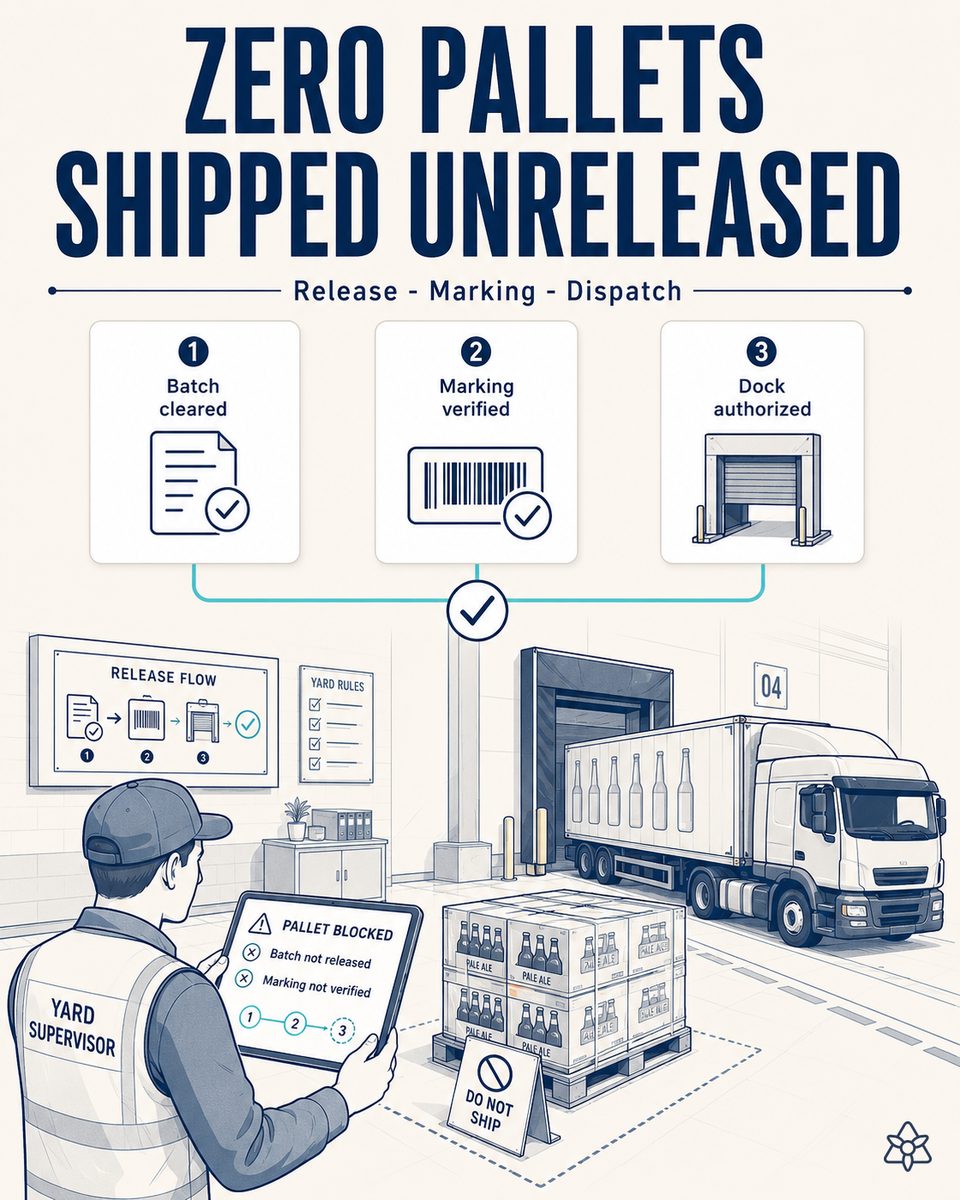
If the batch is not released or the marking does not match, the pallet does not board, and the yard supervisor sees exactly why on their tablet. Every pallet that does board does so with its dossier already assembled.
- Ring 1 · Order and lab: the active order defines brand, format, batch, expiry and destination market; lab results enter the ERP validated and batch release stops leaning on a parallel spreadsheet.
- Ring 2 · Marking: the container coder and the pallet print-and-apply labeler print exactly what the ERP publishes through the API and return confirmation of what was printed. Zero intermediate keying.
- Ring 3 · Edge and JIDOKA AI: the cameras read what the coder just printed and cross-reference it against the active order, and the changeover cameras verify the mounted label and cap. If something does not match, the line stops at that moment, not at the end of the batch.
- Ring 4 · Yard and evidence pack: before loading, the system cross-references each pallet's label against the batch release status and against the result of the previous rings. If the batch is not released or the marking does not match, the pallet does not board and the yard supervisor sees exactly why on their tablet. Every pallet that does board does so with its dossier already assembled.
- SMED AI speeds up brand changeovers so that all this coordination reinforces OEE instead of penalizing it.
Discrepancy found outside vs. discrepancy stopped inside
| Aspect | Without coordination between rings | With the flagship system |
|---|---|---|
| Where it is detected | Distribution center or market | On the line or, at the latest, at the dock |
| Product status | Already outside the plant | Still inside |
| Cost to fix | An order of magnitude higher | Moving one pallet |
| Quality release | Assumed by the system | Checked pallet by pallet |
| Pallet marking | Printed output is trusted | Cross-referenced against the active order |
| Recall risk | Real and unquantified | What the system exists to prevent |
Discrepancy detected at the distribution center or in the market, with mass rework and recall risk, to discrepancy detected on the line or, at the latest, at the dock, with the pallet still inside the plant.
Impact estimate for your plant — to validate against your incident history.
The block below is an estimate to be validated against your plant's actual data. We put it forward so the committee has an order of magnitude; we refine it during the assessment.
- High-volume brewery with several lines, several destination markets and continuous shipping.
- Indicative payback between 6 and 12 months against the first avoided incident.
- What gets counted is mass rework from wrong marking and product held at destination.
- On top of that comes protection against a recall event: hundreds of thousands of euros of direct impact, plus brand damage that is not accounted for but is paid for years.
Estimated payback 6-12 months against the first avoided incident, counting mass rework from wrong marking and product held at destination. On top of that comes protection against a recall event, in the order of hundreds of thousands of euros of direct impact plus brand damage that is not accounted for but is paid for years. *Estimate to validate* against the incident history of recent years.
And the fair question from the production manager
“What if the system blocks a pallet that was fine and holds up shipping?” — the block happens when the release status or the marking do not match, and the yard supervisor sees the exact reason on their tablet and can resolve it on the spot. Compare it with the alternative scenario, which is not smooth shipping: it is that same pallet reaching the market and being discovered there. A false block costs minutes; a false shipment costs a recall.
[1] OpenAI paper "Why Language Models Hallucinate", 2025 — on the reliability of AI in anchored tasks.
What people ask about the dock release system
Do I need the previous eleven pieces for this?
Not all of them, but yes the ones that hold up each ring. Marking stitched to the ERP is the clearest prerequisite: without it, the dock cross-check compares the system against a data point that came from keying. Validated lab entry is what stops release from leaning on a parallel spreadsheet. Edge on the line provides the third ring. It can be deployed in phases, but the order matters and it is not arbitrary.
Will this stop shipping every other day?
It should not stop anything that was fine. The block triggers when the batch is not recorded as released or when the pallet marking does not match the active order, which are two objective conditions, not a system judgment. And when it triggers, the yard supervisor sees the specific reason on their tablet and can resolve it with the truck still at the dock, which is exactly where we want the problem to appear.
What happens to the carrier's slot if there is a block?
That is why the yard ring cross-checks before loading rather than during it: the goal is to catch the problem while the pallet can still be swapped or the order reorganized, not with the truck half loaded. In practice, most blocks are resolved by swapping the affected pallet for another of the same product already released.
Why is it called flagship?
Because it is the case that coordinates the others and where you see what each separate piece was for. The previous eleven have value and payback of their own, but it is here that the whole answers the capital pain of an industrial brewery: a pallet leaving the plant that should not have left. No isolated piece prevents it; the coordination of the four rings does.
What role does SMED AI play in all this?
Making sure the coordination is not paid for in OEE. If you add verification at four points and do nothing else, the plant perceives the system as a toll. SMED AI speeds up brand changeovers, which is where a packaging line loses the most time, so the whole reinforces performance instead of penalizing it. Without that piece, the system defends itself worse internally.
More cases from this series
- The audit dossier that builds itselfPre/post photos, pasteurization curve, lab results and signatures, organized by standard. The audit…
- Marking stops depending on somebody typingBatch, expiry and destination market travel from the ERP to marking through the API, on container and on…
- Lab sheets enter the ERP on their owniLEAN reads the control sheet when it is saved and, after validation, pushes it to the ERP. Up to 80%…
- Line startup stops living on a sheet of paperThe packaging order and the startup checklist captured with a photo: the batch exists in the central…
- The twenty-year-old panel that finally speaksAn external camera reads pasteurization units off the isolated panel and cross-references them with the…
- Hands busy, voice free: shift knowledge stops dying at handoverAn earpiece under the hearing protection: the shift lead dictates while walking and iLEAN structures the…
Ask for the four-ring assessment on one of your lines and its associated dock.
We work on your plant's real data, not ours. Assessment with no commitment.
Request estimated ROI within 48h ‹ See all cases of industrial brewery See food industry