The audit dossier that builds itself
The day the auditor arrives, somebody in the plant spends one or two weeks reconstructing the traceability of the period: shift reports, lab results, who signed which cleaning. The evidence exists, but scattered. With Edge and Agents every batch and every changeover generates its own dossier, organized by certifying standard and downloadable.
The filing gets penalized, not the operation.
A high-volume brewery goes through several audits a year, internal and external, each with its own format and evidence logic: food safety, integrated quality system, environment and safety, destination market labeling requirements, internal group audit. The real process is usually impeccable, but a non-conformity is raised wherever there is a documentary gap: the filing gets penalized, not the operation. And the cost is not the audit itself, it is the week or two of an expensive team preparing it, multiplied by every audit in the year.
- Several audits a year, internal and external, each with its own format and evidence logic: food safety, integrated quality system, environment and safety, destination market labeling requirements and internal group audit.
- The real process is usually impeccable, but a non-conformity is raised wherever there is a documentary gap.
- The cost is not the audit itself: it is the week or two of an expensive team preparing it, multiplied by every audit in the year.
Edge captures the evidence at the moment it happens; Agents organizes it.
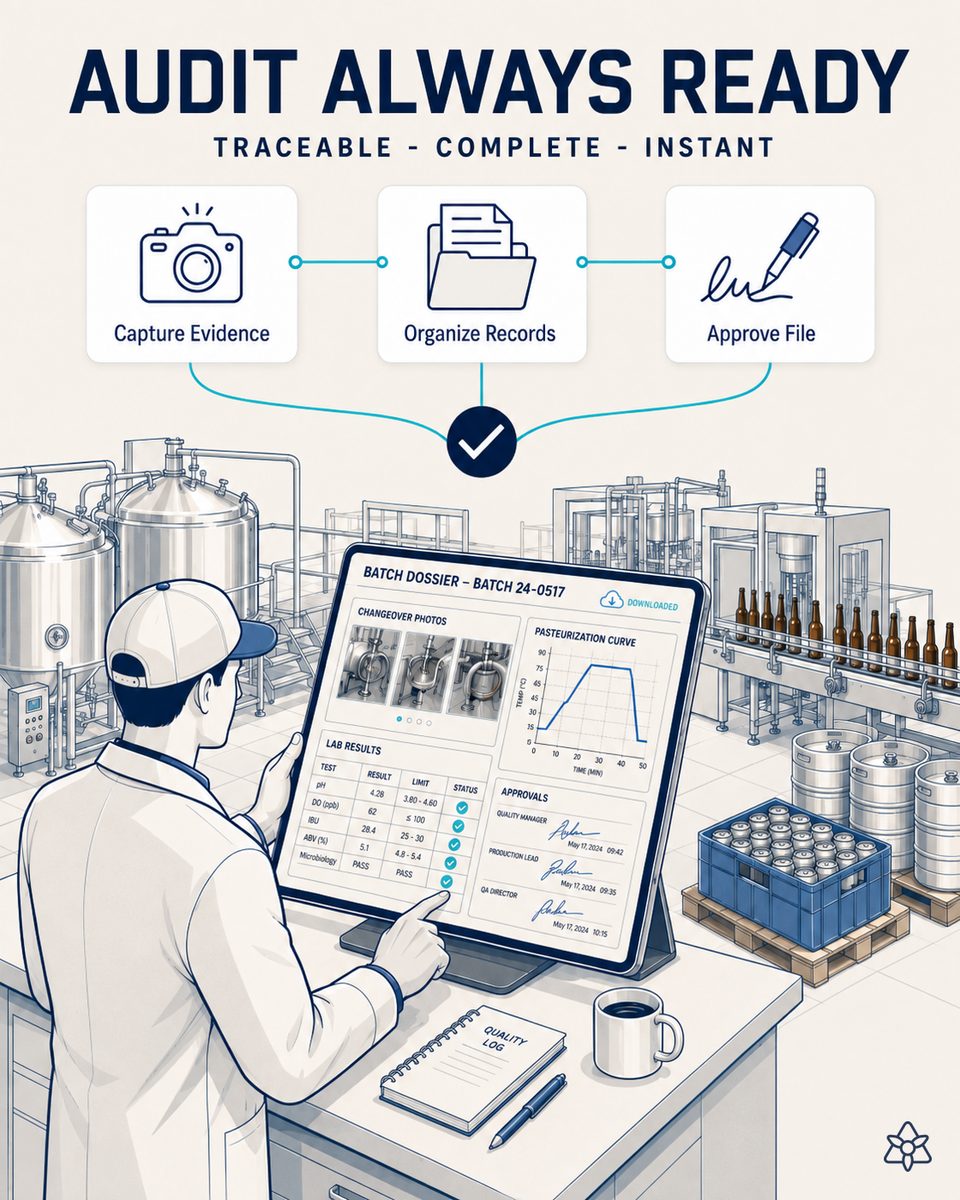
Edge captures the evidence at the moment it happens; Agents organizes it. Step by step: (1) every critical changeover generates pre and post photos of the N points, every line rejection stores its image, every batch accumulates its pasteurization curve, its lab results, its decision log and its timestamped signatures; (2) Agents knows the requirement structure of each standard and assembles the pack by period, by batch or by line, with an index; (3) the agent flags the gaps before the visit, which is the genuinely valuable part: the plant knows where its problem is with time to close it; (4) the auditor downloads the period's evidence pack without anyone in the plant spending an hour reconstructing anything.
The genuinely valuable part is not that the dossier is ready on the day of the visit. It is that the agent flags the gaps beforehand, while there is still time to close them.
- Every critical changeover generates pre and post photos of the verified points, every line rejection stores its image, and every batch accumulates its pasteurization curve, its lab results, its decision log and its timestamped signatures.
- Agents knows the requirement structure of each standard and assembles the pack by period, by batch or by line, with an index.
- The agent flags the gaps before the visit — the plant knows where its problem is with time to close it.
- The auditor downloads the evidence pack without anyone in the plant spending an hour reconstructing anything.
- Evidence is not manufactured for the audit: it is collected at the moment it happens, which is what makes it credible.
Reconstructing traceability vs. having it assembled
| Aspect | Current audit preparation | With Edge and Agents |
|---|---|---|
| Preparation time | 1-2 weeks of quality team | None |
| Source of the evidence | Reconstructed after the fact | Captured at the moment |
| Documentary gaps | Appear during the visit | Detected beforehand, with time |
| Organization | By folders, by hand | By certifying standard, with an index |
| Several audits a year | The whole effort repeats | Same material, different format |
| What the auditor sees | Whatever there was time to gather | The full period, downloadable |
1-2 weeks of reconstruction per audit to zero. Non-conformities from incomplete documentation to detected and closed before the visit.
Impact estimate for your plant — to validate against your numbers.
The block below is an estimate to be validated against your plant's actual data. We put it forward so the committee has an order of magnitude; we refine it during the assessment.
- High-volume brewery with several audits a year between internal and external.
- Indicative payback between 6 and 12 months, depending on the number of annual audits.
- What gets counted is freeing up expensive quality time, which today goes into reconstructing what already happened.
- And something that is not accounted for but weighs: protecting the certifications that enable the export channel.
Estimated payback 6-12 months depending on the number of audits per year, through freeing up expensive quality time and through protecting the certifications that enable the export channel. *Estimate to validate*.
And the fair question from the production manager
“Does a dossier assembled by AI hold up with an auditor?” — what the agent does is organize and index evidence that already exists and was captured at the moment: timestamped photos, process curves, lab results and people's signatures. It does not generate evidence or write conclusions. For an auditor that is stronger than a manual reconstruction done weeks later, because the chain is complete and dated.
[1] OpenAI paper "Why Language Models Hallucinate", 2025 — on the reliability of AI in anchored tasks.
What people ask about the automatic audit dossier
Does the AI manufacture the evidence?
No, and the distinction is critical precisely in front of an auditor. The evidence is captured by the shop floor pieces at the moment the event happens: the pre and post photo of a changeover, the image of every rejection, the batch's pasteurization curve, the lab result, the signature of whoever validated. What the Agents do is organize and index that material according to each standard's requirement structure. They do not write conclusions or fill gaps.
What happens if evidence for something is missing?
The agent flags it, and that is the most valuable function in the whole case. Today documentary gaps appear during the visit, when there is no margin left. If the system warns you weeks in advance that a given period has no recorded cleaning signature, you have time to close it or to document why. Non-conformities that get raised today simply disappear.
Does it work for several standards at once?
Yes, and that is where it pays off. The underlying material is the same; what changes between food safety, quality, environment or destination market labeling requirements is the structure it has to be presented in. The agent knows those structures and assembles a different pack from the same evidence, instead of forcing the team to redo the work for every audit.
Can it be scoped by batch, by line or by period?
By all three. An external auditor usually asks for a period; an investigation into a specific complaint asks for a batch; an internal analysis of a line asks for that line. The pack is generated with whichever cut is needed, with an index, without anybody having to go looking through folders.
Do I need the other pieces already in place for this to be useful?
The more evidence captured at the moment, the more complete the dossier: this case leans on the previous ones more than any other. With Edge on the line and lab capture already running, the pack comes out practically complete. Without them, it organizes whatever exists, which is already an improvement, but it does not reach the point of eliminating the preparation week.
More cases from this series
- Zero pallets shipped unreleased and without verified markingOrder, marking, Edge vision and yard cross-referenced before loading. If the batch is not released or…
- Marking stops depending on somebody typingBatch, expiry and destination market travel from the ERP to marking through the API, on container and on…
- Lab sheets enter the ERP on their owniLEAN reads the control sheet when it is saved and, after validation, pushes it to the ERP. Up to 80%…
- Line startup stops living on a sheet of paperThe packaging order and the startup checklist captured with a photo: the batch exists in the central…
- The twenty-year-old panel that finally speaksAn external camera reads pasteurization units off the isolated panel and cross-references them with the…
- Hands busy, voice free: shift knowledge stops dying at handoverAn earpiece under the hearing protection: the shift lead dictates while walking and iLEAN structures the…
Count the hours your quality team spent on the last audit and we will send the estimated ROI within 48h.
We work on your plant's real data, not ours. Assessment with no commitment.
Request estimated ROI within 48h ‹ See all cases of industrial brewery See food industry