Hands busy, voice free: shift knowledge stops dying at handover
The shift lead of a packaging plant spends the day walking between the machine hall, the lines, the warehouse and the yard, wearing hearing protection, hands busy and eighty-five decibels of noise around them. They cannot type, and that is why nobody asks them anything during the shift. With Connect in voice mode they dictate without stopping: iLEAN listens, structures the incident, anchors it to the active batch and line and returns support in seconds.
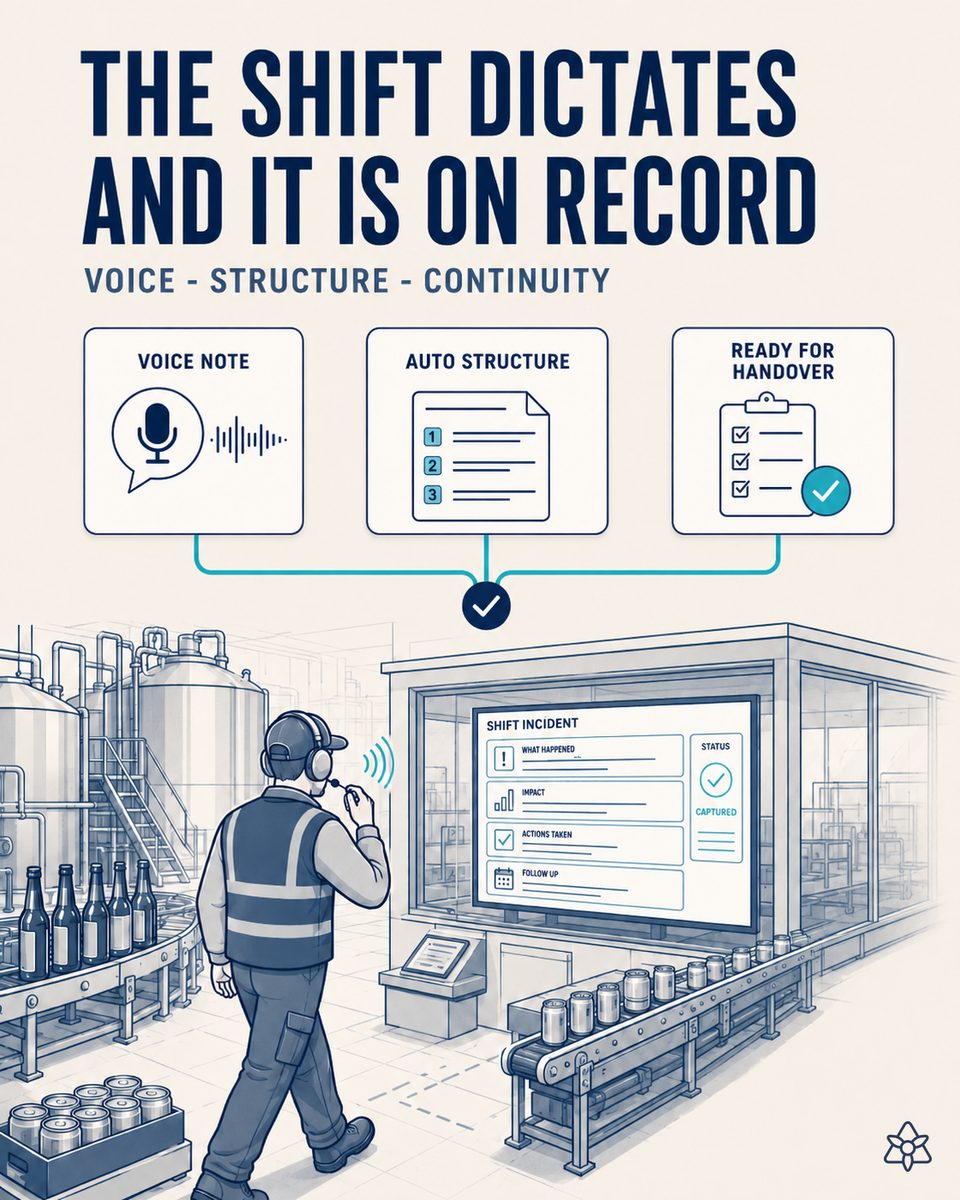
The plant's most valuable knowledge dies at the end of the shift.
The most valuable operational knowledge in a brewery lives in the heads of shift leads and people with decades in the plant. That the case packer on one line has been jamming since the last format change. That the new operator on the washer needs support. That a cap supplier has been shipping material with more variation than usual. None of that enters the system, because entering the system means sitting down to write at the end of an eight-hour shift. When those people rotate or retire, the plant relearns from scratch what it already knew.
- That the case packer on one line has been jamming since the last format change — whoever is standing there knows it, and it reaches no system.
- That the new operator on the washer needs support — mentioned at handover if there is time, and forgotten.
- That a cap supplier is shipping material with more variation than usual — spotted on the floor weeks before it shows up in any indicator.
Connect in voice mode — hands busy, voice free, and eighty-five decibels that stop being an obstacle.
Connect in voice mode. Step by step: (1) a Bluetooth earpiece under the hearing protection, with industrial noise cancellation and a wake word; (2) the shift lead dictates while walking; (3) the LLM structures the dictation as an incident and links it to the active line, shift and batch; (4) it routes it to the right role and returns confirmation by voice to the earpiece or by push to the line lead's tablet. The AI does not decide for them or replace them: it removes the toll of having to write down what they already know. Humans in command.
The shift lead dictates while walking, without stopping and without removing their hearing protection. iLEAN structures the incident, anchors it to the active line and batch, routes it to whoever it concerns and sends confirmation back to the earpiece.
- Bluetooth earpiece under the hearing protection, with industrial noise cancellation and a wake word. No need to pull out a phone or remove PPE.
- Dictation on the move — the shift lead speaks while walking between the machine hall, the lines, the warehouse and the yard.
- Automatic structuring as an incident, linked to the line, shift and batch active at that moment, which is what makes it queryable afterwards.
- Routing to the right role and confirmation back by voice to the earpiece or by notification to the line lead's tablet.
- The AI neither decides nor replaces: it removes the toll of having to write down what they already know. Humans in command.
Knowledge told at handover vs. knowledge on record
| Aspect | Current situation | With Connect voice mode |
|---|---|---|
| When it gets recorded | At the end of the shift, if there is time | On the spot, while walking |
| What it takes to record it | Sitting down to write after eight hours | Speaking |
| Link to context | None, it is loose text | Anchored to active line, shift and batch |
| Shift handover | Depends on what somebody remembers | Queryable history |
| Rotation or retirement | The plant relearns from scratch | The knowledge stays in the plant |
| Hearing protection | Makes phone use impossible | Is where the earpiece goes |
Knowledge that dies at the end of the shift to a structured incident in real time cross-referenced with live data. Handover dependent on what one person remembers to mention to handover with a queryable history.
Why this piece is not measured in payback
The block below is an estimate to be validated against your plant's actual data. We put it forward so the committee has an order of magnitude; we refine it during the assessment.
- Packaging plant on three shifts, with shift leads who spend the day walking with their hands busy.
- A full-shift trial with one section lead: what gets measured is how many incidents are recorded versus how many were recorded before.
- We do not present it as a direct saving because it is not one, and saying otherwise would be selling smoke.
- It is the piece the continuous improvement plans depend on, and the retention of plant knowledge when somebody with twenty years of service retires.
Not directly monetizable and we do not present it as such. It is the piece the continuous improvement plans and the retention of plant knowledge depend on. *Estimate to validate* with the continuous improvement manager.
And the fair question from the production manager
“What if it transcribes badly with eighty-five decibels in the background?” — the earpiece has industrial noise cancellation and recognition works over plant vocabulary, not general language. Even so, what matters is that the transcription triggers no automatic action: it structures an incident that a person will read. A transcription error here costs a correction, not a wrong decision.
[1] OpenAI paper "Why Language Models Hallucinate", 2025 — on the reliability of AI in anchored tasks.
What people ask about voice mode on the floor
Does it work with the noise of a packaging hall?
It is designed for exactly that. The earpiece sits under the hearing protection, with industrial noise cancellation, and it is triggered by a wake word so the shift lead does not have to touch anything. Recognition also works over plant vocabulary — machine names, formats, brands — rather than general language, which is where generic dictation fails in an industrial environment.
Does this record everything the person says during the shift?
No. It is triggered by a wake word and captures the dictation the shift lead chooses to make, exactly as if they pulled out a phone to write a note. It is not continuous listening and it is not a people-monitoring system, and that distinction matters both legally and for adoption: nobody uses something they perceive as an open microphone on them.
What if the shift lead does not want to use it?
That is the right question, because adoption is the real risk of this piece, not the technology. What tends to convince is not the pitch but what comes back: when you dictate something and within seconds you get the history of that machine, or a warning that this material already caused problems last month, it stops being a reporting obligation and becomes a tool that gives you something. That is why we propose trying it for a full shift before deciding anything.
How do you measure whether it works?
With a simple comparison: how many incidents were recorded in a shift with the system versus how many were recorded before. It is a number you see in the first week. What we will not do is present you with a payback in months for this piece, because on its own it does not have one and we know it.
Does it help with shift handover?
It is one of its most useful consequences. Today handover depends on what the outgoing lead remembers to say in a few minutes, with the machine running and in a hurry to leave. With the shift's incidents structured and anchored to line and batch, the incoming lead has a queryable history instead of a conversation to reconstruct from memory.
More cases from this series
- The audit dossier that builds itselfPre/post photos, pasteurization curve, lab results and signatures, organized by standard. The audit…
- Zero pallets shipped unreleased and without verified markingOrder, marking, Edge vision and yard cross-referenced before loading. If the batch is not released or…
- Marking stops depending on somebody typingBatch, expiry and destination market travel from the ERP to marking through the API, on container and on…
- Lab sheets enter the ERP on their owniLEAN reads the control sheet when it is saved and, after validation, pushes it to the ERP. Up to 80%…
- Line startup stops living on a sheet of paperThe packaging order and the startup checklist captured with a photo: the batch exists in the central…
- The twenty-year-old panel that finally speaksAn external camera reads pasteurization units off the isolated panel and cross-references them with the…
Try voice mode for a full shift with your section lead and measure how many incidents end up on record.
We work on your plant's real data, not ours. Assessment with no commitment.
Request estimated ROI within 48h ‹ See all cases of industrial brewery See food industry