The brand changeover stops being signed off blind
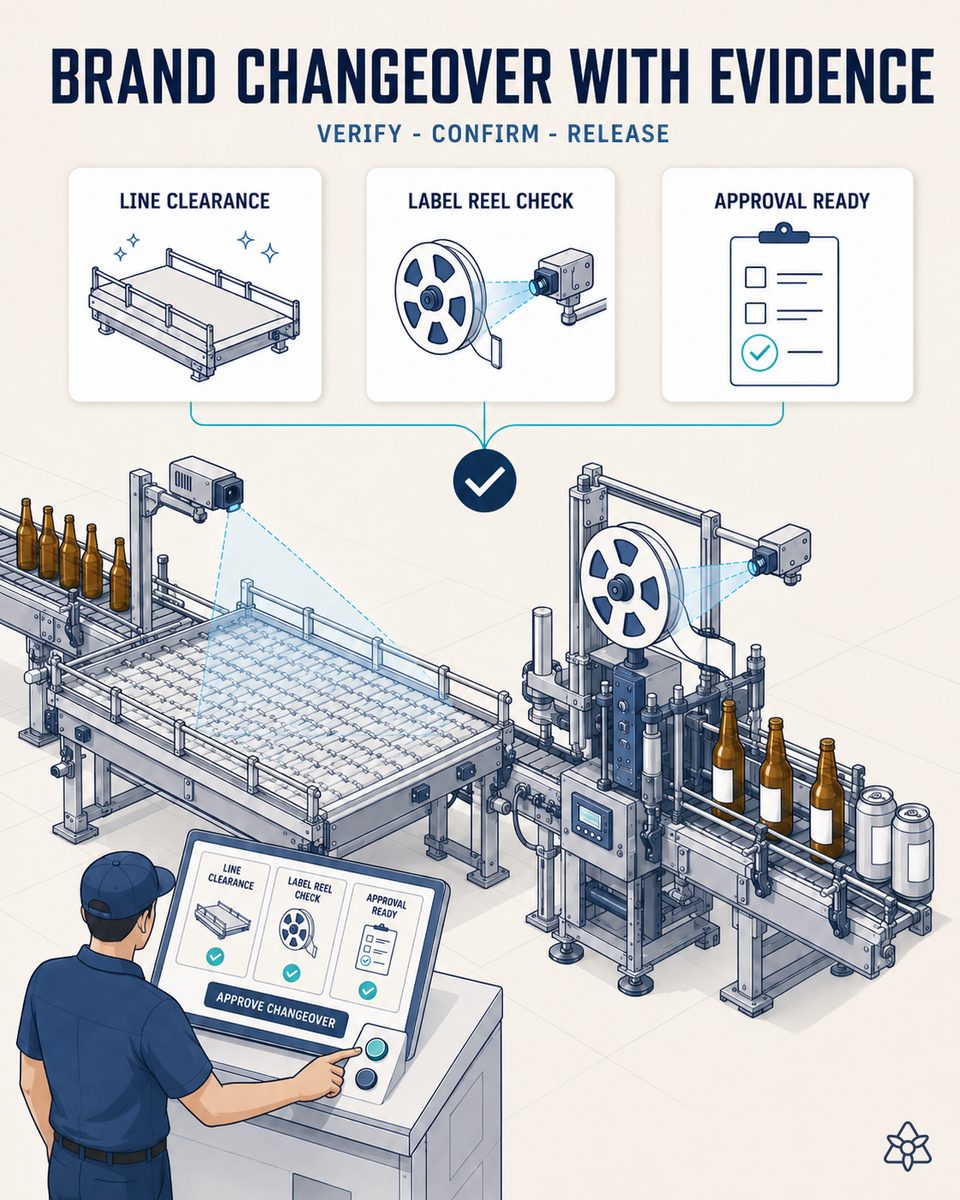
The brand or format changeover is the moment of greatest risk on a packaging line. Emptying the accumulation table, changing label reel and cap, adjusting format and closing the cleaning cycle if required. If anything is left half done, the first few thousand containers come out with the previous brand's label or cap. With Edge, fixed cameras compare every critical point against its reference state and JIDOKA AI does not allow startup until the OK and the signature.
We ask somebody to guarantee something without giving them the means.
With six or more brands sharing the same lines and several formats per brand, changeovers are constant and so is the pressure to shorten them: every minute of changeover is line downtime. Today startup depends on a person signing that everything is ready, with no objective evidence and with that pressure on them. It is not a professionalism problem, it is a problem of asking somebody to guarantee something without giving them the means. And the cost of a badly closed changeover is not the time: it is reworking thousands of mislabeled containers or holding the first batch.
- With six or more brands sharing the same lines and several formats per brand, changeovers are constant and so is the pressure to shorten them.
- Every minute of changeover is line downtime, so startup is signed off in a hurry and with no objective evidence that everything is ready.
- It is not a professionalism problem: it is a problem of asking somebody to guarantee something without giving them the means.
- The cost of a badly closed changeover is not the time: it is reworking thousands of mislabeled containers or holding the first batch.
Edge plus JIDOKA AI plus SMED AI — verification shortens the changeover instead of lengthening it.
Edge plus JIDOKA AI plus SMED AI. Step by step: (1) fixed Edge cameras at the N critical points — accumulation table, mounted label reel, cap hopper, filler infeed, case packer outfeed; (2) CNNs trained to tell a cleared table from residual containers, a correct reel from an incorrect one, a correct cap from an incorrect one; (3) confirmation of cleaning cycle completion where applicable; (4) JIDOKA AI blocks startup until every point reads OK and the quality supervisor signs on that evidence; (5) SMED AI guides the changeover sequence and flags what is missing, so that verification shortens the changeover instead of lengthening it.
Fixed cameras compare every critical point against its reference state. JIDOKA AI does not allow startup until the OK, and SMED AI guides the sequence flagging what is missing. Signing off stops being an act of faith.
- Fixed Edge cameras at the critical points — accumulation table, mounted label reel, cap hopper, filler infeed and case packer outfeed.
- Networks trained to distinguish a cleared table from residual containers, a correct reel from an incorrect one and a correct cap from an incorrect one.
- Confirmation of cleaning cycle completion where applicable, which is where false starts pile up most.
- JIDOKA AI blocks startup until every point reads OK and the quality supervisor signs on that evidence.
- SMED AI guides the changeover sequence and flags what is missing, so verification shortens the changeover instead of lengthening it.
Signing off blind vs. signing on evidence
| Aspect | Current brand changeover | With Edge and JIDOKA AI |
|---|---|---|
| Basis for the signature | One person's judgment in a hurry | Visual evidence point by point |
| Accumulation table | Glanced at | Verified: cleared or with residue |
| Label reel and cap | Checked from memory | Compared against the brand reference |
| Startup with something half done | Possible under time pressure | Blocked until the OK |
| Rework from previous label | Thousands of containers | Eliminated |
| Changeover duration | Pressured downward | Shortened by the SMED guidance |
Signing off blind under time pressure to signing on visual evidence point by point. Rework from wrong brand or label to eliminated. Changeover time to shortened by the SMED guidance.
Impact estimate for your plant — to validate against your numbers.
The block below is an estimate to be validated against your plant's actual data. We put it forward so the committee has an order of magnitude; we refine it during the assessment.
- Lines with several brands and formats sharing them, and changeovers several times per shift.
- Pilot on one line and its critical changeover points.
- Indicative payback between 4 and 10 months, depending on the number of changeovers per week.
- Two things get counted: avoided rework and recovered line time, because the SMED guidance offsets the verification time instead of adding to it.
Estimated payback 4-10 months depending on the number of changeovers per week, counting avoided rework and recovered line time. *Estimate to validate*.
And the fair question from the production manager
“Won't it block the line over anything?” — the block applies to the critical points defined with the plant, not to everything the camera sees, and each point's threshold is calibrated during the pilot. The underlying objection is reasonable: a system that over-blocks ends up being bypassed, and a bypassed system protects nothing. That is why SMED AI exists: if verification also shortens the changeover, it stops being a toll.
[1] OpenAI paper "Why Language Models Hallucinate", 2025 — on the reliability of AI in anchored tasks.
What people ask about validating changeovers with vision
Can JIDOKA AI stop the line on its own?
It blocks startup after a changeover until the critical points read OK; it does not interrupt steady-state production or make decisions on the fly. And startup is not authorized by the system: it is authorized by the quality supervisor signing on the evidence the system has gathered. The machine provides the check; the person keeps the final word.
Doesn't this lengthen the changeover?
That is the objection to answer well, because every minute of changeover is line downtime. The verification itself takes seconds. And SMED AI exists precisely to offset it: it guides the changeover sequence and flags at every moment what is missing, which is where time is actually lost — in back-and-forth, in checking the same thing twice and in waiting for somebody to confirm something. The goal is a shorter changeover, not a longer one.
Which points exactly get verified?
They are defined with the plant, because they depend on the line. The usual ones are the accumulation table (cleared or with residual containers from the previous brand), the mounted label reel, the cap hopper, the filler infeed and the case packer outfeed. If a cleaning cycle applies between brands, confirmation that it has finished is added.
What if an operator decides to bypass the block?
That is the real risk of any system of this kind, which is why the design matters more than the technology. If the system over-blocks or blocks for reasons the floor perceives as absurd, it ends up being bypassed and stops protecting anything. Hence the thresholds are calibrated during the pilot with the line crew, and the scope is limited to the points where failure has real consequences.
Does it work with very similar formats across brands?
That is where it adds the most, because it is where the human eye fails most easily: two nearly identical label reels or two caps of the same color with different embossing. The network is trained on your plant's real references, and those specific confusions are exactly the training material we ask for.
More cases from this series
- The audit dossier that builds itselfPre/post photos, pasteurization curve, lab results and signatures, organized by standard. The audit…
- Zero pallets shipped unreleased and without verified markingOrder, marking, Edge vision and yard cross-referenced before loading. If the batch is not released or…
- Marking stops depending on somebody typingBatch, expiry and destination market travel from the ERP to marking through the API, on container and on…
- Lab sheets enter the ERP on their owniLEAN reads the control sheet when it is saved and, after validation, pushes it to the ERP. Up to 80%…
- Line startup stops living on a sheet of paperThe packaging order and the startup checklist captured with a photo: the batch exists in the central…
- The twenty-year-old panel that finally speaksAn external camera reads pasteurization units off the isolated panel and cross-references them with the…
Count the brand changeovers in one week on your lines and we will send within 48h the associated rework and estimated ROI.
We work on your plant's real data, not ours. Assessment with no commitment.
Request estimated ROI within 48h ‹ See all cases of industrial brewery See food industry