The yard stops losing hours to keying
A brewery yard never stops: trucks come in with packaging material, trucks go out with finished product, and in between the returnable packaging comes back from the market. Today the receiving supervisor signs the delivery note and then keys it line by line while the carrier waits, charging demurrage. With Connect a photo of the delivery note and the pallet labels is enough; the same camera counts the returnables and proposes the entry.
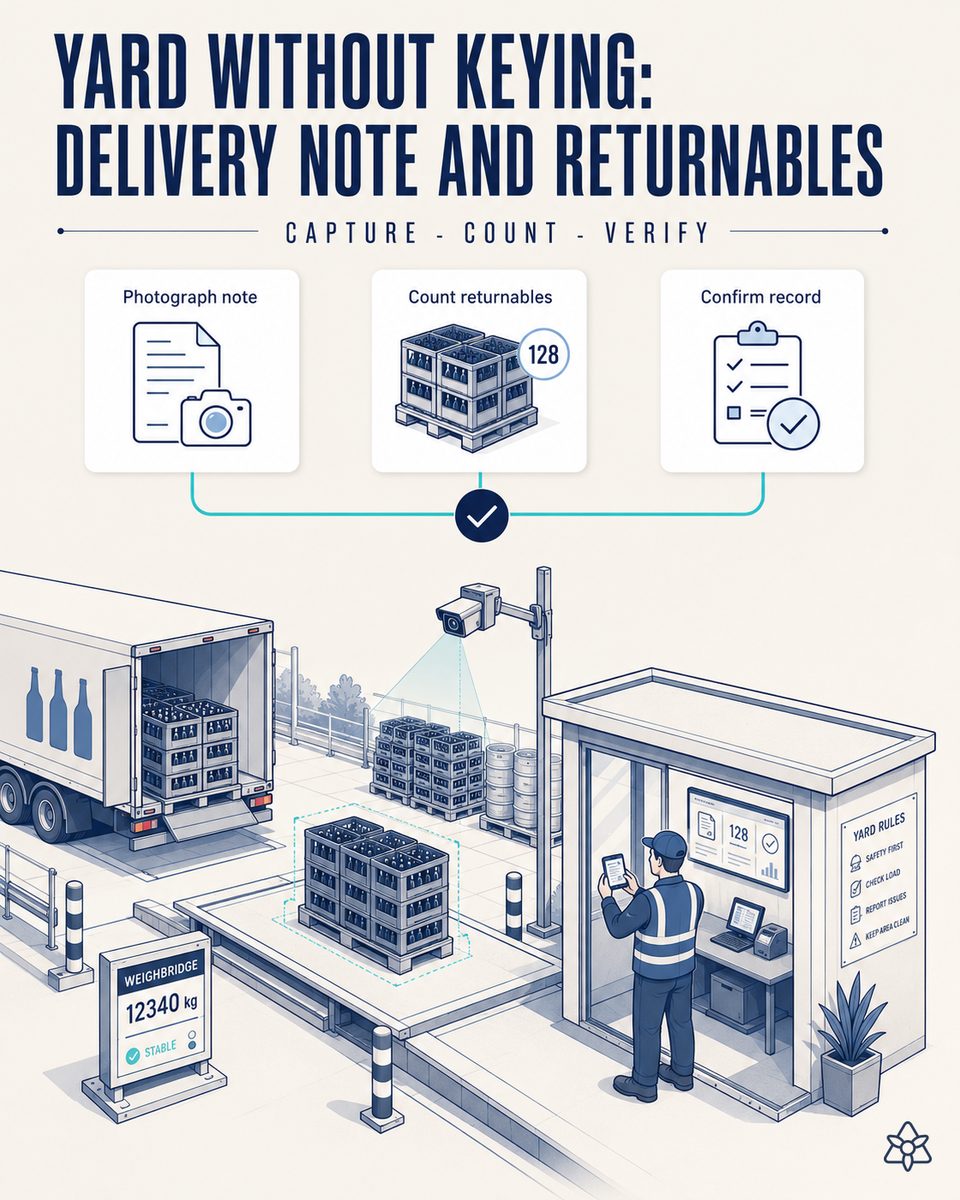
The carrier waits, charging demurrage, while somebody types.
Between thirty and sixty minutes of waiting per truck while somebody enters the delivery note into the ERP. And if it is keyed fast so as not to keep the carrier waiting, the material batch enters wrong: that discrepancy is not visible that day, it appears weeks later in a quality investigation nobody can close anymore. With returnable packaging the problem is of a different nature and a larger size: empty bottles and crates coming back from the market are counted by eye onto a sheet of paper and reconciled days later. It is a high-value asset that moves outside the four walls of the warehouse, and its imbalance is detected when it is already impossible to reconstruct what happened.
- Between thirty and sixty minutes of waiting per truck while the delivery note is entered into the ERP, line by line.
- If it is keyed fast so as not to keep the carrier waiting, the material batch enters wrong, and that discrepancy does not surface that day: it surfaces weeks later in a quality investigation nobody can close anymore.
- Returnable packaging is a bigger problem: bottles and crates come back from the market, are counted by eye onto paper and reconciled days later. A high-value asset that moves outside the four walls of the warehouse.
Connect in photo-the-analog mode toward the ERP — the supplier's delivery note exactly as they send it.
Connect in photo-the-analog mode toward the ERP. Step by step: (1) photo of the supplier delivery note — AI vision recognizes each supplier's format without asking any of them to change it and extracts the tabular structure; (2) photo of the pallet labels, reading GS1-128, QR, barcode or plain OCR; (3) for returnables, visual counting of pallets and crates by size plus damaged-container detection; (4) summary on the weighbridge cabin tablet and validation with one tap; (5) automatic push to the ERP warehouse module through the API.
One photo of the delivery note and another of the pallet labels. The same camera counts the returnables by size and spots damaged containers. One validation tap in the cabin and the material is in the ERP. The truck leaves.
- Photo of the supplier delivery note — vision recognizes each supplier's format without asking any of them to change it, and extracts the tabular structure.
- Photo of the pallet labels, reading GS1-128, QR, barcode or plain OCR depending on what each one carries.
- Visual counting of returnables by size, with damaged-container detection, at the moment of unloading and with the image as evidence.
- Summary on the weighbridge cabin tablet and validation with one tap.
- Automatic push to the ERP warehouse module through the API, already carrying the signature of whoever validated.
Keyed receiving vs. captured receiving
| Aspect | Current receiving | With iLEAN Connect |
|---|---|---|
| Truck time in the yard | 30-60 min | 5 min |
| Delivery note entry | Keyed line by line | Photo and one validation tap |
| Material batch error | Surfaces weeks later | Corrected before entry |
| Returnable counting | By eye, onto paper | Visual, by size, with an image |
| Returnable reconciliation | Days later, unreconstructable | At the moment of unloading |
| Invoiced demurrage | Assumed as a fixed cost | Falls with yard time |
Truck turnaround of 30-60 min to 5 min. Hidden material batch errors to zero. Returnable counting estimated and reconciled days later to counting evidenced by photo at the moment of unloading.
Impact estimate for your plant — to validate against your numbers.
The block below is an estimate to be validated against your plant's actual data. We put it forward so the committee has an order of magnitude; we refine it during the assessment.
- Yard with continuous inbound packaging material, outbound finished product and returnables coming back from the market.
- The receiving and warehouse module typically charges 3-4 active users per shift: receiving supervisor, clerical support, supervisor and weighbridge.
- With Connect only the supervisor validates, with one tap, without logging into the ERP. Typical reduction of 50-70% in receiving and warehouse module licenses, plus the saving on mass-capture modules and dedicated terminals.
- Indicative payback between 3 and 8 months, also counting the direct saving on invoiced carrier demurrage.
The receiving and warehouse module typically charges 3-4 active users per shift (receiving supervisor, clerical support, supervisor, weighbridge); with Connect only the supervisor validates, with one tap, without logging into the ERP. Typical reduction of 50-70% in receiving and warehouse module licenses, plus the saving on mass-capture modules and dedicated terminals, plus the direct saving on carrier demurrage. Estimated payback 3-8 months. *Estimate to validate*.
And the fair question from the production manager
“What if it misreads a quantity on the delivery note and stock enters wrong?” — extracting a table from a delivery note is an anchored task over a structured document, where the best models drop below 1.5% error [1]. And above all: today's keying error under time pressure is far more frequent than that, and it is discovered weeks later. Here the summary is validated in the cabin with the truck still in front of you.
[1] OpenAI paper "Why Language Models Hallucinate", 2025 — on the reliability of AI in anchored tasks.
What people ask about digitizing receiving and returnables
Do suppliers have to use a common delivery note format?
No, and that is what makes the case viable. Every supplier sends their delivery note however they want, and standardizing formats is an endless project that you do not even control. Vision recognizes the tabular structure of the document rather than relying on fixed-coordinate templates, so it lives with different delivery notes per supplier from day one.
How do you count returnable packaging with a camera?
By visually counting pallets and crates at the moment of unloading, distinguishing sizes and flagging damaged containers. What matters is not only the number: it is that the image remains as evidence. Today a returnable imbalance is detected days later, when it is already impossible to reconstruct what actually arrived on each truck; with the unloading photo, it can be.
Does this replace the warehouse RF terminal?
At the receiving point, largely yes, and part of the saving is there: beyond user licenses, mass-capture modules and dedicated terminals that existed only for this step tend to disappear. In the rest of the warehouse it touches nothing: this is not a project to replace your warehouse system, it is removing the keying from the point where the truck waits.
Who validates in the yard?
The receiving supervisor, from the weighbridge cabin tablet, with one tap on a visual summary. The difference from today is that they validate instead of typing: they see what was read from the delivery note and the pallets, and confirm or correct. The rest of the team stops needing ERP access for this task.
How much real time is saved per truck?
The target is going from thirty or sixty minutes to about five. The range depends on how many lines the delivery note has and whether returnables arrive mixed by size. It is worth measuring first: most plants do not have the figure for how long a truck spends in the yard or how much demurrage is invoiced per month, and that number tends to be a surprise.
More cases from this series
- The audit dossier that builds itselfPre/post photos, pasteurization curve, lab results and signatures, organized by standard. The audit…
- Zero pallets shipped unreleased and without verified markingOrder, marking, Edge vision and yard cross-referenced before loading. If the batch is not released or…
- Marking stops depending on somebody typingBatch, expiry and destination market travel from the ERP to marking through the API, on container and on…
- Lab sheets enter the ERP on their owniLEAN reads the control sheet when it is saved and, after validation, pushes it to the ERP. Up to 80%…
- Line startup stops living on a sheet of paperThe packaging order and the startup checklist captured with a photo: the batch exists in the central…
- The twenty-year-old panel that finally speaksAn external camera reads pasteurization units off the isolated panel and cross-references them with the…
Measure how many demurrage hours your yard invoices per month and we will send within 48h the estimated ROI of removing the keying.
We work on your plant's real data, not ours. Assessment with no commitment.
Request estimated ROI within 48h ‹ See all cases of industrial brewery See food industry