The human gate that makes all plant AI signable
An autonomous AI agent writes into your systems on its own. iLEAN does not: nothing it captures enters the ERP master record without a human having seen it first. In a brewery that takes the form of an industrial tablet at each line and another in the weighbridge cabin, with a two-second visual summary and two buttons: confirm or correct.
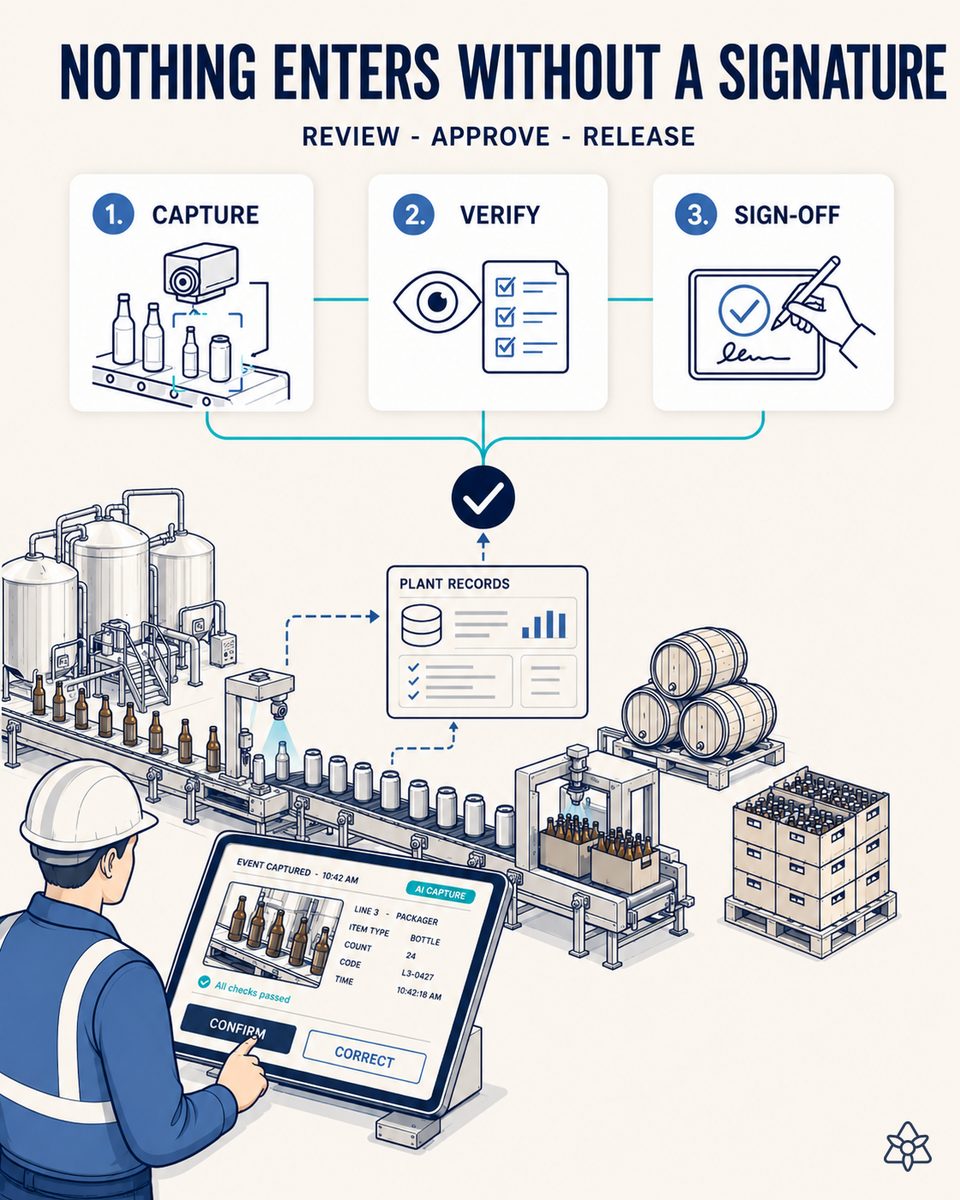
Two opposite objections that have to be solved at once or there is no project.
In a plant that already has serious corporate systems, the brake on AI is not technical but data governance: if the AI starts writing into the master record, who answers when it is wrong? It is a fair objection and the IT function always raises it. Facing it is the opposite objection, from the floor: the operator does not want to type and will not adopt anything that adds work. Without solving both at once, no capture project reaches production.
- The IT one: if the AI starts writing into the master record, who answers when it is wrong? It is a fair objection and it always comes up.
- The shop floor one: the operator does not want to type and will not adopt anything that adds work on top of their shift.
- Without solving both at once, no capture project reaches production: it stays a permanent pilot or dies in committee.
A tablet at the line, a two-second summary and two buttons.
Connect in early human verification mode. Step by step: (1) every capture — order photo, panel reading, parsed email, voice dictation, lab sheet — is summarized visually; (2) the summary appears on the industrial tablet at the line or in the weighbridge cabin; (3) the supervisor confirms with two taps (✓ it enters / ✏️ correct before entry); (4) only then does the data cross into the central system, with a record of who signed and when. The interface is designed to validate in two seconds, not to enter data.
An autonomous agent writes into your systems on its own. iLEAN does not: nothing enters the master record without a human having seen it. The interface is designed to validate in two seconds, not to enter data.
- Every capture is summarized visually — order photo, panel reading, parsed email, voice dictation or lab sheet. It does not matter where it came from.
- The summary appears where the person is: the industrial tablet at the line or in the weighbridge cabin, not an email somebody will open tomorrow.
- Two taps: confirm that it enters, or correct before it enters. Nothing else.
- Only then does it cross into the central system, with a record of who signed and when. Signature traceability is what answers the IT question.
- Designed to validate, not to type — two seconds of attention, which is what answers the shop floor question.
Autonomous agent vs. early human verification
| Aspect | AI writing to the master on its own | With early human verification |
|---|---|---|
| Who is accountable | Nobody clearly | The person who signed, with a timestamp |
| IT committee approval | Hard to get | Data governance is settled |
| Load on the operator | None, but no control either | Two taps per capture |
| Bad data in the master | Found weeks later | Corrected before it enters |
| Traceability | Technical log | Signature with owner and time |
| Shop floor adoption | Distrust | The operator sees and decides |
Either unvalidated data polluting the master record, or data not captured out of distrust, to data captured and validated within seconds with signature traceability.
Why this piece is an enabler and does not sell on its own
The block below is an estimate to be validated against your plant's actual data. We put it forward so the committee has an order of magnitude; we refine it during the assessment.
- It has no standalone payback and we are not going to invent one: by itself it saves nothing.
- It is the requirement for the other eleven pieces to be approved by an IT committee.
- Its value is measured by what it unlocks, not by what it saves.
- It is also what makes the floor adopt it: the operator does not lose control of what enters the system with their name on it.
An enabling piece, not monetizable in isolation. Without it, the other eleven pieces do not get approved by an IT committee. *Strategic value*.
And the fair question from the production manager
“Isn't this putting manual work back into the process?” — it is the right question and the answer is in the interface design. Validating is not typing: the screen shows a visual summary meant to be read in two seconds and it is resolved with one tap. What is removed is data entry; what is kept is the human decision, which is precisely what nobody wants to delegate to a machine.
[1] OpenAI paper "Why Language Models Hallucinate", 2025 — on the reliability of AI in anchored tasks.
What people ask about governing the data AI captures
Why not let the AI write directly?
Because the question of who answers when the data is wrong has no good answer if nobody has seen it. In a plant with serious corporate systems, the master record feeds production, quality, warehouse and finance: bad data does not sit still, it propagates. Early human verification costs two seconds per capture and turns a diffuse risk into a signature with a name and a timestamp.
Doesn't this slow the capture down?
The capture is instant; what is added is a two-second validation. Compare it with the real alternative, which is not “zero friction” but somebody retyping the data by hand hours or days later. Verification does not compete with full automation: it competes with clerical retyping, and there it wins by an order of magnitude.
Where is the tablet physically?
Where the person who can validate is: at each packaging line and in the yard weighbridge cabin. Not in an office, because then validation piles up and stops being early. The location is part of the design, not a deployment detail.
What if the supervisor does not validate?
The data does not enter the master record. It stays in the verification queue, visible, and the system does not accept it by administrative silence. This is deliberate: a system that assumes validation by default after a timeout ends up being a system with no validation, and the guarantee we give IT would stop being true.
How do you demonstrate it to an auditor?
Every data point that entered the system carries who validated it and when, plus the original capture it came from. For an auditor that is better evidence than a manual transcription, because the chain is complete: the source document exists, the reading exists and the signature of whoever accepted it exists.
More cases from this series
- The audit dossier that builds itselfPre/post photos, pasteurization curve, lab results and signatures, organized by standard. The audit…
- Zero pallets shipped unreleased and without verified markingOrder, marking, Edge vision and yard cross-referenced before loading. If the batch is not released or…
- Marking stops depending on somebody typingBatch, expiry and destination market travel from the ERP to marking through the API, on container and on…
- Lab sheets enter the ERP on their owniLEAN reads the control sheet when it is saved and, after validation, pushes it to the ERP. Up to 80%…
- Line startup stops living on a sheet of paperThe packaging order and the startup checklist captured with a photo: the batch exists in the central…
- The twenty-year-old panel that finally speaksAn external camera reads pasteurization units off the isolated panel and cross-references them with the…
Tell us how your plant governs the data entering the ERP today and we will show you how early human verification fits.
We work on your plant's real data, not ours. Assessment with no commitment.
Request estimated ROI within 48h ‹ See all cases of industrial brewery See food industry