The email that prevents a changeover made in vain
In a brewery, packaging material governs the schedule: no label, no brand. Delay notices arrive by email or WhatsApp to one specific person, who reads them when they can — often once the changeover is already scheduled and the line prepared. Connect sits in silent copy, reads the alert at second zero, cross-references it with the schedule and stock, and returns the concrete action to the planner and the shift lead.
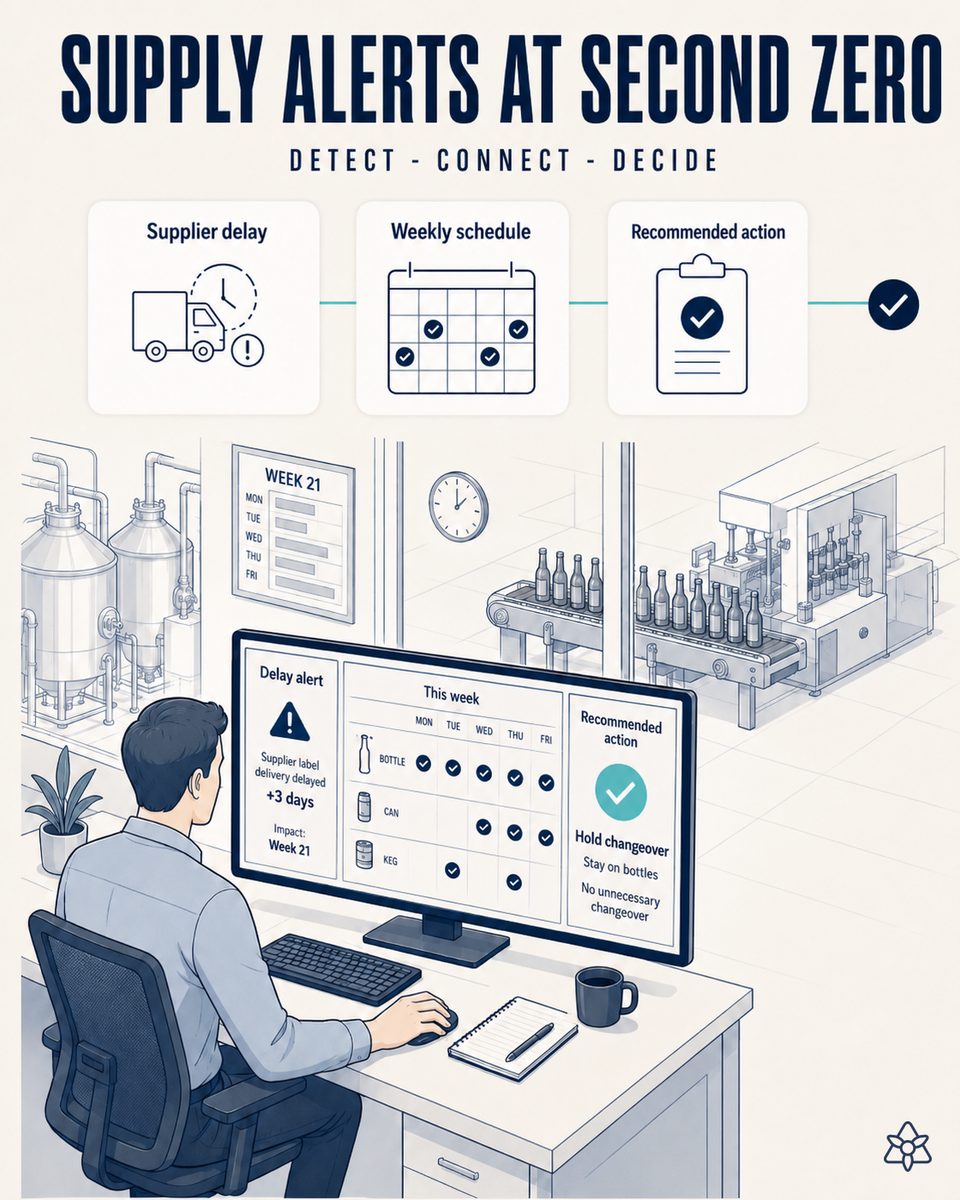
The information that would have prevented the stoppage was in an email from first thing.
A brand changeover on a high-cadence line costs between one and three hours of line downtime. Preparing it with material that will not arrive means paying for that changeover twice, and the information that would have prevented it sat in an email from first thing in the morning. The mirror case is the carrier who texts to say they will miss their yard slot: the dock stands empty, the next unit waits and the yard accumulates demurrage that gets invoiced.
- A brand changeover costs one to three hours of line downtime. Preparing it with material that will not arrive means paying for it twice.
- The alert reaches one specific person, by email or WhatsApp, and gets read when that person can — often once the changeover is scheduled and the line prepared.
- The mirror case is the yard: the carrier warns they will miss their slot, the dock stands empty, the next unit waits and demurrage gets invoiced.
Connect in chaotic-sources mode — it reads a mailbox, not people, and returns action instead of notification.
Connect in chaotic-sources mode. Step by step: (1) a corporate mailbox dedicated to suppliers and a WhatsApp Business number sit in silent copy 24/7 — the system reads a mailbox, it does not watch people or enter personal inboxes; (2) the LLM extracts intent (supply delay, slot change, material non-conformity) and entities (supplier, material, quantity, date); (3) it cross-references them with the packaging schedule and live ERP stock; (4) it returns a concrete action to the right role — which brand to bring forward, which line to reschedule, which yard slot to move — not a notification that an email has arrived.
The system sits in silent copy of a corporate mailbox. It extracts intent and entities, cross-references them with the packaging schedule and live stock, and tells the planner which brand to bring forward and which slot to move. It does not announce that an email arrived: it says what to do about it.
- A dedicated corporate mailbox and a WhatsApp Business number sit in silent copy 24/7. The nuance matters: the system reads a company mailbox, it does not watch people or enter personal inboxes.
- Intent extraction — supply delay, yard slot change, material non-conformity — and entities: supplier, material, quantity, date.
- Cross-reference with the packaging schedule and live ERP stock, which is what separates a summary from a decision.
- A concrete action returned to the right role: which brand to bring forward, which line to reschedule, which yard slot to move.
- Without changing the supplier's channel — nobody has to ask a supplier to stop sending emails or a carrier to stop sending voice notes.
Alert read when somebody can vs. alert processed at second zero
| Aspect | Current alert handling | With iLEAN Connect |
|---|---|---|
| Latency to action | 2-5 h of human latency | Seconds |
| Depends on | One specific person opening the email | A mailbox read 24/7 |
| What reaches the planner | The forwarded email | The concrete action, already cross-referenced |
| Changeover made in vain | Discovered while preparing the line | Avoided before scheduling it |
| Missed yard slot | Empty dock and invoiced demurrage | Rescheduled while the slot is still usable |
| Supplier channel | Email and WhatsApp, unchanged | Email and WhatsApp, unchanged |
2-5 h of human latency to seconds. Rescheduling based on what somebody read hours ago to rescheduling with current data. Changeovers prepared in vain to changeovers avoided.
Impact estimate for your plant — to validate against your numbers.
The block below is an estimate to be validated against your plant's actual data. We put it forward so the committee has an order of magnitude; we refine it during the assessment.
- Brewery with several brands sharing lines and a constant flow of packaging material alerts.
- Pilot on the packaging supplier mailbox, which is where the material that governs the schedule lives: no label, no brand.
- Indicative payback between 3 and 7 months, depending on the frequency of critical alerts and the cost per line-hour.
- Two things get counted: line stoppages avoided from changeovers prepared in vain and carrier demurrage not incurred in the yard.
Estimated payback 3-7 months depending on the frequency of critical alerts and the cost per line-hour, counting avoided line stoppages and carrier demurrage not incurred. *Estimate to validate*.
And the fair question from the production manager
“What if the system misreads an email and reschedules a line wrongly?” — it reschedules nothing on its own: it proposes to the planner, who decides. The AI task here is anchored — extracting supplier, material, quantity and date from a text — and in that kind of task the best models dropped below 1.5% error [1]. What changes is not who decides, but when they find out there is something to decide.
[1] OpenAI paper "Why Language Models Hallucinate", 2025 — on the reliability of AI in anchored tasks.
What people ask about reading supplier alerts with AI
Does this read my people's email?
No, and the distinction is deliberate because it is the first objection raised and it is a fair one. Connect is copied on a dedicated corporate mailbox for suppliers, of the orders@ or suppliers@ kind, and on a company WhatsApp Business number. It does not enter personal inboxes, does not read private conversations and does not watch people: it reads a company channel that already exists and that somebody on the team checks manually today.
Do suppliers have to change how they send alerts?
No, and that is exactly what makes the case viable. Any project that starts with “all suppliers must use our portal” dies in the attempt, because the small supplier will not use it and the large one has its own system. Connect works with whatever arrives: prose emails, an attached PDF, a WhatsApp message or a voice note. The input stays chaotic; what gets organized is the handling.
How is this different from a mail rule or an alert?
A rule tells you an email arrived; this tells you what to do about it. The difference is the cross-reference: the alert is checked against the packaging schedule and live stock, so the output is not “label supplier delay”, it is “the brand scheduled for the night shift on line 3 does not have enough label stock, proposal: bring Thursday's brand forward and move the changeover”. That is already a decision somebody can approve in a minute.
Who makes the final call?
The planner or the shift lead, always. The system does not reschedule lines or move yard slots on its own: it prepares the proposal with the cross-referenced data and puts it in front of whoever holds the responsibility. Humans in command is not a slogan here — it is what lets the planning function adopt the tool instead of defending itself against it.
How long until it is running?
A pilot on a single mailbox is set up in weeks, not quarters, because there is no integration with the supplier's system and no development on their side: it is a matter of reading a channel that already exists. What takes a little longer is tuning the cross-reference with the packaging schedule, because that does require understanding how your planning works.
More cases from this series
- The audit dossier that builds itselfPre/post photos, pasteurization curve, lab results and signatures, organized by standard. The audit…
- Zero pallets shipped unreleased and without verified markingOrder, marking, Edge vision and yard cross-referenced before loading. If the batch is not released or…
- Marking stops depending on somebody typingBatch, expiry and destination market travel from the ERP to marking through the API, on container and on…
- Lab sheets enter the ERP on their owniLEAN reads the control sheet when it is saved and, after validation, pushes it to the ERP. Up to 80%…
- Line startup stops living on a sheet of paperThe packaging order and the startup checklist captured with a photo: the batch exists in the central…
- The twenty-year-old panel that finally speaksAn external camera reads pasteurization units off the isolated panel and cross-references them with the…
Tell us your case and we will send within 48h the estimated ROI of putting iLEAN in copy of your supplier mailbox.
We work on your plant's real data, not ours. Assessment with no commitment.
Request estimated ROI within 48h ‹ See all cases of industrial brewery See food industry