Zero unplanned downtime
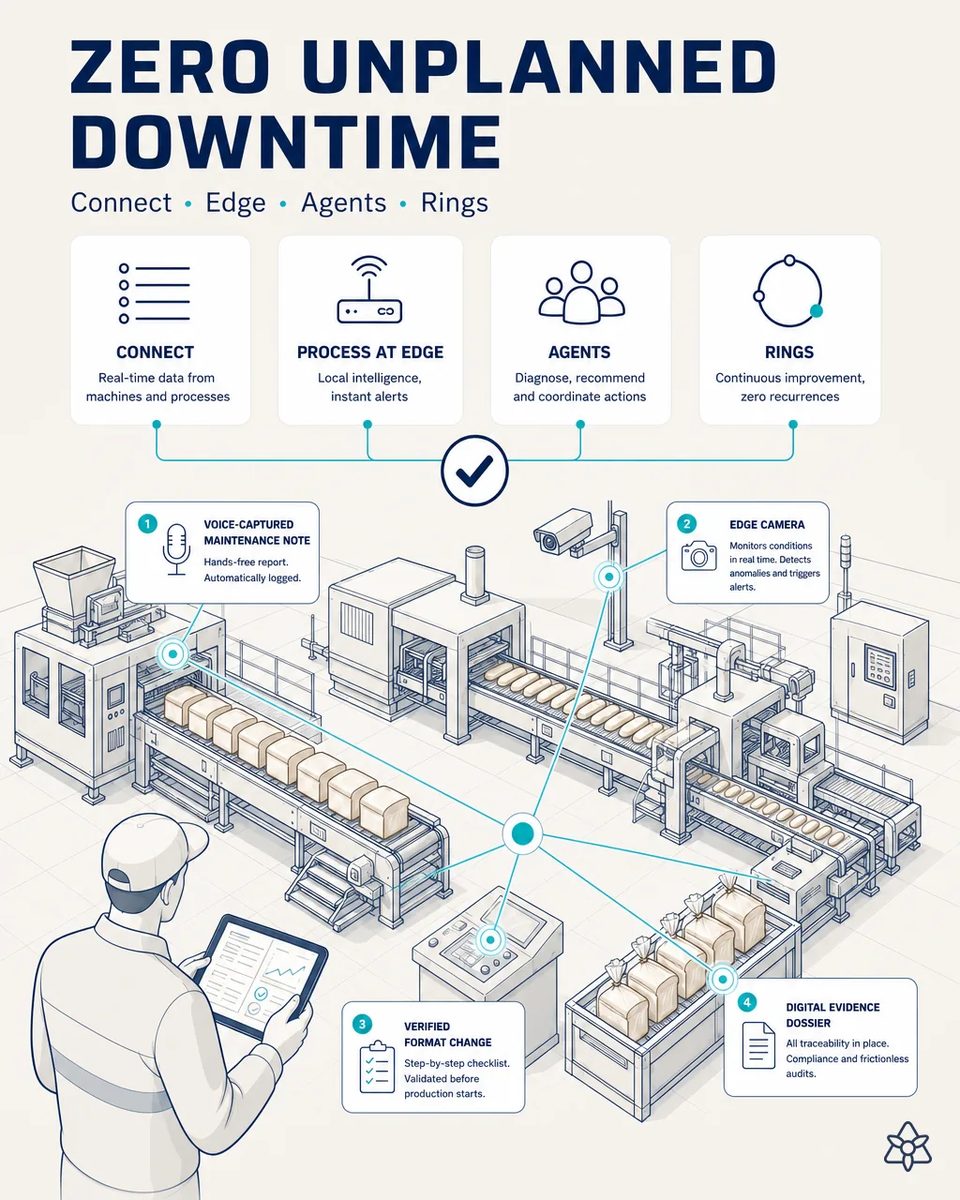
Every minute of unplanned downtime on a 15,000-unit/hour line is production gone for good. The iLEAN system coordinates four rings that cross-check each other — shift-leader voice input, maintenance-history integration, Edge visual verification, and an evidence dossier — to catch a deviation before it becomes a stoppage.
On a line making 15,000 units an hour, a stopped minute never comes back.
Unplanned downtime on high-cadence lines is the sub-sector's biggest operational and economic risk. Every relevant incident costs unrecoverable lost production, plus emergency corrective maintenance, plus the risk of missing a major retail order.
- Unplanned downtime on high-cadence lines is the sub-sector's biggest operational and economic risk. Every minute stopped is production gone for good, not deferred.
- Each relevant incident adds emergency corrective maintenance on the mixer, the tunnel oven or the slicer, at the worst price and with whatever spare is at hand. Dough already mixed or proofing is lost along with the run.
- And with short-shelf-life bread, a lost run can mean missing a major retail order that cannot be made up the next day.
- The warning signs were there — a noise, an off-weight startup, a changeover that never settled — but each lived in a different place and nobody joined them until the line was already down.
Four rings that verify each other — the eleven cases above, coordinated.
Ring 1 (Connect, cases 1 and 4): the startup log and issues dictated by the shift leader capture early deviation symptoms. Ring 2 (legacy integration, case 8): maintenance history is stitched to the ERP and the active Production Order. Ring 3 (Edge, cases 9 and 10): the line camera confirms the product is correct and that a format change started up well; if something doesn't match, JIDOKA AI alerts or blocks before the deviation spreads. Ring 4 (Agents, case 11): every intervention and format change gets documented, feeding root-cause analysis. SMED AI speeds up format changes so the coordination doesn't cost productivity.
No single ring prevents a stoppage. The strength is in the cross-check: a symptom dictated by the shift leader, the asset's maintenance history and what the camera sees on the belt, pointing at the same place before the line stops. When independent sources start to agree on a problem, that is the moment to act.
The four rings against unplanned downtime
| Ring | Cases it draws on | What it catches |
|---|---|---|
| 1 · Early symptoms | Line startup (1) + shift leader headset (4) | Startup settings and noises before they become faults |
| 2 · Maintenance memory | Integration via API, as with the coder (8) | Asset history tied to the ERP and the active order |
| 3 · Product on the belt | Defect vision (9) + format change (10) | A deviation JIDOKA AI alerts on or blocks before it spreads |
| 4 · Documented cause | Audit evidence pack (11) | Every intervention recorded for root-cause analysis |
| SMED AI | Format changeovers (10) | Faster changes, so coordination costs no output |
| Rings pointing different ways | All of the above | A person decides on the combined evidence |
Impact estimate — to be validated with maintenance and operations leadership.
The block below is an estimate to be validated against your plant's actual data. We put it forward so the committee has an order of magnitude; we refine it during the assessment.
- Estimated payback 6-12 months, counted against the first relevant stoppage avoided.
- Improved OEE on the covered lines, because recurring stoppages are caught in the process instead of corrected after the line stops.
- Lower emergency corrective maintenance cost, shifting spend toward planned and predictive work scheduled outside production hours.
- And less risk of missing a major retail order because a line went down on the wrong morning. Operations and maintenance leadership are the right people to put the final number on it, line by line.
Improved OEE on covered lines, reduced emergency corrective maintenance cost versus predictive. Estimated payback of 6 to 12 months against the first relevant stoppage avoided. Estimate to validate with the maintenance manager and operations leadership.
And the fair question from the production manager
“Do we have to deploy all twelve cases before this does anything?” — no, and framing it that way would be the way never to start. The rings are built in layers and most cases pay on their own. With line startup and the shift leader's headset you already have ring 1. Where rings cross-check, matching a symptom to an asset's history is an anchored task, where the best models drop below 1.5% error [1], and a person decides.
[1] OpenAI paper "Why Language Models Hallucinate", 2025 — on the reliability of AI in anchored tasks.
What people ask about the zero-downtime system
Which case should a bakery start with?
Usually line startup or the shift leader's headset: few dependencies, short deployment and ring 1 is in place from the first weeks. The other rings are added as each one proves its value on your own lines.
Does JIDOKA AI stop the line on every doubt?
No. It alerts or blocks on a verifiable discrepancy between sources. When the uncertainty belongs to the model, the case goes to a person instead of stopping production. The line stops only for something that can be checked.
Where does SMED AI come in?
In format changeovers: it shortens them so the extra verification of ring 3 does not cost output on lines that switch formats several times a week.
Does it replace our maintenance software?
No. Ring 2 stitches the maintenance history you already keep to the ERP and the active order, so a symptom can be read against past repairs on the same asset. iLEAN joins the systems; it does not replace any of them.
Can the return be sized before committing?
Yes: with your stoppage history from the last year, the cost of an hour lost on each line and the number of changeovers per week, the return per ring is estimated before choosing the order of deployment.
More cases from this series
- Coder without typingiLEAN stitches the date/batch coder to the ERP via API: a batch change is a tap in the ERP, not typing…
- Supplier alert in secondsiLEAN reads the flour supplier's email at zero latency, cross-references active ERP orders, and suggests…
- Voice that keeps walkingThe shift leader dictates issues while walking the floor with a headset; iLEAN structures them and…
- Lab Excel, into the ERPiLEAN Connect absorbs the lab's quality Excel and pushes it to the ERP after verification, with up to…
- Camera reads vintage panelAn external camera reads a 15-20-year-old proofing-chamber panel and digitizes its curve without…
- Paperless line startupHow Connect digitizes the Production Order and oven startup log with two phone photos, at zero latency,…
Tell us what your last unplanned stoppage on a bread line cost you.
We work on your plant's real data, not ours. Assessment with no commitment.
Request estimated ROI within 48h ‹ See all cases of industrial bakery See food industry