Defect caught on the fly
On the sector's fastest lines, reaching 15,000 units per hour, piece-by-piece human visual inspection is mathematically impossible. iLEAN Edge places an overhead camera above the line, infers in milliseconds, and ejects the defective piece before final packaging.
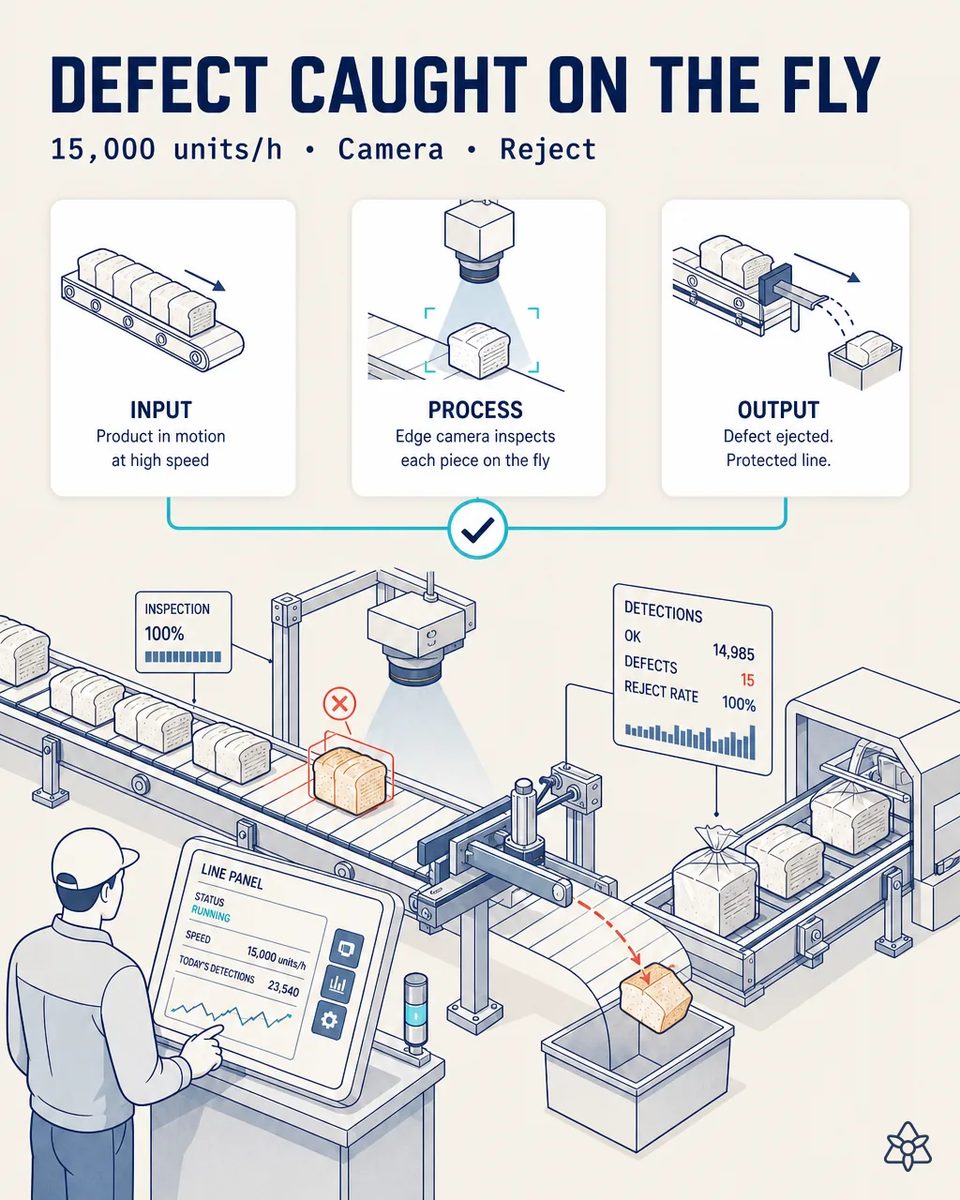
At 15,000 units an hour, inspection by eye is a sampling plan.
100% human visual inspection is impossible at the real cadence of the most modern lines. Sampling-based inspection leaves gaps that translate into retail returns and lost customer trust.
- The sector's fastest lines reach 15,000 units per hour. Piece-by-piece human inspection at that cadence is mathematically impossible, however good the team is.
- What exists is sampling: one or two percent of loaves or buns checked by eye, usually at the spiral cooler exit or before the slicer. The rest is trusted to the process being stable.
- Everything in between ships: a collapsed top, a burnt crust, a torn bun, a loaf stuck to its neighbor, a pale batch from an oven zone running cold.
- Those gaps come back days later as route returns and complaints from the retail buyer, and with them a loss of trust that no sample plan recovers.
Edge — local CNN vision above the belt, inference in milliseconds, ejection before packaging.
Edge — local CNN vision, no need to send images to the cloud (latency, cost, bandwidth). Model trained on the specific format of each line (sliced bread, burger or hot-dog buns).
The camera does not get tired at hour seven and does not sample. Every loaf is classified before the bagger, and the defective one leaves the line on its own, so what reaches the retail shelf is what quality would have approved by hand. Images never leave the plant: inference runs next to the belt, with no latency, bandwidth or cloud cost to justify.
Sampling by eye versus Edge inspection at full cadence
| Aspect | Today | With iLEAN Edge |
|---|---|---|
| Share of production inspected | 1-2% sampling | 100% of pieces |
| Collapsed top or burnt crust | Ships unless sampled | Ejected before the bagger |
| Burger bun versus hot-dog bun | Same tired eye for both | A model trained per format |
| Images and cloud traffic | — | Processed on site, nothing uploaded |
| Route returns for visual defects | A recurring cost | Drastically reduced |
| Defect history per batch | None | Counted and stored |
Impact estimate — to be validated with your bakery's numbers.
The block below is an estimate to be validated against your plant's actual data. We put it forward so the committee has an order of magnitude; we refine it during the assessment.
- Estimated payback 5-12 months, depending on your current scrap ratio.
- Plus the reduction in retail returns for visual defects, which today reach the customer before they reach quality and cost the freight, the credit note and the buyer's patience.
- From one or two percent sampling to 100% piece inspection, at the line's real cadence and on every shift, including nights and weekends.
- And a defect count per batch that tells the oven and proofing teams where the problem starts, so the cause is corrected upstream instead of rejected downstream.
Estimated payback of 5 to 12 months depending on current scrap ratio, plus reduced retail returns. Estimate to validate.
And the fair question from the production manager
“What if it ejects good bread?” — the false positive is the real risk of any vision system, which is why the model is trained on good and bad pieces of your own formats and with that line's lighting. Classifying a known defect on a known format is an anchored task, where the best models drop below 1.5% error [1], and borderline pieces are sent to a review lane for a person to decide. Every decision feeds back into training, so the line's own judgment ends up inside the model.
[1] OpenAI paper "Why Language Models Hallucinate", 2025 — on the reliability of AI in anchored tasks.
What people ask about defect vision on a bread line
Can it keep up with 15,000 units an hour?
Yes. Inference runs locally next to the line and takes milliseconds per piece. It does not depend on the plant network or a cloud connection, so a network outage does not stop inspection.
Does it work for pan loaves, burger buns and hot-dog buns?
Yes, with a model trained on each format. When the line changes format, the camera switches model with the active Production Order, without anyone touching a setting. Seeded and unseeded buns are treated as separate formats when their defects differ.
Where on the line does the camera go?
Before final packaging, usually after the spiral cooler has brought the loaf down to slicing temperature and before the slicer or bagger, so the defective piece never reaches the bag. The ejector sits right after the camera, and every rejected piece is counted against its batch.
How many images does training need?
Fewer than people expect, because a bread line's defect catalog is short and repetitive: tops, crusts, tears, doubles and color. What matters is that they are real pieces from your formats, photographed under your line's lighting.
Is the line's quality technician still needed?
Yes. The camera takes the impossible task of watching every piece off their hands and gives them a defect count per batch, so their time goes to causes in the oven or the proofer rather than to sampling.
More cases from this series
- Coder without typingiLEAN stitches the date/batch coder to the ERP via API: a batch change is a tap in the ERP, not typing…
- Supplier alert in secondsiLEAN reads the flour supplier's email at zero latency, cross-references active ERP orders, and suggests…
- Voice that keeps walkingThe shift leader dictates issues while walking the floor with a headset; iLEAN structures them and…
- Lab Excel, into the ERPiLEAN Connect absorbs the lab's quality Excel and pushes it to the ERP after verification, with up to…
- Camera reads vintage panelAn external camera reads a 15-20-year-old proofing-chamber panel and digitizes its curve without…
- Paperless line startupHow Connect digitizes the Production Order and oven startup log with two phone photos, at zero latency,…
Tell us what share of your route returns comes from visual defects.
We work on your plant's real data, not ours. Assessment with no commitment.
Request estimated ROI within 48h ‹ See all cases of industrial bakery See food industry