Iberian salchichón lactic fermentation with AI — the pH curve is decided in the first few hours.
The lactic fermentation of cured Iberian salchichón is won in the first 24-72 hours: if the pH does not come down at the expected rate, the rest of the curing process is only trying to rescue a batch that was born wrong. iLEAN Edge captures pH, water activity and temperature batch by batch, and the agents propose the adjustment to the fermentation lead. The person signs — the chamber does not change parameters on its own.
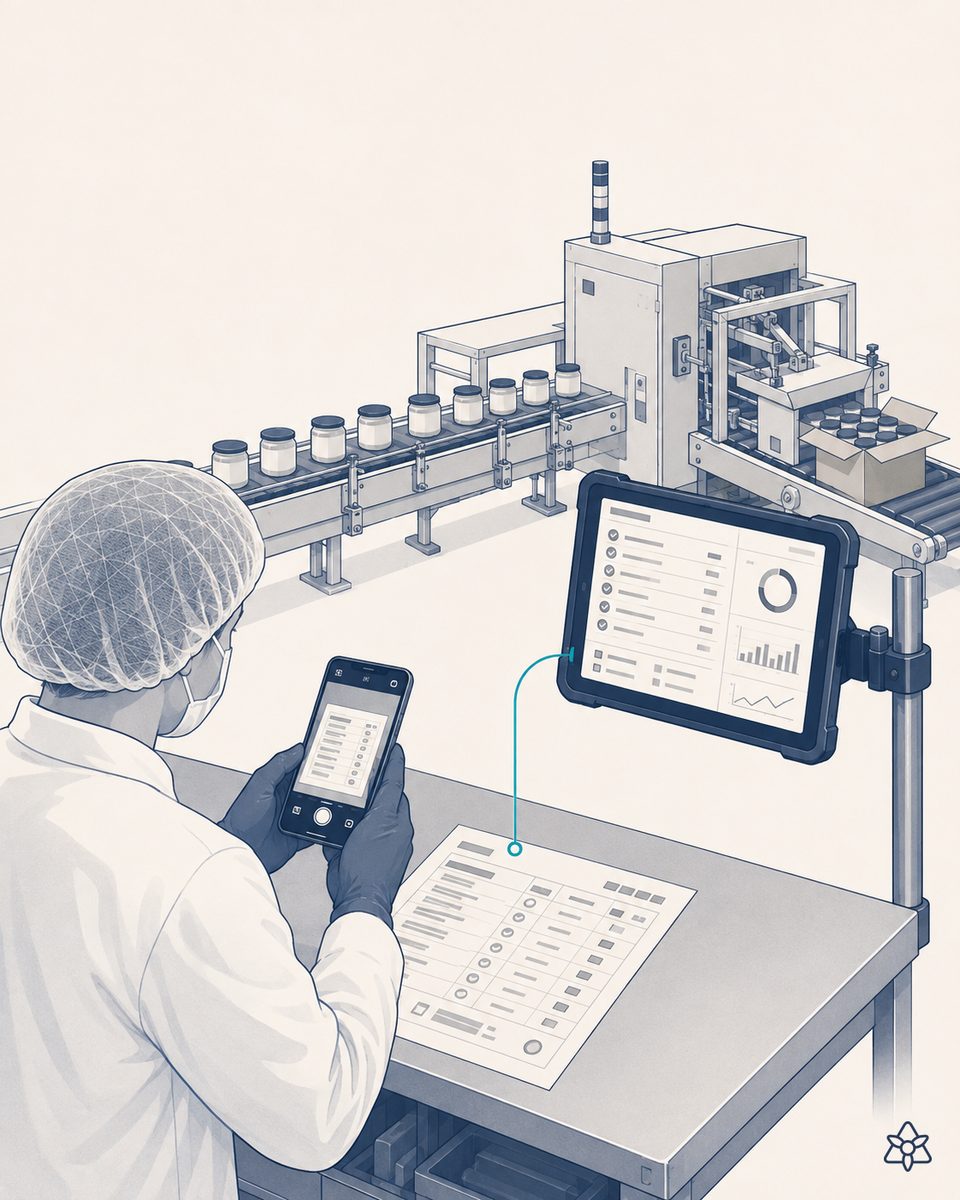
You see the curve after the fact — and after the fact there is nothing left to fix.
The lactic fermentation of cured Iberian salchichón is the moment that decides the rest of the process. And the problem is always the same: the three variables that matter live in different systems, and the pH curve is invisible until the lab sample comes back — and by then the batch is already hanging in the curing cellar.
- What went in — the batch recipe: starter cultures, sugar, salt, spices, Iberian raw material (origin, initial pH, fat). It usually sits in the ERP, in the MES or in the R&D lead's spreadsheet.
- What is happening — the real curve of pH, water activity and chamber temperature, hour by hour. Sometimes only in a local SCADA, sometimes only in the fermentation lead's notebook.
- What should be happening — the expected curve for that product, built on hundreds of previous batches that live in the veteran's head.
The fermentation lead knows all of this, but cannot open every chamber every hour or cross-check the curve against the recipe by eye. When the culture does not take, when the temperature has drifted, or when the raw material came in carrying competing flora, the batch is salvaged “as it comes out”: soft texture, flat flavor, a degraded brand — or, in the worst case, a microbiological risk that edges toward a recall.
iLEAN does not redesign fermentation — it puts it in plain sight while there is still time to adjust.
The problem with lactic fermentation is not ignorance of the process: it is information that arrives too late. iLEAN acts as the putty between the ERP recipe, the chamber SCADA and the fermentation lead's knowledge, without asking you to change the chamber or the ERP.
Edge measures the curve continuously. Connect captures the recipe wherever it lives. The agent cross-references it with the expected curve and, if the slope does not add up, it calls the lead. The person signs — the chamber does not change parameters on its own.
The iLEAN pieces applied to Iberian salchichón lactic fermentation:
- Edge — pH, water activity and temperature sensors per chamber and per batch, capturing continuously. Slope and plateau detection in milliseconds. It works with no network: if the plant loses WiFi, Edge keeps measuring and recording, because critical fermentation cannot depend on connectivity.
- Connect — captures the batch recipe, the starter culture lot used, the raw material of origin, and everything that comes in from outside (an email from the culture supplier announcing a lot change, a WhatsApp message from the cutting room). At second zero, with nothing forwarded around.
- Agent — cross-references the real curve with the expected curve, the culture and the recipe. If fermentation falls short, it proposes a hypothesis (old culture, low temperature, competing flora) and an adjustment. It does not lower the temperature by itself. The fermentation lead validates and signs — the three safety rings guarantee that the set point never changes without human validation.
Manual fermentation vs. fermentation governed with iLEAN
| Aspect | Lab sampling + notebook | With iLEAN Edge + Connect + Agent |
|---|---|---|
| pH / aw / temperature capture | Spot samples, once per shift | Continuous, per batch and per chamber |
| Detecting a culture that will not start | When the lab returns the figure | In the first few hours, from the slope |
| Cross-check recipe ↔ real curve | Mental, batch by batch | Automatic against the expected curve |
| Deviation alert | When the lead opens the chamber | Right then, through the lead's channel |
| Adjustment decision | The lead decides and writes it down | The agent proposes, the lead signs |
| Operation with no network | n/a | Edge keeps measuring on the panel's own power |
Impact estimate for your plant — to be validated with your numbers.
The block below is an estimate to be validated with the specific data of your plant. We put it forward so the committee has an order of magnitude; we refine it during the diagnostic.
- Iberian sausage plant with 2-6 fermentation chambers, several recipes (vela calibre, cular, spice mixes), starter cultures made in house or bought in.
- Edge pilot in one chamber (pH / aw / temperature sensors + integration with the batch recipe from the ERP/MES). First value expected within a few weeks.
- Indicative payback between 4 and 9 months, depending on the cost per salvaged batch and on how often culture incidents happened over the past year.
- Expected improvement floor: a reduction of ≥ 30% in batches that end up cured as second grade because of irregular fermentation.
- The hard lever: a single Iberian batch saved by an early alert pays for a good part of the pilot.
And the fermentation lead's reasonable doubt
“What if the AI measures correctly but proposes the wrong adjustment?” — hallucination is a problem of free generation, not of anchored tasks. Cross-referencing pH, aw and temperature with the expected curve and the batch recipe is an anchored task. In this kind of task, the best models brought error below 1.5% [1]. And even so, what is critical is never decided alone: iLEAN proposes, the lead signs. The three safety rings exist precisely for this.
[1] OpenAI paper “Why Language Models Hallucinate”, 2025 — on the reliability of AI in anchored tasks.
What people ask about lactic fermentation of Iberian salchichón with AI
Why does lactic fermentation decide the quality of an Iberian salchichón?
In the lactic fermentation of salchichón, the lactic acid starter bacteria (Lactobacillus, Pediococcus) consume the added sugars and drive the pH down from roughly neutral values to the target acid range. That drop in pH does three things that decide everything else in the process: it inhibits pathogenic flora, it destabilizes the proteins, giving the sausage its texture, and it sets the aroma profile that is characteristic of slow curing. If the pH curve falls short or overshoots, the rest of the curing process is only trying to rescue a batch that was born wrong.
How does iLEAN control the pH curve during fermentation?
iLEAN Edge installs pH, water activity (aw) and temperature sensors per fermentation room and per batch, and records the curve continuously. The agents cross-reference it with the batch recipe (starter cultures, sugar, salt, spices) and with the expected curve for that product. If the pH drop slows down more than is acceptable, or if the chamber temperature drifts, the system puts it in front of the fermentation lead through whichever channel they use. The person validates the temperature or ventilation adjustment; the chamber does not change parameters on its own.
What happens if the starter cultures do not take and fermentation never gets going?
It is one of the classic risks of batch curing: an old culture, poorly rehydrated, poorly dosed, or raw material carrying competing flora. When Edge sees that the pH is not dropping at the expected rate in the first few hours, the agent cross-references the curve with the batch's starter culture and with previous batches of the same product, and proposes three things: check the culture lot, adjust temperature and ventilation to help the start, and flag the batch for closer human follow-up. The fermentation lead's judgment rules; the agent supports it.
Is iLEAN useful if fermentation runs in old chambers with no SCADA?
Yes — that is exactly the situation where iLEAN wins. Edge is installed as a capture layer on top of the existing chamber, with its own pH, aw and temperature sensors, or reading the ones already there. Connect captures the batch recipe whether it comes from the ERP, from a vertical MES or from the lead's spreadsheet. We do not ask you to change the chamber or the ERP; we fill the gaps. And Edge keeps measuring if the plant loses its network, because critical fermentation cannot depend on WiFi.
What does AI-governed fermentation save in cured Iberian salchichón?
The hard lever is in the batches that are accepted “as they come out” because nobody saw the curve drift in time: soft texture, flat flavor, a marginal microbiological risk that ends in brand damage or, in the worst case, in a recall. AI-governed fermentation removes that bottleneck: the first alert comes in the first few hours, not three days later. We estimate first value in a few weeks and an indicative payback of months, not years — the exact order of magnitude we close with your data.
More cases in food
- Iberian breed purity verification 100/75/50 — the vet's eye, extended to every animal.iLEAN Vision reads hoof, coat and morphology at the slaughterhouse and supports Iberian breed purity…
- Cured Iberian lomo, curing and weight loss with AI — every extra point of weight loss is expensive lomo going out as thin air.How iLEAN Edge governs pH, water activity and weight loss in cured Iberian lomo by cellar, batch and…
- Montanera weighing — the number that decides whether an animal qualifies as acorn-fed, tied to the ear tag at second zero.iLEAN Connect captures Iberian pig montanera entry/exit weighing, calculates acorn weight gain and ties…
- RIBER traceability for Iberian ham — tying the dehesa to the seal, without the batch close costing a week of spreadsheets.iLEAN Tracer ties the RIBER/ITSA record piece by piece, from the dehesa to the seal on the cured ham,…
- Skin packing of Iberian ham slices — the micro-leak you cannot see becomes a return from the shelf.How iLEAN Edge detects micro-leaks in skin packs of Iberian ham slices in line, with AI vision and a…
- Sobrasada IGP Mallorca — you do not touch the curing curve, you watch it better.How iLEAN Edge governs the curing curve and the traditional stuffing of Sobrasada IGP Mallorca with AI…
Tell us your case and in 48h we'll send you the estimated ROI of this AI project for your Iberian salchichón.
We work on your plant's real data, not ours. Diagnostic with no commitment.
Request estimated ROI in 48h See food industry