RIBER traceability for Iberian ham — tying the dehesa to the seal, without the batch close costing a week of spreadsheets.
Iberian traceability lives in too many places: RIBER, ITSA, SIGGAN, the slaughterhouse MES, the drying house ERP, the cutting room lead's notebook. iLEAN Tracer is the piece that captures all those links as they happen and ties them to the ear tag, to the batch and to the piece. Closing the batch stops being a spreadsheet exercise and becomes a property of the system. The person signs at every critical node.
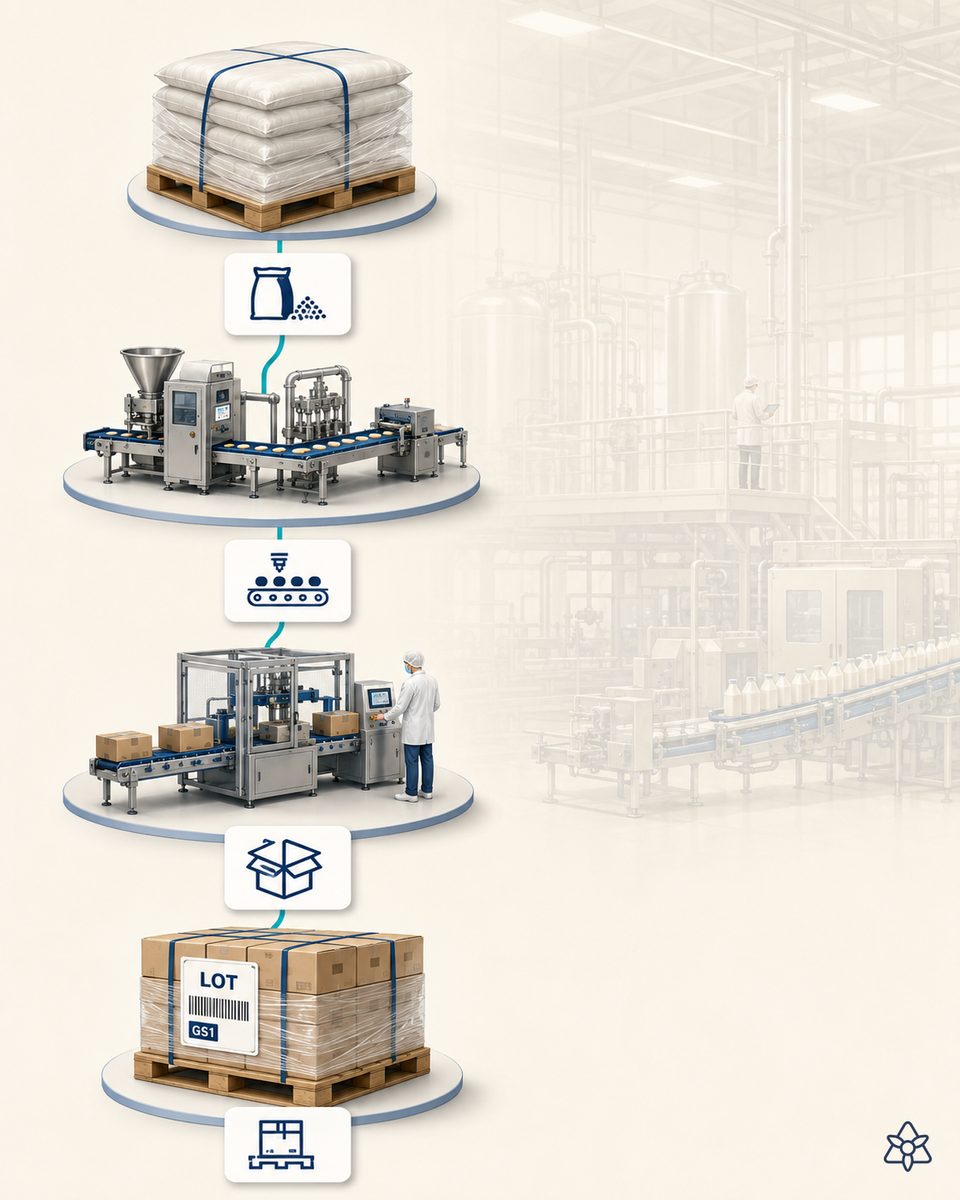
RIBER exists — keeping it clean without extra manual work does not.
Iberian pig traceability crosses at least six links and five different systems, almost never connected to each other:
- Dehesa and livestock — ear tag, batch, entry weight into montanera. SIGGAN, the farm logbook, RIBER.
- Montanera and finishing farm — feeding, ITSA. A PDF from the certification body, paperwork from the finishing farm.
- Slaughter — carcass number, classification. The slaughterhouse MES (sometimes in house, sometimes a third party's).
- Cutting — the cut extracted, the barcode. MES or a thermal printer label.
- Drying house — entry into curing, chamber control, exit. ERP, chamber sheets, the master ham curer's judgment.
- Sealing and sales — color, seal number, shipping. A scanner gun and a sticker.
RIBER is the official source of truth. Whatever does not appear in it fills parallel spreadsheets that two people maintain every month to close the accounting batch. When the certification body or the Ministry of Agriculture asks for piece-by-piece traceability, that week of spreadsheets turns into two. And the day the cutting room lead retires, part of the chain leaves with them.
iLEAN is not a seventh system — it is the putty that stitches together the RIBER, the MES and the ERP you already have.
The problem with Iberian traceability is not a lack of data: it is data living on islands (RIBER, ITSA, MES, ERP, the logbook, the vet's judgment) that only gets cross-referenced by hand at closing. iLEAN Tracer acts as the putty that fills those gaps, without asking you to change your RIBER, your MES or your ERP.
Connect captures every link where it happens. Edge watches the critical points (yard, cutting, seal). The agent stitches the chain and blocks the close if something does not add up. The person signs — never the other way round.
The iLEAN pieces applied to RIBER traceability from the dehesa to the seal:
- Connect — captures RIBER, SIGGAN, the certification body's ITSA, the slaughterhouse/cutting MES and the drying house ERP. It also captures the voice note dictated by the cutting room lead, the photo of the ear tag in the yard, the email from the certifier with a change of criteria. Bidirectional: it also drafts the replies to the certification body, which a person signs.
- Edge — AI vision terminals at the three critical points: the handling yard (reads the ear tag and the traits), the cutting room (reads the carcass mark and the cut extracted), the sealing line (reads the seal color and the piece). Each terminal runs locally: it does not depend on the network to record.
- Agent — the brain that stitches. It lives in Central, cross-references links as they happen, builds the batch file live (not at closing) and blocks progress if the chain breaks. If the finishing farm's ITSA is missing, it says so on the day it happens, not three months later.
Closing the batch by hand vs. traceability stitched with iLEAN Tracer
| Aspect | Traditional traceability | With iLEAN Tracer (Connect + Edge + Agent) |
|---|---|---|
| Capture per link | Each one in its own system or on paper | Unified at second zero, anchored to ear tag/batch/piece |
| Batch close | A week of spreadsheets every month | The file is ready the day the batch closes |
| Gap detection | External audit or a complaint | The day the data is missing — with room to fix it |
| Vet's / master ham curer's knowledge | In their head, gone at retirement | Captured as model criteria (with their signature) |
| Operation with no network on the farm | n/a | Edge keeps recording locally and syncs when it is back |
| Certification body (ENAC) and Ministry audits | Manual rebuild, weeks of work | Piece-by-piece dossier in one click |
Impact estimate for your plant — to be validated with your numbers.
The block below is an estimate to be validated with the specific data of your chain. We put it forward so the committee has an order of magnitude; we refine it during the diagnostic.
- Iberian group with its own livestock, slaughterhouse/cutting and drying house, several thousand pieces a year, acorn-fed and field-fed certifications managed with a logbook + ERP + ITSA reports as PDFs.
- Tracer pilot on two critical links (handling yard ↔ slaughterhouse and cutting ↔ sealing). First value expected within a few weeks: the batch file goes from being closed a week later to being ready the day it closes.
- Indicative payback between 4 and 9 months, depending on your current batch-closing hours, how often the certification body raises nonconformities, and the cost of the recall risk from incomplete traceability.
- Expected reduction in manual closing work ≥ 30%; the rest translates into fewer arguments with the certifier and a better position in a Ministry inspection.
And the quality manager's reasonable doubt
“What if the AI gets the stitching wrong and lets a weak link through?” — hallucination is a problem of free generation, not of anchored tasks. In tasks where the AI merely recontextualizes a piece of data from one system into another (reading the ITSA, tying it to the ear tag, checking it against RIBER), the best models brought error below 1.5% [1]. And even so, what is critical is never decided alone: the agent blocks the close and the person signs. The three safety rings exist precisely for this.
[1] OpenAI paper “Why Language Models Hallucinate”, 2025 — on the reliability of AI in anchored tasks.
What people ask about RIBER traceability in the Iberian sector
What does RIBER traceability actually cover in the Iberian sector?
RIBER (the single register of the Iberian sector) covers the whole chain: farm of origin, finishing farm, feeding, slaughter, cutting, curing and sealing. Every animal has an ear tag and every batch an identifier. The ITSA reports (technical health reports on feeding) anchor the finishing or montanera stage. In practice, almost no company has that trace tied piece by piece from the first link to the last — the links live in different systems, parallel spreadsheets fill the gaps, and the audit is rebuilt by hand. RIBER exists; keeping it clean without extra manual work is another story.
How does iLEAN Tracer stitch together links that today live on islands?
Tracer combines Connect (capture of RIBER, SIGGAN, ITSA, the slaughterhouse/cutting MES, the drying house ERP) with Edge (AI vision in the handling yard, the cutting room and the sealing line). What comes in through an API comes in through an API; what arrives as a PDF in a shared folder comes in too; what lives in the cutting room lead's head is captured by voice as they dictate over the piece. The agent cross-references every link and, if the chain breaks at any point, it flags it before the batch moves on. Traceability stops being a manual month-end effort and becomes a property of the system.
What happens if a RIBER link does not add up when the cured ham batch is closed?
The agent blocks the batch closing and proposes one of three actions: complete the missing data (sometimes it is an ITSA PDF that nobody uploaded), reclassify the designation downward using the trace that is documented, or open a nonconformity if the gap cannot be closed. The person validates the option. What matters: the problem shows up when the batch is closed, not in the ENAC-accredited certification body's audit three months later, when there is no room left to maneuver.
Does Tracer replace RIBER or the certification body's system?
No. Tracer replaces nothing — it sits on top and fills the gaps. RIBER, the ITSA reports, the slaughterhouse MES and the drying house ERP remain the source of truth for each link. iLEAN acts as the putty that joins those systems and captures what none of them records (the vet's voice note, the photo of the ear tag in the yard, the change of criteria from the certifier that arrived by email). Nothing thrown away, nothing rewired — just the cracks sealed.
How long does it take to start a Tracer pilot between the dehesa and the drying house?
The method is iLEAN's usual one — a few days of immersion with the team (livestock, slaughterhouse/cutting, drying house), a first capability running within a few weeks (typically capture between two critical links: handling yard ↔ slaughterhouse, or cutting ↔ sealing), a complete pilot line at one of the links, and expansion to the rest carried out by the customer with their own trained people. The initial investment covers Edge terminals + integrations with RIBER/MES/ERP, plus the annual license. Indicative payback in the range of a few months once you value the reduction in batch-closing hours and the nonconformity risk avoided.
More cases in food
- Cured Iberian lomo, curing and weight loss with AI — every extra point of weight loss is expensive lomo going out as thin air.How iLEAN Edge governs pH, water activity and weight loss in cured Iberian lomo by cellar, batch and…
- Montanera weighing — the number that decides whether an animal qualifies as acorn-fed, tied to the ear tag at second zero.iLEAN Connect captures Iberian pig montanera entry/exit weighing, calculates acorn weight gain and ties…
- Iberian salchichón lactic fermentation with AI — the pH curve is decided in the first few hours.How iLEAN Edge governs pH, water activity and temperature during the lactic fermentation of cured…
- Skin packing of Iberian ham slices — the micro-leak you cannot see becomes a return from the shelf.How iLEAN Edge detects micro-leaks in skin packs of Iberian ham slices in line, with AI vision and a…
- Sobrasada IGP Mallorca — you do not touch the curing curve, you watch it better.How iLEAN Edge governs the curing curve and the traditional stuffing of Sobrasada IGP Mallorca with AI…
- Iberian ham slicing in a white room with AI — fat, bone and marbling slice by slice, pack weight intact.iLEAN Vision in the slicing white room detects fat, bone and marbling slice by slice and adjusts the…
Tell us your case and in 48h we'll send you the estimated ROI of this AI project for your Iberian traceability.
We work on your chain's real data, not ours. Diagnostic with no commitment.
Request estimated ROI in 48h See Iberian