Montanera weighing — the number that decides whether an animal qualifies as acorn-fed, tied to the ear tag at second zero.
Weighing the pigs on the way into and out of the montanera is the single most decisive data point for the acorn-fed designation — and it almost always lives in a nameless scale ticket and a notebook full of ear tags with no weights. iLEAN Connect ties the weight to the ear tag there and then, calculates the minimum weight gain against RD 4/2014, and closes the batch with no later rebuild. The vet signs.
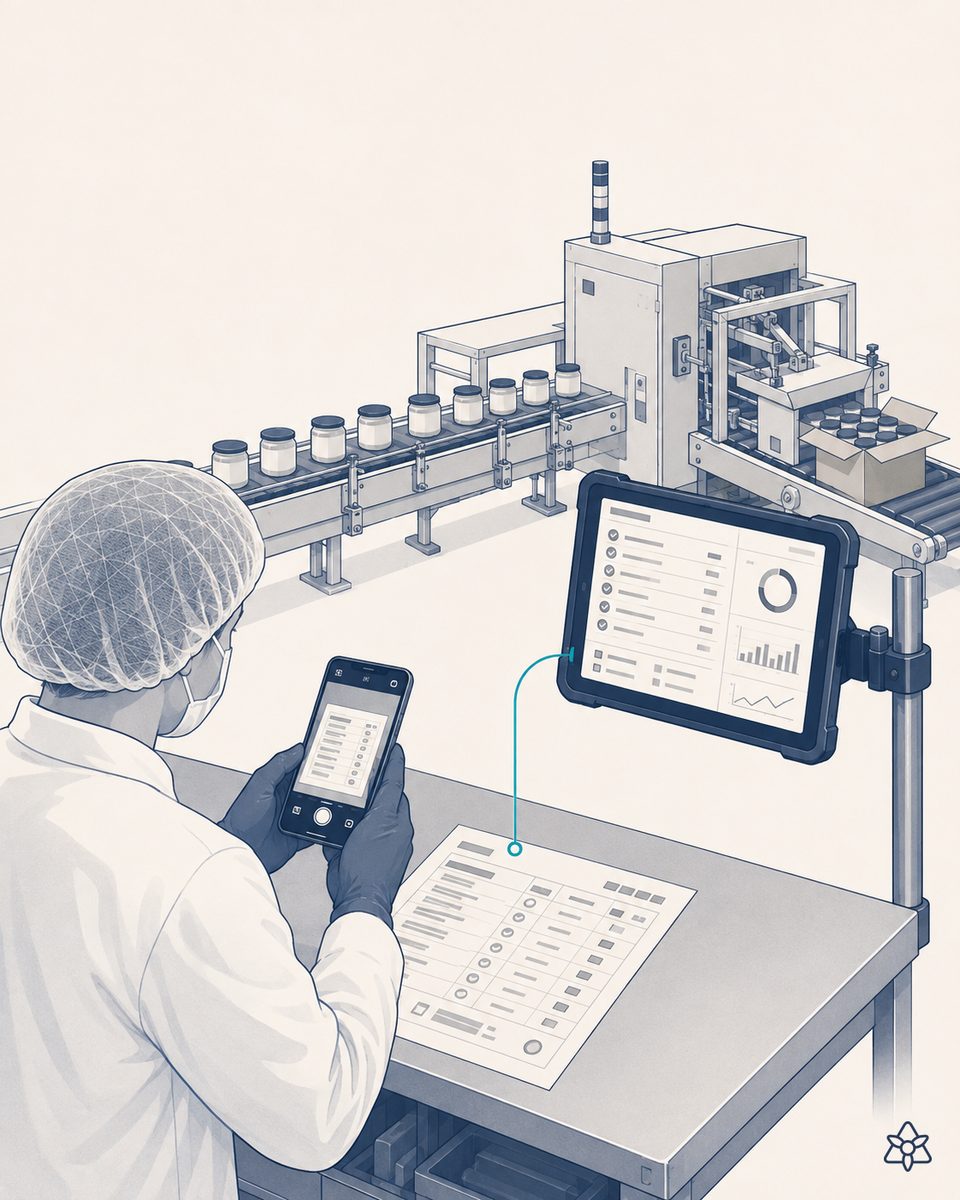
The scale gives you a weight. The notebook gives you an ear tag. Marrying them is the daily fight.
Entry and exit weighing for the montanera is the most decisive data point in whether a pig qualifies for the acorn-fed designation. The regulation requires a minimum weight gain per animal — and it has to be provable. Out in the yard, that cross-reference lives in three different places:
- The scale — it prints a ticket or sends it to an old head unit. It has no idea which animal the weight belongs to.
- The ear tag and the vet's notebook — it knows which animal went through but does not remember the exact weight by the time the day ends.
- The month-end spreadsheet — someone reconciles ticket and notebook a week later, with a cooler head and colder memories.
When there are 800 pigs in the yard, a long day and a farmer in a hurry to let them out, the manual cross-check leaves gaps. And a gap turns, without anyone having done anything wrong, into a downgraded designation or a non-conformity from the certifier. The veteran vet's knowledge prevents problems — but it also lives in his head on the day he retires.
iLEAN does not change your scale or your notebook — it stitches them together in the handling yard.
The problem with weighing is not a lack of information: it is information living in islands (scale, ear tag, notebook, RIBER) that gets cross-referenced late, by hand and from memory. iLEAN Connect acts as the putty that stitches those four points together in the second the animal steps onto the scale. Without asking you to change a thing.
The scale reads the weight. The camera or the dictation reads the ear tag. The agent calculates the gain and compares it against RD 4/2014. The vet signs — never the other way round.
The iLEAN pieces applied to montanera weighing:
- Connect (sliding scale of capture) — it reads a modern scale by API, an older one by serial port, a truly ancient one by photographing the display. The vet's field app captures the ear tag in the same pass (photo + OCR, or voice). Weight and ear tag are tied together at second zero.
- Connection to RIBER and SIGGAN — the weighing data is not one more island; it feeds the animal's RIBER record and is cross-referenced with the fattening unit's ITSA. If what was weighed today does not match what SIGGAN says about the animal, it is flagged before the animal is released.
- Weight-gain agent — it calculates the difference between entry weight and exit weight and compares it against the RD 4/2014 threshold. If the animal falls short, it marks it for reassessment. The vet decides the designation.
- It works without a network out in the dehesa — the Edge device keeps its logic locally. Synchronization with Central happens when the technician gets back into coverage. What is critical does not depend on signal.
Traditional weighing vs. weighing stitched together with iLEAN Connect
| Aspect | Traditional weighing | With iLEAN Connect (scale + field app + agent) |
|---|---|---|
| Cross-reference weight ↔ ear tag | Ticket + notebook, spreadsheet afterwards | Tied at second zero, out in the yard |
| Reading an old scale | Operator reads the display and writes it down | Connect reads the port or a photo of the display |
| Weight-gain calculation | Spreadsheet at close, by hand | The agent calculates against RD 4/2014 live |
| Borderline animals | Spotted at the audit, already too late | Spotted in the yard, with room to decide |
| No signal in the dehesa | n/a | Works locally, syncs on the way back |
| Batch file | Rebuilt afterwards | Ready on the day of weighing |
Impact estimate for your plant — to be validated with your numbers.
The block below is an estimate to be validated with the specific data of your farms. We put it forward so the committee has an order of magnitude; we refine it during the diagnostic.
- Iberian livestock operation with several dehesa farms, several hundred pigs on montanera, a portable yard scale and notebook + spreadsheet at close.
- Connect pilot in the yard (scale reader + field app + integration with RIBER). First value expected within a few weeks: weight and ear tag tied together at second zero.
- Indicative payback between 4 and 9 months, depending on your current cost in vet-hours at close and the number of animals that today fall short of acorn-fed through a counting error.
- Expected reduction in manual reconciliation work ≥ 30%; the rest translates into a stronger standing with the certifier and fewer reclassifications.
And the farmer's reasonable doubt
“What if the reader misreads the ear tag and the weight gets tied to the wrong animal?” — hallucination is a problem of free generation, not of anchored tasks. In tasks where the AI merely reads an ear tag and ties it to the scale ticket from the very next second, the best models brought error below 1.5% [1]. And even so, what is critical is never decided alone: the agent flags the animal and the vet signs. The three safety rings exist precisely for this.
[1] OpenAI paper “Why Language Models Hallucinate”, 2025 — on the reliability of AI in anchored tasks.
What people ask about montanera weighing of Iberian pigs
What minimum weight gain does RD 4/2014 require for the acorn-fed designation?
Royal Decree 4/2014 sets, for the acorn-fed designation, a minimum weight gain per animal during the montanera, measured between the weight recorded on entry to the handling yard at the start of the montanera and the weight recorded on exit. The exact figure and the fine print (entry weight, time window, maximum weight) are set by the regulation and by the ENAC-accredited certification body. What matters operationally: that calculation is made by weighing the animals twice, in the yard, on a traceable scale. Anything that cannot be demonstrated with clean data does not qualify as acorn-fed.
How does iLEAN Connect read an old scale with no network?
iLEAN Connect works on a sliding scale of capture. If the scale is modern and has an interface, it is integrated directly. If it has an old head with a serial port or a display that spits out a ticket, Connect reads the port or reads the ticket. If all it gives is a display, the vet's field app captures the value by photo or by voice and ties it to the ear tag. What matters: the weight data ends up anchored to the animal, to the batch and to the farm, without passing through an intermediate spreadsheet. Connect works whatever the age of the scale — integration is no longer a one-year project.
Does the system calculate the minimum weight gain live?
Yes. The agent cross-references the entry weight and the exit weight tied to the same ear tag, calculates the gain and compares it against the RD 4/2014 threshold. If an animal falls short, it flags it before the handling session is closed. The vet decides: move the pig to a lower designation (field grain-fed or grain-fed), repeat the weighing if there is doubt about calibration, or mark the animal for reassessment. The decision is signed and anchored to the ear tag — ready for audit with no later rebuild.
What happens if I lose the trace between the weight and the ear tag?
That is the historic pain of montanera weighing: the scale ticket says nothing about the animal, and the vet's notebook records the ear tag with no weight. The classic data island. iLEAN Connect resolves that cross-reference in the handling yard: the moment the animal steps onto the scale is the same moment the camera reads the ear tag or the vet dictates it. Weight and ear tag are tied together at second zero — not in the month-end spreadsheet. If for any reason they cannot be matched, the agent flags it before the animal is released.
How much does it cost to implement iLEAN weighing in the yard?
The order of magnitude of a montanera weighing pilot with iLEAN is low compared with other Edge pilots — the initial investment covers the scale reader + field app + integration with RIBER, plus an annual license. The indicative payback lands in the range of a few months once you value the reduction in vet-hours spent reconciling data, the improvement in correctly designating animals that were being left out through a counting error, and your standing with the certification body. We ask for your data and send you the estimated ROI in 48h, with your numbers.
More cases in food
- Mite detection in ham drying rooms with AI — sweep the chamber before release to market.iLEAN Vision detects ham mites (Tyrophagus, Acarus) in the drying room before release to market, round…
- Iberian breed purity verification 100/75/50 — the vet's eye, extended to every animal.iLEAN Vision reads hoof, coat and morphology at the slaughterhouse and supports Iberian breed purity…
- Cured Iberian lomo, curing and weight loss with AI — every extra point of weight loss is expensive lomo going out as thin air.How iLEAN Edge governs pH, water activity and weight loss in cured Iberian lomo by cellar, batch and…
- Iberian salchichón lactic fermentation with AI — the pH curve is decided in the first few hours.How iLEAN Edge governs pH, water activity and temperature during the lactic fermentation of cured…
- RIBER traceability for Iberian ham — tying the dehesa to the seal, without the batch close costing a week of spreadsheets.iLEAN Tracer ties the RIBER/ITSA record piece by piece, from the dehesa to the seal on the cured ham,…
- Skin packing of Iberian ham slices — the micro-leak you cannot see becomes a return from the shelf.How iLEAN Edge detects micro-leaks in skin packs of Iberian ham slices in line, with AI vision and a…
Tell us your case and in 48h we'll send you the estimated ROI of this AI project for your montanera weighing.
We work on your operation's real data, not ours. Diagnostic with no commitment.
Request estimated ROI in 48h See Iberian