The Delivery Note Photo That Skips Double Entry
The truck arrives with Iberian ham, seafood or breadcrumbs. The receiving lead has to type line by line into the ERP while the driver waits, racking up demurrage. iLEAN Connect digitizes the delivery note and each pallet's lot labels in seconds, recognizing GS1-128, QR, barcode or plain OCR depending on the supplier.
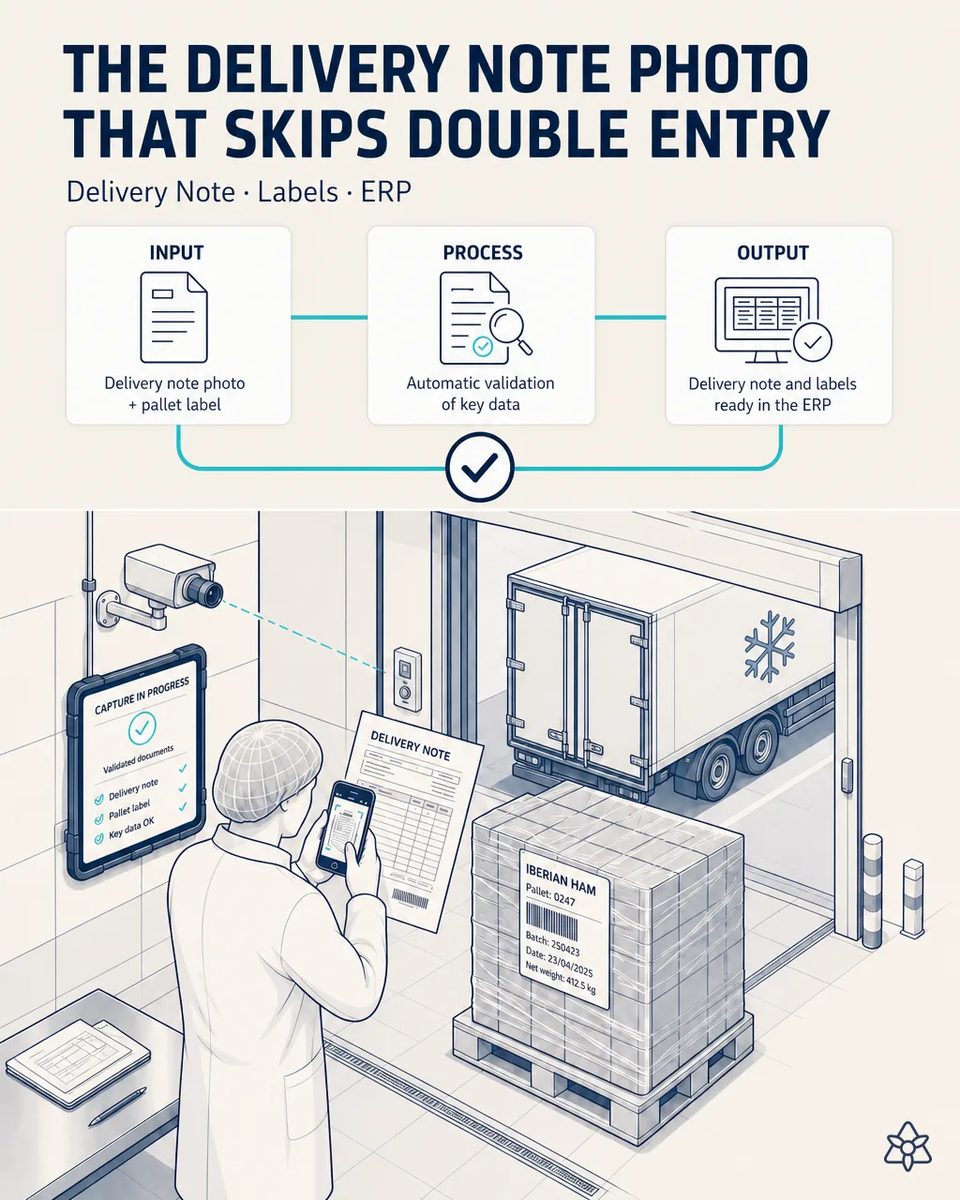
All of the plant's traceability is born on the dock, and it is born in a hurry.
The truck arrives with Iberian ham, seafood or breadcrumbs. The receiving lead has to type line by line into the ERP while the driver waits, racking up demurrage.
- The truck arrives with Iberian ham, seafood or breadcrumbs, and the receiving lead types the delivery note into the ERP line by line while the driver waits.
- Forty-five minutes of a refrigerated truck on the dock is demurrage, and the pressure to go faster is exactly what produces a mistyped lot.
- Every supplier labels differently: a GS1-128 pallet label from the breadcrumb supplier, a QR code from one cheese producer, a handwritten note from the artisan ham supplier.
- And the lot recorded there is the one every later traceability query depends on, including the one a distributor makes about a pack already sitting on a shelf, months after the truck left.
Connect on the dock — GS1-128, QR, barcode or plain OCR, whatever the supplier uses.
iLEAN Connect digitizes the delivery note and each pallet's lot labels in seconds, recognizing GS1-128, QR, barcode or plain OCR depending on the supplier. The receiving lead validates with a tap on the tablet and iLEAN pushes lot, quantity, expiry and supplier straight into the ERP via API.
One photo of the delivery note and of each pallet's lot labels, a tap on the tablet to validate, and iLEAN pushes lot, quantity, expiry and supplier into the ERP through the API. The lot and the expiry that get recorded are the ones printed on the original label, with the photo behind them as evidence. That is what turns backward traceability from a reconstruction into a query.
Today's receiving versus receiving in one tap
| Aspect | Today | With iLEAN Connect |
|---|---|---|
| Truck on the dock | 45 minutes | 5 minutes |
| Lot and expiry recorded | Retyped from the label | Read from the label itself |
| Suppliers who label differently | Each one handled by hand | GS1-128, QR, barcode or OCR |
| Evidence behind the record | None | The photo of the note and the label |
| A traceability query months later | Hunt for paper | One query by lot |
| Receiving module licenses | Several seats | 50-70% fewer |
Truck idle for 45 minutes during line-by-line entry → Receiving validated with one tap, truck free in 5 minutes.
Impact estimate — to be validated with your numbers.
The block below is an estimate to be validated against your plant's actual data. We put it forward so the committee has an order of magnitude; we refine it during the assessment.
- Estimated payback 3-8 months, counting the demurrage avoided and the licenses released.
- A typical reduction of 50 to 70% in receiving-module seats, since the module today needs several active users and with Connect only the validator does.
- From 45 minutes of truck idle at the dock down to 5, with the receiving lead free again and the cold chain shortened.
- And backward traceability on a premium ingredient that stops depending on how carefully somebody typed a lot code under pressure, with a driver waiting and a phone ringing.
Payback 3-8 months · -50/-70% receiving-module ERP licenses. The ERP's receiving module today requires several active seats. With Connect, only the validator needs one. Typical reduction of 50 to 70% in that module's licenses, with a 3-8 month payback. Estimate to validate.
And the fair question from the production manager
"Our suppliers all label differently, and some of them still write by hand." — that is precisely the case this handles: each label type is read the way it is actually written, and reading a delivery note or a lot label is an anchored task where the best models drop below 1.5% error [1]. The receiving lead confirms on the tablet before anything enters the ERP, and the photo stays attached as evidence.
[1] OpenAI paper "Why Language Models Hallucinate", 2025 — on the reliability of AI in anchored tasks.
What people ask about digitizing goods receipt
Does it read a handwritten delivery note?
Yes, and it is common with small artisan suppliers who still write the weight in by hand. Fields read with low confidence are raised for confirmation on the tablet rather than pushed through unchecked.
What if the delivery note and the pallet labels disagree?
The discrepancy is shown on the tablet before anything is accepted, with both readings side by side. Catching it on the dock is far cheaper than catching it the day that lot has to be traced back through a whole production week.
Does it record the temperature of the delivery?
When it is on the note, or read at the dock, yes, tied to the same receipt. For frozen seafood and chilled dairy it belongs with the lot, because it is the first link in the cold chain you are responsible for.
Do we need a barcode scanner?
No. The phone is enough, and it handles GS1-128, QR and plain print in the same capture without the receiving lead having to choose a mode or know what the supplier used this time.
Can we start with receiving alone?
Yes, and many plants do, because the dock is where the queue and the demurrage are visible to everybody, including the driver who is waiting and the transport company that invoices for it.
More cases from this series
- Paperless Batch Start for Gourmet Croquette PlantsiLEAN Connect digitizes the work order and recipe sheet the moment a gourmet croquette batch starts,…
- The Production Lead Reports Without StoppingThe production lead logs incidents by voice while walking the line, hands-free, without ever stopping…
- The IQF Freezing Tunnel Starts TalkingAn external camera reads the IQF freezing tunnel's panel and digitizes its temperature curve without…
- Online Orders Stop Being Re-TypedOnline store and HORECA orders flow automatically into the production system, with no manual re-entry.
- The Quality Spreadsheet Stops Living on Its OwniLEAN reads the lab's quality control spreadsheet and pushes it into the ERP after validation, cutting…
- Catching a Supplier Delay Before It Costs the ShiftiLEAN reads the seafood or ham supplier's delay email instantly and proposes how to replan production…
Tell us how long a refrigerated truck waits at your dock today while the delivery note is typed in line by line.
We work on your plant's real data, not ours. Assessment with no commitment.
Request estimated ROI within 48h ‹ See all cases of gourmet croquettes and appetizers See food industry