The Production Lead Reports Without Stopping
The production lead spends the shift walking between batter, forming, breading and freezing, hands occupied most of the day. Nobody asks them anything because they can't type. That the seafood SKU is breaking more today, that the new breading operator will need backup — today none of that reaches any system.
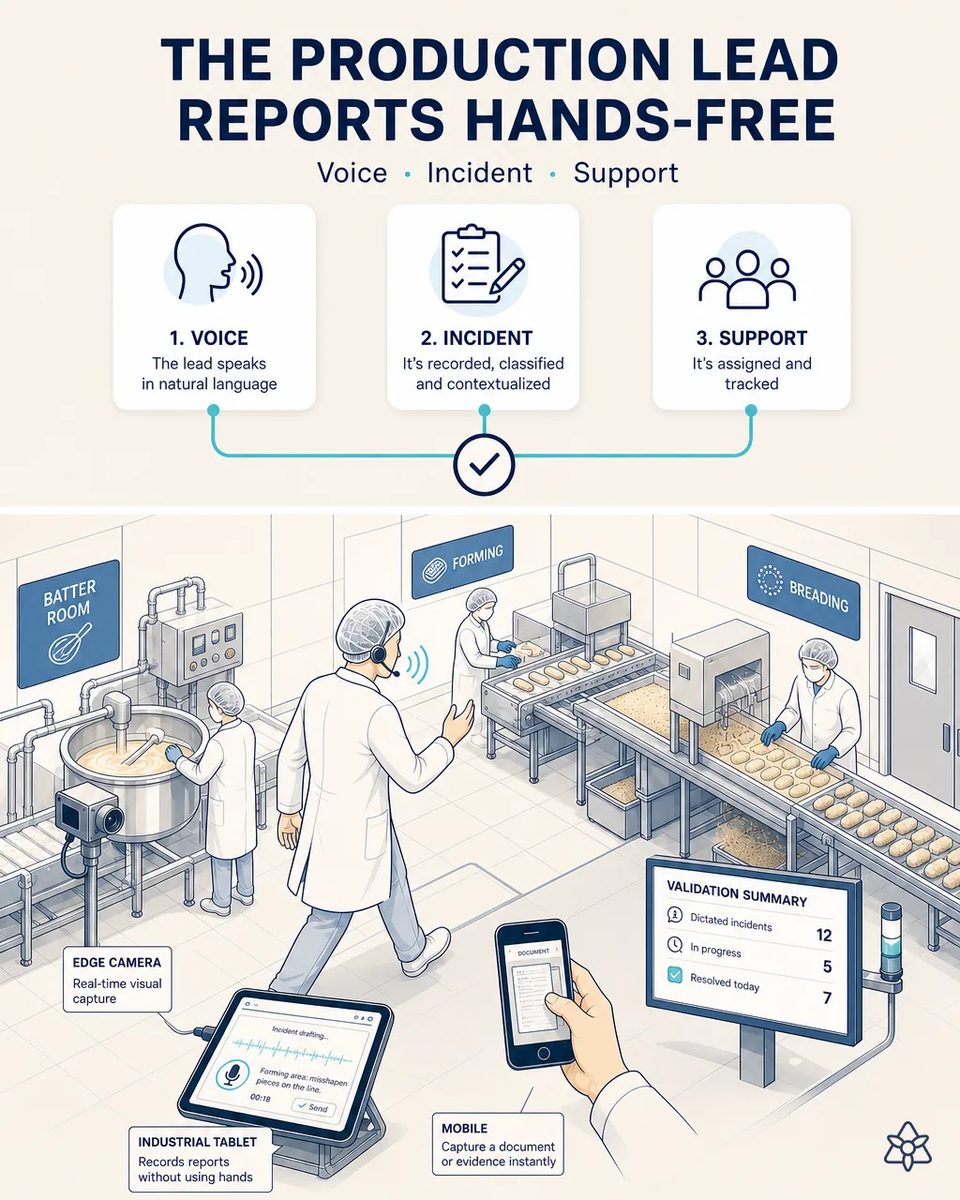
The person who knows the range best is the one who cannot stop to write.
The production lead spends the shift walking between batter, forming, breading and freezing, hands occupied most of the day. Nobody asks them anything because they can't type.
- The production lead spends the shift walking between the batter room, forming, breading and the freezing tunnel, with their hands occupied most of the day.
- That the seafood SKU is breaking more today, that the boletus batter has run thinner since the last flour lot, that the new breading operator will need backup on the next changeover: none of that reaches any system.
- Nobody asks them anything because they cannot type, and typing means walking back to an office at the other end of the plant.
- With 18 SKUs and short runs, that lost knowledge is precisely the fine-tuning that makes a gourmet product repeatable batch after batch, and today it survives only in one person's head and in a five-minute handover at the door.
Connect in voice mode — iLEAN listens to the production lead, not to the line.
That the seafood SKU is breaking more today, that the new breading operator will need backup — today none of that reaches any system. With hands-free Connect mode they say it out loud and iLEAN structures it as an incident tied to the active SKU, line and shift, without breaking stride.
Humans in command taken literally: it records what the production lead chooses to say, when they choose to say it, and answers by voice or with a push to the supervisor's tablet within seconds. That distinction is not cosmetic — it is what keeps the case alive in month six instead of quietly dying as one more thing nobody uses.
Today's shift versus the dictated shift
| Aspect | Today | With iLEAN Connect |
|---|---|---|
| What the production lead sees | Lost at the end of the shift | Structured as an incident |
| A batter running thin since a flour lot | Remembered, maybe | Tied to the SKU, line and shift |
| Backup for a new breading operator | Depends who is beside them | Requested and tracked |
| The production lead's effort | Walk back to the office | Speak while walking |
| A problem recurring on one SKU | Solved from scratch each time | Detected as recurring |
| Ordinary conversation on the floor | — | Not recorded |
Operational knowledge that dies at shift end → Incident logged and resolved in seconds, on the move.
Impact estimate — to be validated with your numbers.
The block below is an estimate to be validated against your plant's actual data. We put it forward so the committee has an order of magnitude; we refine it during the assessment.
- No standalone payback: this is an enabling piece. The brief treats it as strategic value, not as a line in a business case.
- What it buys is continuous improvement with a memory: the fine-tuning of each SKU stops living in one person's head.
- The shift handover goes from five spoken minutes to a written summary that exists before the next shift walks in.
- And a problem that has come back three times on the same SKU stops being an anecdote and becomes a pattern with a date.
Strategic value · enables continuous improvement on the floor. iLEAN replies by voice or with a push to the supervisor's tablet within seconds, closing the loop without the production lead ever having to stop.
And the fair question from the production manager
"Is this here to check up on my team?" — no: iLEAN listens to the production lead, and only to what they choose to dictate, never to the floor. There is no continuous listening. On the transcription, dictating an incident with its SKU, line and symptom is an anchored task where the best models drop below 1.5% error [1], and the structured record still lands on the tablet for confirmation.
[1] OpenAI paper "Why Language Models Hallucinate", 2025 — on the reliability of AI in anchored tasks.
What people ask about capturing the shift by voice
Does it work with the noise of the batter kettles and the tunnel fans?
That is the design condition. The headset is compatible with the hygiene cap and with hearing protection, and recognition is prepared for industrial noise and for the vocabulary of the trade.
Does the production lead have to say the batch number?
No. The active SKU, line and shift are already known from batch start-up, so the dictation can be as natural as telling a colleague what just happened at the forming machine.
What comes back to them?
An answer by voice, or a push to the supervisor's tablet, within seconds. Closing the loop without stopping is what makes people keep using it after the first week, instead of it becoming one more thing nobody does.
Why does this case carry no payback of its own?
Because its value is what it enables: it feeds the other cases with what only a person walking the floor can see. Putting a number on it would mean inventing one, and the brief deliberately does not.
Can the range's know-how be queried afterwards?
Yes, and that is the long game: what was fine-tuned on each SKU is exactly what nobody hands over today and what has to be relearned from scratch every time the range grows or the team changes.
More cases from this series
- Paperless Batch Start for Gourmet Croquette PlantsiLEAN Connect digitizes the work order and recipe sheet the moment a gourmet croquette batch starts,…
- The IQF Freezing Tunnel Starts TalkingAn external camera reads the IQF freezing tunnel's panel and digitizes its temperature curve without…
- Online Orders Stop Being Re-TypedOnline store and HORECA orders flow automatically into the production system, with no manual re-entry.
- The Quality Spreadsheet Stops Living on Its OwniLEAN reads the lab's quality control spreadsheet and pushes it into the ERP after validation, cutting…
- Catching a Supplier Delay Before It Costs the ShiftiLEAN reads the seafood or ham supplier's delay email instantly and proposes how to replan production…
- The Delivery Note Photo That Skips Double EntryA single photo of the delivery note and lot labels pushes ingredient receiving into the ERP, cutting up…
Tell us how much of what your production lead sees in a shift survives it.
We work on your plant's real data, not ours. Assessment with no commitment.
Request estimated ROI within 48h ‹ See all cases of gourmet croquettes and appetizers See food industry