Paperless Batch Start for Gourmet Croquette Plants
Every shift starts with a printed work order and the batter recipe sheet for that SKU. With 18 different croquettes in the catalog, matching the right sheet to the right batch is where origin errors start. The shift lead photographs the work order and the recipe sheet at start-up. iLEAN Connect reads the structure and extracts SKU, allergens, format and notes, with zero change to how they already work.
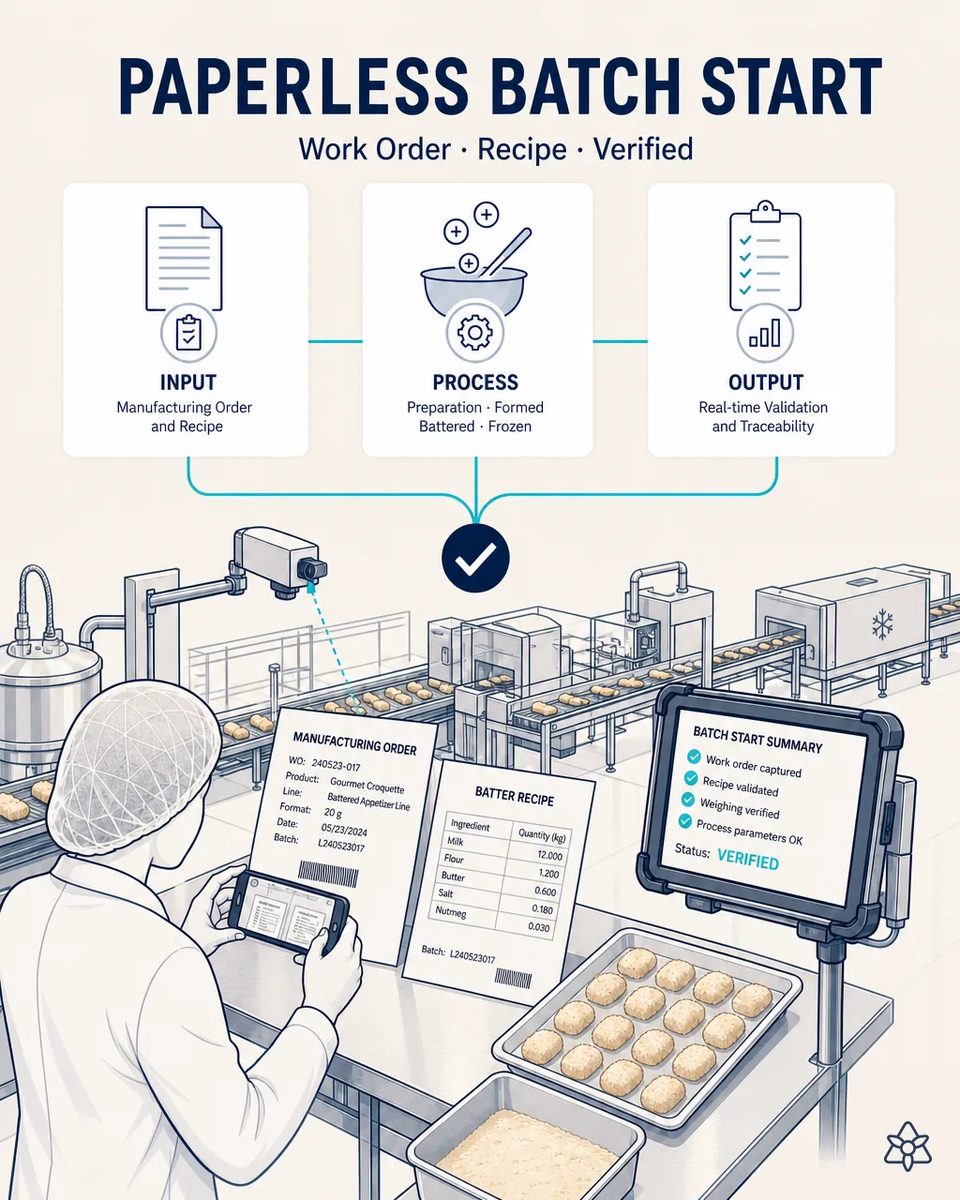
The batch is defined by two sheets of paper that only exist on the line.
Every shift starts with a printed work order and the batter recipe sheet for that SKU. With 18 different croquettes in the catalog, matching the right sheet to the right batch is where origin errors start.
- Every run starts with a printed work order and the batter recipe sheet for that SKU: milk, flour, butter, the filling and the format. With 18 croquettes in the catalog, the sheet changes several times a day.
- Matching the right sheet to the right run is where origin errors start, and in a gourmet range that sheet also carries the chef's version of the recipe and the notes that came out of the last tasting panel.
- Between the shift lead signing it and somebody transcribing it, four to eight hours pass — and over a weekend of campaign production, considerably more.
- During that gap the batch exists on a tray and in a freezer, but exists in no queryable system: not for the store's stock, not for a distributor asking which allergens that lot declares. And in a range built on short runs, two or three batches can start before the first one is typed in.
Connect in photo mode — the shift lead keeps filling in the same paperwork.
The shift lead photographs the work order and the recipe sheet at start-up. iLEAN Connect reads the structure and extracts SKU, allergens, format and notes, with zero change to how they already work. The batch is recorded in iLEAN's central memory the instant the line starts, with its SKU and allergens already traced, instead of waiting hours for someone to transcribe it.
It is the lightest of the twelve to deploy and the one the floor accepts fastest, because it asks for no new habit: the shift lead adds one photo to what they already did. That is usually why it is the first case signed off.
Batch start-up on paper versus batch start-up captured
| Aspect | Today, on paper | With iLEAN Connect |
|---|---|---|
| When the batch exists | 4-8 h later, more over a weekend | Second zero |
| SKU and format of the run | Read off a sheet on the line | Recorded with the batch |
| Allergens of the recipe | Implicit in the sheet | Traced from the first minute |
| The chef's recipe version | Whichever sheet was printed | Tied to the batch it produced |
| Handwritten note on the sheet | Lost unless somebody types it | Extracted and attached |
| The shift lead's habit | — | Unchanged: one photo |
Work order and recipe sheet on paper, transcribed hours later → Batch logged with SKU and allergens in zero seconds.
Impact estimate — to be validated with your numbers.
The block below is an estimate to be validated against your plant's actual data. We put it forward so the committee has an order of magnitude; we refine it during the assessment.
- Estimated payback 4-9 months, depending on how many runs a day the line starts.
- Transcription time the production lead stops spending and gets back on the floor.
- From a 4-8 hour lag to zero-second capture, weekends included.
- And every batch reaches the store's stock and a distributor's traceability query with its SKU and its allergens already attached.
Payback 4-9 months · from 4-8h lag to zero-second capture. Estimated payback for this pilot is 4 to 9 months depending on daily batch volume, plus the transcription time it frees up for the production lead. Estimate to validate against real plant data.
And the fair question from the production manager
"What if it reads the wrong quantity off the recipe sheet?" — reading fields from a document with a known structure is an anchored task, where the best models drop below 1.5% error [1]. And there is a second net: the summary lands on the line tablet and the shift lead confirms or corrects it before anything crosses into the system.
[1] OpenAI paper "Why Language Models Hallucinate", 2025 — on the reliability of AI in anchored tasks.
What people ask about digitizing batch start-up
Do we have to change our work order or our recipe sheet?
No. They stay exactly as they are, including the chef's own format and the handwriting on top. Connect reads the structure of the document you already print.
Does it pick up the notes written on the sheet during the run?
Those are the most valuable part, because that is where what actually happened gets written: a batter that needed longer to rest, a filling batch that came in wetter. They are extracted like any other field, and a low-confidence value is flagged for a person to confirm.
Is it worth it for a short run of 200 units?
That is the normal case in a gourmet range and precisely why it pays: a short run costs the same paperwork as a long one, so the transcription overhead per kilo produced is far higher. The shorter and more varied your runs, the more this case returns.
Do we need the ERP connected from day one?
No. The batch is recorded in iLEAN's central memory from the very first run, and the push into the ERP is wired afterwards, once the value is visible to the people who have to approve the integration.
Does it also capture the weighing sheet?
Yes, when it is part of the start-up pack. It is what lets you check later that the filling ratio printed on the pack matches what was actually weighed into the batch, which for an own-brand claim is not a detail.
More cases from this series
- The Production Lead Reports Without StoppingThe production lead logs incidents by voice while walking the line, hands-free, without ever stopping…
- The IQF Freezing Tunnel Starts TalkingAn external camera reads the IQF freezing tunnel's panel and digitizes its temperature curve without…
- Online Orders Stop Being Re-TypedOnline store and HORECA orders flow automatically into the production system, with no manual re-entry.
- The Quality Spreadsheet Stops Living on Its OwniLEAN reads the lab's quality control spreadsheet and pushes it into the ERP after validation, cutting…
- Catching a Supplier Delay Before It Costs the ShiftiLEAN reads the seafood or ham supplier's delay email instantly and proposes how to replan production…
- The Delivery Note Photo That Skips Double EntryA single photo of the delivery note and lot labels pushes ingredient receiving into the ERP, cutting up…
Tell us how many hours pass today between a run starting and its batch existing in your system.
We work on your plant's real data, not ours. Assessment with no commitment.
Request estimated ROI within 48h ‹ See all cases of gourmet croquettes and appetizers See food industry