Catching a Supplier Delay Before It Costs the Shift
The seafood or Iberian ham supplier emails a delay warning. It lands in an inbox checked late in the day, once a work order is already planned around that ingredient. iLEAN reads the email in zero seconds, extracts the intent and the affected ingredient, and cross-checks it against the active work orders in the ERP.
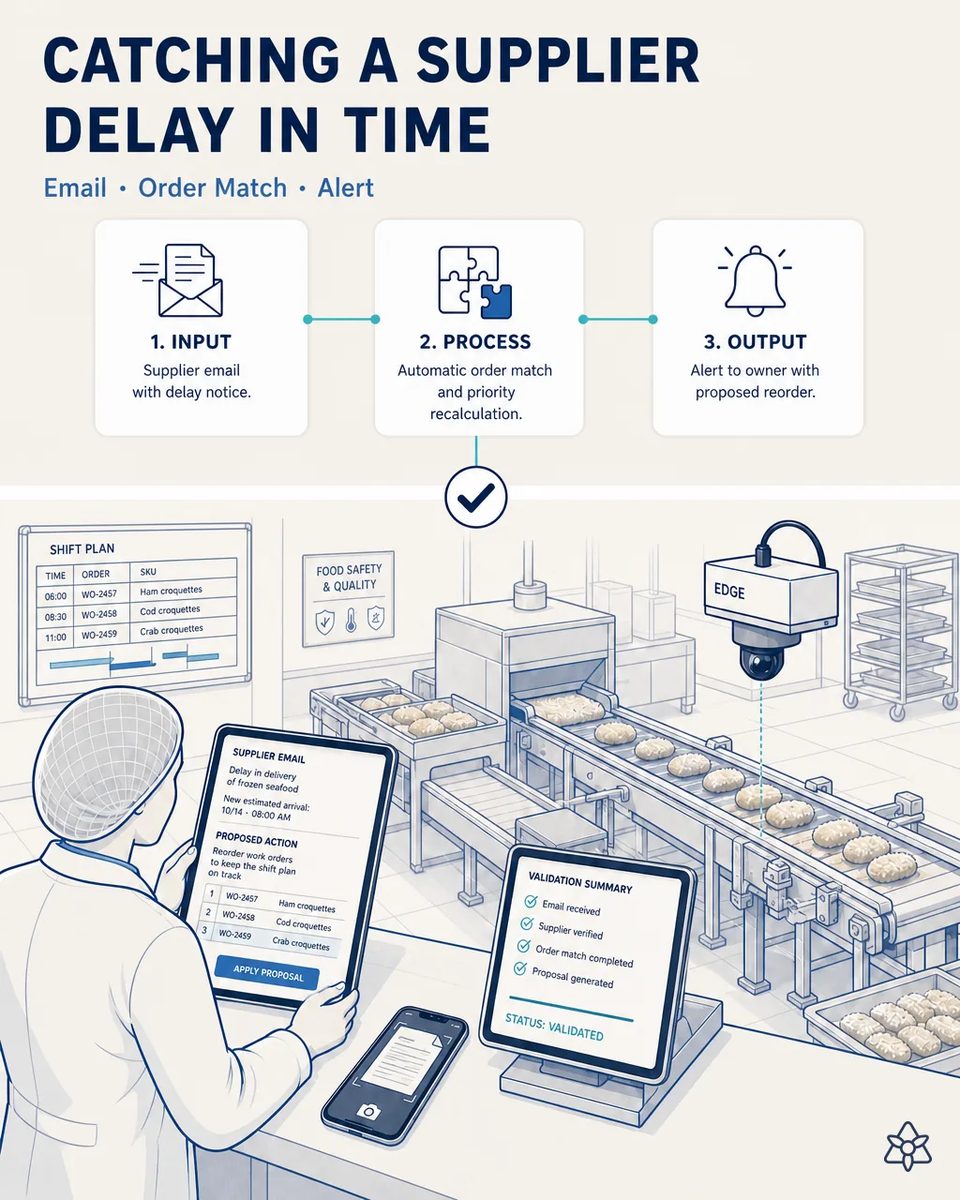
The message that breaks the week arrives by email, to one inbox, read late.
The seafood or Iberian ham supplier emails a delay warning. It lands in an inbox checked late in the day, once a work order is already planned around that ingredient.
- The fresh cod supplier, the Iberian ham trimmings supplier or the seasonal mushroom grower sends a delay warning by email. It lands in an inbox that gets checked at the end of the day.
- By then the work order built around that ingredient is planned, the batter room has its schedule and the online store is still selling a SKU that will not be made this week.
- Premium ingredients have a short shelf life and no substitute: you cannot swap Iberian ham for a generic one in a product sold as gourmet without breaking the label and the promise behind it.
- Read two or three hours late, the alert costs a stopped line and a batter room with nothing to do; read in minute one, it is a change of sequence nobody outside the plant ever notices.
Connect in chaotic-sources mode — the email is read, extracted and crossed.
iLEAN reads the email in zero seconds, extracts the intent and the affected ingredient, and cross-checks it against the active work orders in the ERP. Instead of forwarding the email, iLEAN proposes the action: which SKU to bring forward and which to reschedule, handing the production lead a ready-made decision.
Finding out sooner is not enough. What changes the shift is knowing which work orders use that ingredient and what to run instead — and that is what comes back: which SKU to bring forward and which to reschedule, ready for the production lead to accept or discard. Instead of one more forwarded email, a decision that is already made and only needs a signature.
Today's supplier alert versus the crossed alert
| Aspect | Today, in the inbox | With iLEAN Connect |
|---|---|---|
| When it is read | End of the day | In seconds |
| Which runs it affects | Worked out by hand | Crossed against the open work orders |
| What you receive | A forwarded email | A proposed resequencing |
| A short-shelf-life ingredient | Arrives with the line stopped | Arrives into a replanned slot |
| The online store's stock | Selling what will not be made | Corrected with the replan |
| Who decides | Whoever opens the email | The production lead — iLEAN proposes |
Supplier alert read 2-3 hours late, line blocked → Alert processed in seconds, immediate replanning.
Impact estimate — to be validated with your numbers.
The block below is an estimate to be validated against your plant's actual data. We put it forward so the committee has an order of magnitude; we refine it during the assessment.
- Estimated payback 3-7 months, depending on how often critical alerts happen for short-shelf-life ingredients.
- Line stoppages that turn into a change of sequence instead of an idle batter room and a shift of people with nothing to form.
- Premium raw material that stops being written off because it arrived against a plan nobody moved in time.
- And a store that stops promising a SKU the plant already knows it cannot make this week, which in direct sales is a cancelled order and a refund, not an internal delay.
Payback 3-7 months · from hours blocked to replanning in seconds. Estimated payback is 3 to 7 months depending on how often critical supplier alerts happen for short-shelf-life ingredients. Estimate to validate.
And the fair question from the production manager
"Are you going to read our whole mailbox?" — no. iLEAN sits in copy on the operational address used with suppliers and sees only what is sent there. On the extraction itself, classifying the intent of a supplier message and pulling out the ingredient and the new date is an anchored task, where the best models drop below 1.5% error [1] — and the replan is proposed, never applied on its own.
[1] OpenAI paper "Why Language Models Hallucinate", 2025 — on the reliability of AI in anchored tasks.
What people ask about reading supplier alerts
Does it tell a real delay from a routine message?
Yes, and that distinction is the whole point: two days late on fresh cod moves the week, while a price list update or a delivery confirmation interrupts nobody. Only what changes the plan is escalated.
Does it know which work orders use that ingredient?
When it is crossed with the ERP, yes. That is the difference between an alert and a replan: the ingredient is matched to the recipes that carry it and to the runs already scheduled around them.
What if the supplier writes from a phone instead of by email?
The same applies to a message on an operational company number, which is how a good part of the traffic with small artisan suppliers actually arrives. What matters is that the channel is the one used with suppliers, never a personal one.
Can it change the plan on its own?
No. It proposes a resequencing with the affected SKUs listed and the consequences of each option, and the production lead applies it with one tap or ignores it entirely.
Does it work with suppliers writing in another language?
Yes. Intent extraction does not depend on the language of the message, which matters with imported seafood, specialty cheese and seasonal produce bought abroad.
More cases from this series
- Paperless Batch Start for Gourmet Croquette PlantsiLEAN Connect digitizes the work order and recipe sheet the moment a gourmet croquette batch starts,…
- The Production Lead Reports Without StoppingThe production lead logs incidents by voice while walking the line, hands-free, without ever stopping…
- The IQF Freezing Tunnel Starts TalkingAn external camera reads the IQF freezing tunnel's panel and digitizes its temperature curve without…
- Online Orders Stop Being Re-TypedOnline store and HORECA orders flow automatically into the production system, with no manual re-entry.
- The Quality Spreadsheet Stops Living on Its OwniLEAN reads the lab's quality control spreadsheet and pushes it into the ERP after validation, cutting…
- The Delivery Note Photo That Skips Double EntryA single photo of the delivery note and lot labels pushes ingredient receiving into the ERP, cutting up…
Tell us what the last ingredient delay you found out about too late ended up costing you in stopped hours and wasted raw material.
We work on your plant's real data, not ours. Assessment with no commitment.
Request estimated ROI within 48h ‹ See all cases of gourmet croquettes and appetizers See food industry