Machine telemetry decides how much to make
The vending machines already report sales and stock through telemetry. The kitchen plans the next day's production in a different system. In between, someone exporting and re-adjusting by hand, or gut feeling. iLEAN Connect links the telemetry system and the kitchen plan through APIs. What sells in each machine and route automatically feeds the production proposal per recipe.
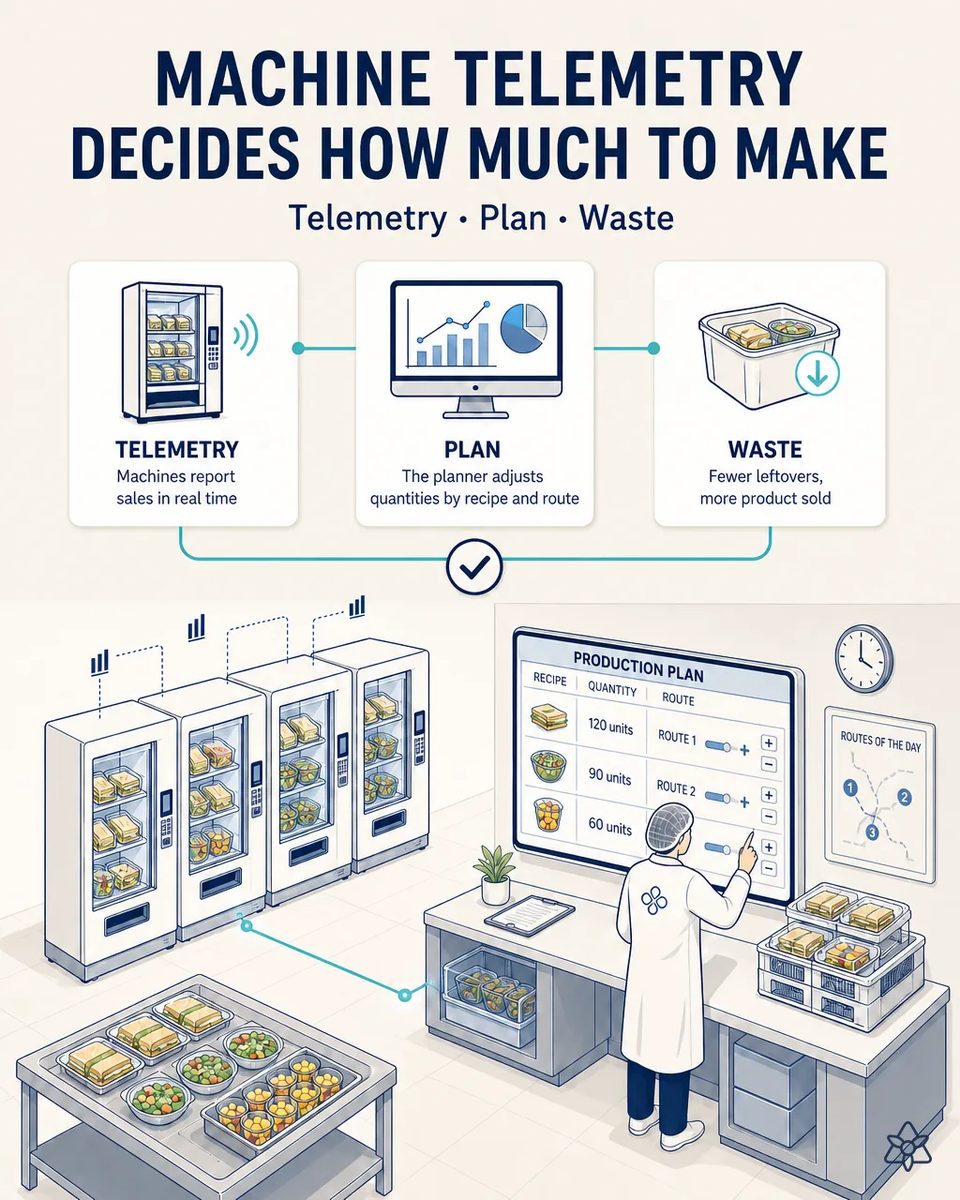
The machines report every sale, and the kitchen plans as if they did not.
The vending machines already report sales and stock through telemetry. The kitchen plans the next day's production in a different system. In between, someone exporting and re-adjusting by hand, or gut feeling. A fresh sandwich or salad expires in a few days. Making too much is waste pulled from the machine; making too little is an empty spiral and a lost sale.
- The vending machines already report sales and stock through telemetry. The kitchen plans the next day's production in a different system, and the two do not talk.
- In between there is someone exporting files and adjusting by hand, or simply gut feeling about what the route will need.
- A fresh sandwich or salad has a shelf life of a few days. Making too much is expiry waste pulled from the machine by the route driver; making too little is an empty spiral and a lost sale.
- With thousands of machines and hundreds of routes, no manual adjustment keeps up, so the same recipes are wasted on the same routes week after week. Nobody has the hours to look at each machine.
Connect stitching telemetry and the kitchen plan by API — replacing neither system.
iLEAN Connect links the telemetry system and the kitchen plan through APIs. What sells in each machine and route automatically feeds the production proposal per recipe. iLEAN proposes quantities per recipe and route; the planner reviews and adjusts them with their own judgment, for a holiday or an event, for example.
What sells in each machine and on each restocking route feeds the production proposal per recipe automatically. The planner still decides, and still knows that a holiday or an event on site changes everything; what changes is that they start from real sales instead of from a blank sheet. Expiry waste stops being a fixed cost and becomes a number the kitchen can steer.
Planning by export versus planning from telemetry
| Aspect | Today | With iLEAN Connect |
|---|---|---|
| Input to tomorrow's plan | Manual exports and intuition | Yesterday's sales per machine |
| Quantity per recipe and route | Rounded up to be safe | Proposed from real demand |
| Expiry waste pulled by route drivers | Accepted as a cost | Down 20 to 40% |
| Empty spirals at peak hours | Noticed by the customer | Fewer |
| Holiday or on-site event | Same plan as any day | Adjusted by the planner |
| Telemetry and planning systems | Two islands | Both kept, now connected |
Plan by gut feeling and manual exports → proposal per recipe and route from real sales; expiry waste −20 to −40%.
Impact estimate — to be validated with your telemetry and waste data.
The block below is an estimate to be validated against your plant's actual data. We put it forward so the committee has an order of magnitude; we refine it during the assessment.
- Estimated payback 3-6 months, the shortest in this matrix.
- Estimated expiry waste reduction of 20 to 40%.
- Fewer empty slots in the machines, which is sales recovered without adding a single machine. On a fleet of thousands of refrigerated machines, those slots add up quickly.
- And neither the telemetry platform nor the planning system has to be replaced.
Payback 3-6 months · expiry waste cut by 20-40% (estimate to be validated). Less expiry waste and fewer empty slots, without replacing either system. Estimated waste reduction of 20 to 40%, payback of 3 to 6 months. Estimate to be validated.
And the fair question from the production manager
“A forecast is only as good as the data — what about holidays and one-off events?” — that is why the planner keeps the last word. The proposal comes from real sales per machine and route, and matching telemetry records to recipes and routes is an anchored task, where the best models drop below 1.5% error [1]. The holiday, the trade fair in the building or the canteen closed for works are the planner's judgment, and the adjustments they make feed the next proposals.
[1] OpenAI paper "Why Language Models Hallucinate", 2025 — on the reliability of AI in anchored tasks.
What people ask about planning the kitchen from machine telemetry
Do we have to change our telemetry platform?
No. iLEAN connects to the platform you already have through its API, and to the planning system on the other side. Setting up the connection is usually the fastest part of the project, because both systems already expose their data.
Is the proposal per machine or per route?
Per recipe and route, built up from each machine's sales and stock. That is the level at which the kitchen produces and the route driver loads. Proposals are grouped the way your restocking routes are built, so the planner reviews them in the order the kitchen works.
How does it handle a new recipe with no sales history?
It starts from similar recipes on the same routes and the planner sets the first quantities. After a few days the machine's own sales take over. New recipes are also where gut feeling costs most, so starting from comparable sales on the same routes reduces the risk of a bad launch.
Does it account for product still in the machine?
Yes. Stock reported by telemetry and the use-by date of what is already in the spiral are part of the calculation, not just yesterday's sales. That avoids making more of a salad when the machine still holds units with two days of shelf life left.
Where does the waste reduction come from?
From not making product the route will not sell before its use-by date. The estimated 20 to 40% is checked against your own waste records. Most of the gain comes from a handful of recipes and routes that are consistently overproduced, which the data makes obvious within weeks.
More cases from this series
- Allergen recipe changeover validated by cameraEdge cameras validate clean-downs between allergen recipes; the line does not restart without visual OK…
- The food-safety audit, always readyiLEAN Agents organizes HACCP, cleaning and temperature evidence by batch: audits and tenders always…
- The blast chiller that now talksA camera reads the blast chiller panel and records each batch's chilling curve without replacing the…
- Fresh goods receiving with one photoFresh goods receiving with one photo: delivery note, batch, use-by and temperature into the ERP with one…
- From the HACCP spreadsheet to the ERP without retypingFrom the HACCP spreadsheet to the ERP without retyping, with human validation and up to 80% fewer…
- The kitchen lead speaks, iLEAN takes notesThe kitchen lead dictates with gloves on; iLEAN structures the issue and replies with support in…
Tell us what share of your fresh product ends as expiry waste today.
We work on your plant's real data, not ours. Assessment with no commitment.
Request estimated ROI within 48h ‹ See all cases of fresh-food vending See food industry