The blast chiller that now talks
In the kitchen, cooked chicken, egg or pasta go through the blast chiller before sandwiches and salads are assembled. That rapid chilling is a HACCP critical control point. The chiller panel shows the curve, but it is connected to nothing. iLEAN Connect adds an external camera that reads the chiller screen every few seconds, without touching the machine. iLEAN rebuilds the full curve and links it to the batch inside.
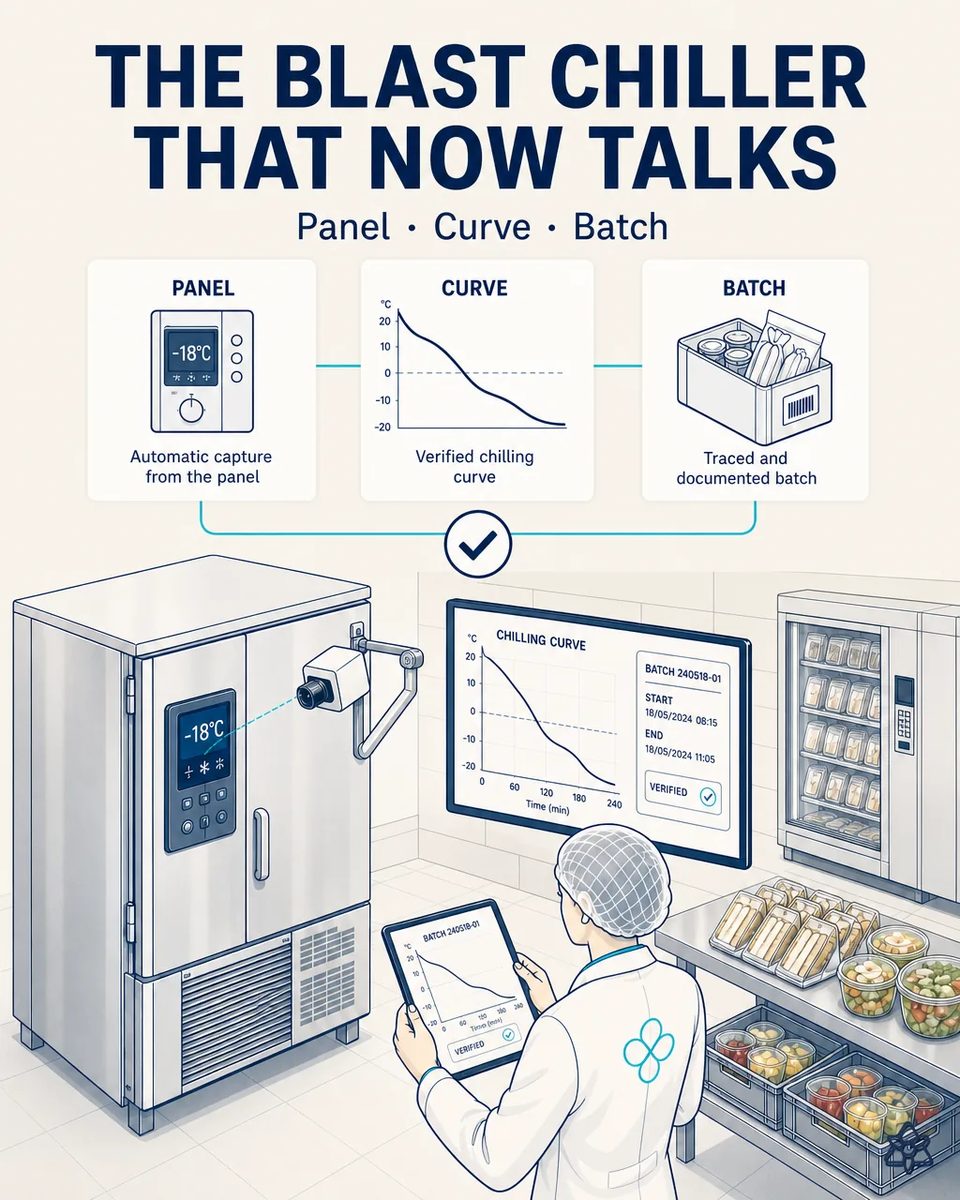
The critical control point records its curve on a screen that forgets it.
In the kitchen, cooked chicken, egg or pasta go through the blast chiller before sandwiches and salads are assembled. That rapid chilling is a HACCP critical control point. The chiller panel shows the curve, but it is connected to nothing. Someone writes the final temperature on a sheet, or the curve disappears when the next cycle starts. Replacing the chiller with a connected one is expensive and unnecessary.
- Cooked chicken, boiled egg and pasta go through the blast chiller before sandwiches and salads are assembled. That rapid chilling is a HACCP critical control point, and it is the one where cooked ingredients are most exposed.
- The chiller panel shows the whole curve while the cycle runs. It is connected to nothing, so when the next cycle starts, the curve is gone. The kitchen trusts it while it runs and loses it once it ends.
- What survives is a final temperature written on a sheet, sometimes with the time it was read and sometimes without. An auditor sees one number; nobody sees how it got there.
- Replacing working chillers with connected ones is an expensive capex line for a data problem, and it does not fix the units already in the kitchen.
Connect reading the chiller screen — solved from the outside, without opening the machine.
iLEAN Connect adds an external camera that reads the chiller screen every few seconds, without touching the machine. iLEAN rebuilds the full curve and links it to the batch inside. If a cycle misses the target temperature within the set time, iLEAN alerts the quality lead before that ingredient reaches the assembly table. The person decides.
The camera reads what the chiller already displays, every few seconds, and iLEAN rebuilds the curve. The machine is not touched and its warranty is not at stake; the kitchen simply stops losing the record of its most sensitive step. And because each curve is tied to its batch, the evidence follows the cooked ingredient into the sandwich and onto the restocking route.
Today's blast chiller versus the chiller being read
| Aspect | Today | With iLEAN Connect |
|---|---|---|
| Chilling record | One final temperature on paper | Full curve per cycle |
| Which batch was inside | Inferred from the time | Linked to the batch code |
| Cycle missing its target | Found at audit, if at all | Alert during the cycle |
| Ingredient reaching assembly | No check against the curve | Held until quality decides |
| The chiller's controller | — | Untouched |
| Chiller replacement | In the capex plan | Not needed for the data |
Final temperature handwritten or lost → full curve per batch; deviation found at audit → alert during the cycle.
Impact estimate — to be validated with your kitchen's chilling cycles.
The block below is an estimate to be validated against your plant's actual data. We put it forward so the committee has an order of magnitude; we refine it during the assessment.
- Estimated payback 5-10 months.
- A complete chilling record for every batch, with no paper and no new machine.
- A deviation that used to surface at audit now triggers an alert while the cycle is still running.
- And the cooked ingredient that missed its target stops reaching the assembly table unnoticed. That is food safety protected before assembly, not explained after a complaint.
Payback 5-10 months · batch-by-batch chilling record without replacing the chiller (estimate to be validated). A complete chilling record for every batch, with no paper and no new machine. Estimated payback of 5 to 10 months. Estimate to be validated.
And the fair question from the production manager
“Does a camera reading a chiller display hold up in front of a health inspector?” — the task is anchored: a fixed screen, digits in known positions and a physically possible temperature range, where the best models drop below 1.5% error [1]. Any frame whose value falls outside that range is discarded rather than recorded, and the quality lead signs the deviations, not the camera.
[1] OpenAI paper "Why Language Models Hallucinate", 2025 — on the reliability of AI in anchored tasks.
What people ask about reading the blast chiller
Does the chiller's controller or warranty get involved?
No. The camera sits outside the machine on its own bracket and reads the screen like a person would. Nothing is wired into the chiller. That is why maintenance and the chiller supplier usually approve it quickly: there is nothing for them to revalidate.
How does it know which batch is inside the chiller?
From the batch already captured on the production sheet and the cycle start shown on the panel. The quality lead can correct the link on the tablet if two batches share a cycle. That link is what turns a curve into evidence: an inspector can see which chicken or pasta batch went through which cycle.
What happens when a cycle misses its target in time?
iLEAN alerts the quality lead during the cycle, before that ingredient reaches the assembly table. The decision to extend, rework or discard stays with the person. The alert reaches the quality lead on the tablet or by message, with the curve attached, so the decision is made on data and not on a guess.
Is a curve better than the final temperature for HACCP?
It shows how the product got there, which is what a critical control point is meant to prove. A single reading cannot show a slow start that recovered at the end. It also lets quality see trends across weeks, such as a chiller that takes longer every Monday because it is overloaded after the weekend.
Can one camera cover several chillers?
It depends on the layout of the kitchen. Usually each panel gets its own camera, because the framing has to be stable for the reading to be reliable. Mounting is done in a few hours per chiller and does not stop production: the camera is fixed outside the cooking area's work zone.
More cases from this series
- Allergen recipe changeover validated by cameraEdge cameras validate clean-downs between allergen recipes; the line does not restart without visual OK…
- The food-safety audit, always readyiLEAN Agents organizes HACCP, cleaning and temperature evidence by batch: audits and tenders always…
- Fresh goods receiving with one photoFresh goods receiving with one photo: delivery note, batch, use-by and temperature into the ERP with one…
- From the HACCP spreadsheet to the ERP without retypingFrom the HACCP spreadsheet to the ERP without retyping, with human validation and up to 80% fewer…
- The kitchen lead speaks, iLEAN takes notesThe kitchen lead dictates with gloves on; iLEAN structures the issue and replies with support in…
- Snap the kitchen production sheetOne photo of the kitchen production sheet and the fresh batch exists in the system instantly, with…
Tell us how many chilling cycles a day leave no curve in your kitchen.
We work on your plant's real data, not ours. Assessment with no commitment.
Request estimated ROI within 48h ‹ See all cases of fresh-food vending See food industry