From the HACCP spreadsheet to the ERP without retyping
Every shift, quality fills in a spreadsheet in a shared folder: cold-room temperatures, vegetable sanitizing, finished-product checks. That live data does not reach the ERP until someone retypes it, sometimes weeks later. The quality lead validates it on screen and iLEAN posts it to the ERP through the API. Nobody in the lab types anything into the ERP.
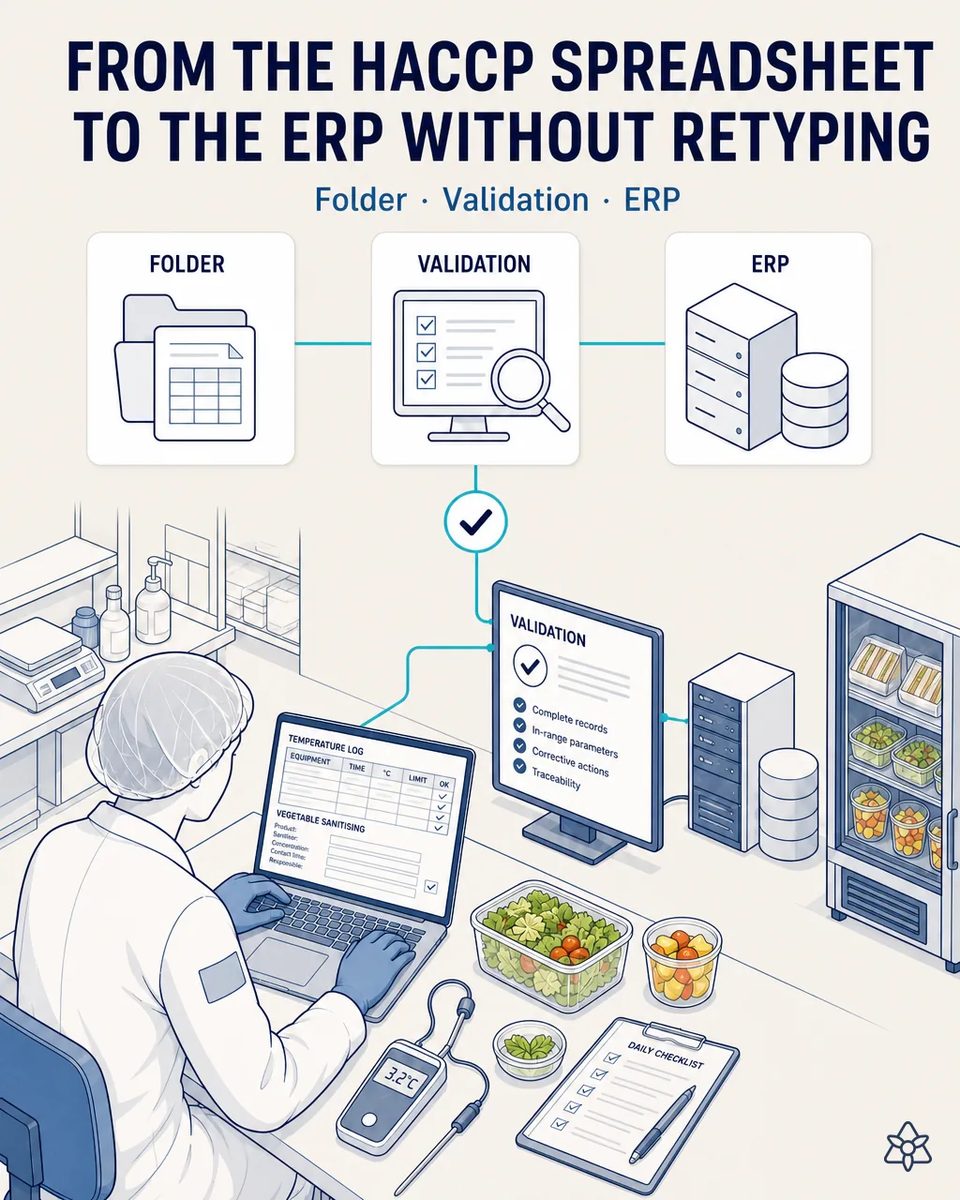
The HACCP data is taken every shift and reaches the ERP weeks later.
Every shift, quality fills in a spreadsheet in a shared folder: cold-room temperatures, vegetable sanitizing, finished-product checks. That live data does not reach the ERP until someone retypes it, sometimes weeks later.
- Every shift, quality fills in a spreadsheet in a shared folder: cold-room temperatures, vegetable sanitizing, finished-product checks. The format works for the people filling it in; the problem is everything that happens after the file is saved.
- That data is live, but the ERP only sees it when somebody retypes it, sometimes weeks later and usually in a rush before an audit. By then the data is history, not control.
- Retyping costs half a day a month and brings its own errors: a decimal lost, a cold room swapped for another, a sanitizing record attached to the wrong date.
- And every person who logs into the ERP only to enter quality records is one more license, paid every month for typing.
Connect watching the shared folder — it reads the spreadsheet, quality validates, the ERP receives.
iLEAN Connect observes the shared folder: when the file is saved, it reads what is new, interprets it with a grounded model and prepares the record. The quality lead validates it on screen and iLEAN posts it to the ERP through the API. Nobody in the lab types anything into the ERP. If five people log into the ERP today only to enter quality records, that is five licenses. With Connect, only the validator needs one: a typical 50 to 80% cut in quality-module licenses.
Quality keeps its spreadsheet exactly as it is. When the file is saved, iLEAN reads what is new, prepares the record and the quality lead validates it on screen. Nobody in the lab types into the ERP, and only the validator needs a license. The ERP finally reflects the kitchen the same day, and the license bill shrinks with it. Quality changes nothing, and the ERP stops lagging behind the kitchen.
The HACCP spreadsheet on its own versus the spreadsheet feeding the ERP
| Aspect | Today | With iLEAN Connect |
|---|---|---|
| Lag from spreadsheet to ERP | Weeks | Seconds after validation |
| Retyping effort | Half a day a month | None |
| Cold-room temperature records | Copied with typos | Posted as entered |
| Vegetable sanitizing log | Detached from the batch | Cross-checked by batch |
| Spreadsheet layout | Must not change | Can change; it is interpreted |
| ERP licenses for quality entry | 5 | 1, the validator |
Weeks of lag and half a day a month retyping → records in the ERP in seconds; 5 licenses → 1.
Impact estimate — to be validated against your ERP license invoice.
The block below is an estimate to be validated against your plant's actual data. We put it forward so the committee has an order of magnitude; we refine it during the assessment.
- Estimated payback 4-9 months.
- A typical cut of 50 to 80% in quality-module ERP licenses: if five people log in only to enter records, the validator is the one who still needs access. The saving repeats every month, which is why it is often the line finance notices first.
- Weeks of lag turned into seconds, with half a day a month of retyping recovered.
- And audits answered with batch-level cross-checked data instead of a spreadsheet printed the night before. The quality team spends its time on control, not on transcription.
Payback 4-9 months · -50 to -80% quality-module ERP licenses (estimate to be validated). Weeks of lag turned into seconds, audits with batch-level cross-checked data and recurring license savings. Estimated payback of 4 to 9 months. Estimate to be validated.
And the fair question from the production manager
“Every shift fills in the spreadsheet a little differently — will it cope?” — yes, that is expected. Parsing does not depend on fixed cell positions: a grounded model interprets columns, units and notes, which makes it an anchored task where the best models drop below 1.5% error [1]. And nothing reaches the ERP until the quality lead has seen it on screen.
[1] OpenAI paper "Why Language Models Hallucinate", 2025 — on the reliability of AI in anchored tasks.
What people ask about moving HACCP records into the ERP
Do we have to redesign the HACCP spreadsheet?
No. It is read as it is today, and if somebody adds a column next month it keeps working, because it is interpreted rather than mapped cell by cell. Quality keeps using the tool it already knows, and the ERP receives clean records from the first week.
Does it read the files or watch the people filling them in?
The files. iLEAN observes the shared folder and acts when a file is saved; there is no tracking of who types or when. That separation matters to the quality team and is part of what makes the case easy to approve internally.
What if a cold-room temperature is out of range?
It is flagged to the quality lead before validation, so the corrective action can be recorded alongside the reading instead of discovered later. That turns a reading on a spreadsheet into a documented HACCP event with its corrective action attached.
Is the license cut realistic?
If people log into the quality module only to enter records, yes: they stop needing access. A typical cut is 50 to 80%, to be checked against your contract. The validator keeps full access; the others keep read access if they need it, which usually costs far less.
Does the sanitizing log get linked to the batches it affects?
Yes, by date, shift and line. That is what lets an auditor see which batches came from vegetables sanitized under which record. It closes the gap auditors most often point at: the sanitizing record existed, but nobody could say which product it covered.
More cases from this series
- Allergen recipe changeover validated by cameraEdge cameras validate clean-downs between allergen recipes; the line does not restart without visual OK…
- The food-safety audit, always readyiLEAN Agents organizes HACCP, cleaning and temperature evidence by batch: audits and tenders always…
- The blast chiller that now talksA camera reads the blast chiller panel and records each batch's chilling curve without replacing the…
- Fresh goods receiving with one photoFresh goods receiving with one photo: delivery note, batch, use-by and temperature into the ERP with one…
- The kitchen lead speaks, iLEAN takes notesThe kitchen lead dictates with gloves on; iLEAN structures the issue and replies with support in…
- Snap the kitchen production sheetOne photo of the kitchen production sheet and the fresh batch exists in the system instantly, with…
Tell us how many people log into your ERP only to enter quality records.
We work on your plant's real data, not ours. Assessment with no commitment.
Request estimated ROI within 48h ‹ See all cases of fresh-food vending See food industry