Snap the kitchen production sheet
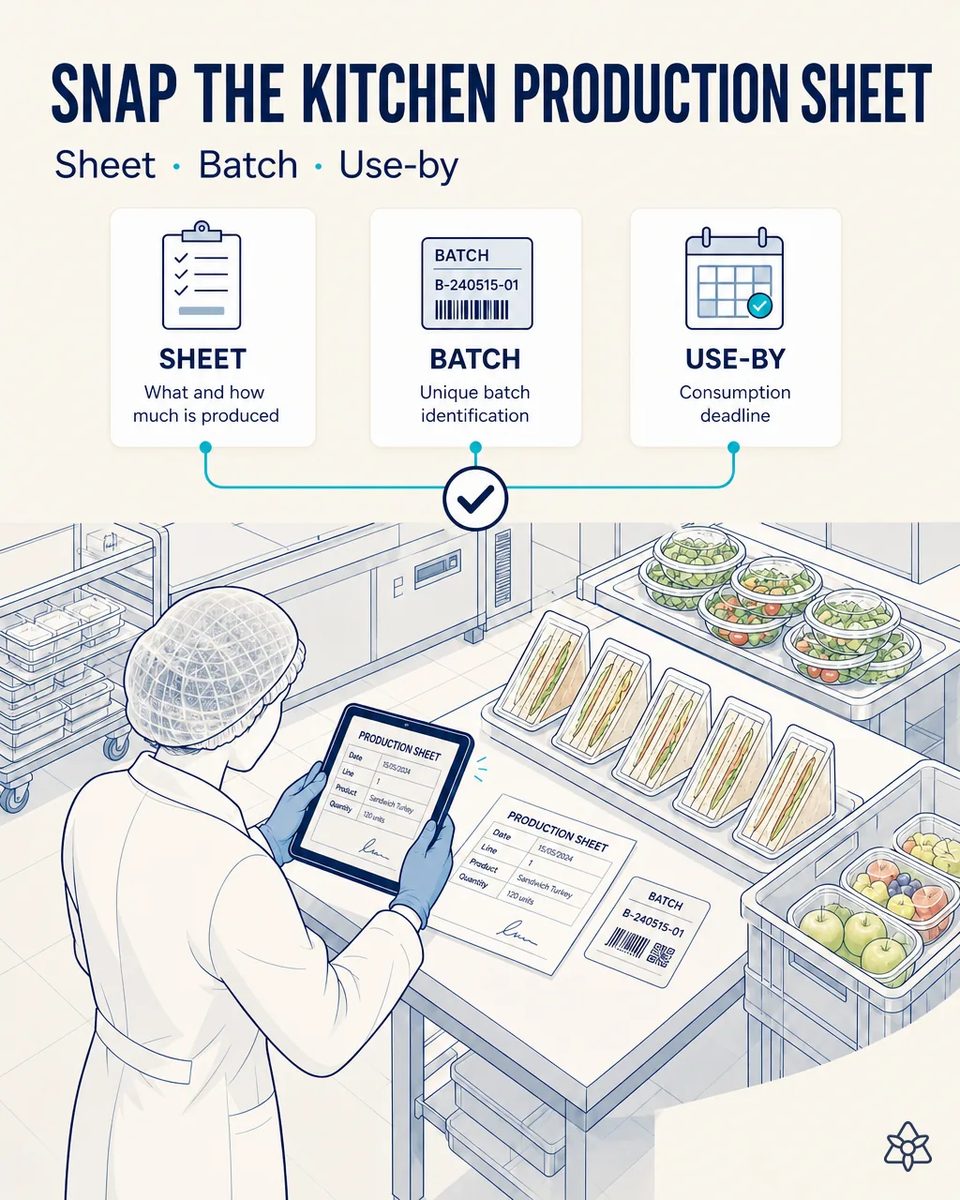
In a central kitchen that prepares sandwiches, salads and cut fruit for thousands of vending machines, every shift starts with a printed production sheet: recipe, quantity, batch and use-by date. The day's changes are handwritten on top. With iLEAN Connect, the line lead takes a photo of the sheet and the first label. iLEAN reads the layout, extracts recipe, batch, quantity and use-by date, and stores it in central memory. No change of habit.
The sheet that says what was made reaches the system when the product is already on the road.
In a central kitchen that prepares sandwiches, salads and cut fruit for thousands of vending machines, every shift starts with a printed production sheet: recipe, quantity, batch and use-by date. The day's changes are handwritten on top. That sheet reaches the system hours later, when someone types it in. For a product that expires in a few days, every hour without data is an hour without knowing which batch goes on which route.
- Every shift in the central kitchen starts with a printed production sheet: recipe, quantity, batch and use-by date. Then the day happens on top of it, in pen: a recipe swapped because the lettuce came in short, an extra run of chicken wraps, a batch split in two.
- Those handwritten changes are exactly what the ERP never sees until somebody types the sheet in, hours later or the next morning.
- Meanwhile the trays have left the cold room and the route drivers are loading them. For a product with a shelf life of a few days, that gap is a large share of its life. The route driver knows the machine, not the batch.
- If a customer calls about a sandwich in a hospital machine, rebuilding which batch went on which restocking route means pulling paper from a folder and asking the dispatch team from memory.
Connect in photo mode — the line lead adds one photo to the sheet they already fill in.
With iLEAN Connect, the line lead takes a photo of the sheet and the first label. iLEAN reads the layout, extracts recipe, batch, quantity and use-by date, and stores it in central memory. No change of habit. Before anything enters the system, the line lead sees the summary on the tablet and confirms it with two taps. The AI reads; the person decides.
Nothing changes on the assembly table: the same sheet, the same pen, the same first label. What changes is that the batch is born digital in the same minute it is born physically, and that is the minute traceability to the vending machine begins. It is also the case every other one leans on, because a batch that exists from minute one is what the chiller, the route and the machine can later be linked to.
The paper production sheet versus the photographed sheet
| Aspect | Today, on paper | With iLEAN Connect |
|---|---|---|
| Batch visible in the system | Hours later, when typed | From minute one, validated |
| Recipe swapped mid-shift | A pen mark nobody transcribes | Extracted and tied to the batch |
| Use-by date on the first label | Copied by hand | Read from the photo |
| Batch to restocking route | Rebuilt from paper and memory | One lookup |
| Complaint from a machine | Hunt through the folder | Query by batch code |
| The line lead's routine | — | Same sheet plus one photo |
Paper sheet retyped hours later → validated digital batch from minute one; batch → route → machine traceability rebuilt by hand → instant lookup.
Impact estimate — to be validated with your kitchen's batch volume.
The block below is an estimate to be validated against your plant's actual data. We put it forward so the committee has an order of magnitude; we refine it during the assessment.
- Estimated payback 4-9 months, depending on the number of batches the central kitchen opens per day.
- From a paper sheet retyped hours later to a validated digital batch in seconds.
- Kitchen-to-machine traceability closes without typing: batch, route and machine in one query.
- Typing time recovered by the line leads and the office, which today goes on transcription instead of the line. That time usually lands on the busiest people in the kitchen.
Payback 4-9 months · from paper sheet to digital batch in seconds (estimate to be validated). The batch exists in the system from minute one, and kitchen-to-machine traceability closes without typing. Estimated payback of 4 to 9 months depending on batch volume. Estimate to be validated.
And the fair question from the production manager
“What if it misreads a handwritten quantity or a use-by date?” — reading fields from a sheet with a known layout, handwriting included, is an anchored task, where the best models drop below 1.5% error [1]. And there is a second net: the line lead sees the summary on the tablet and confirms it with two taps before anything enters the system. A low-confidence field is flagged, never guessed.
[1] OpenAI paper "Why Language Models Hallucinate", 2025 — on the reliability of AI in anchored tasks.
What people ask about photographing the kitchen production sheet
Does the production sheet layout have to change?
No. Vision reads the sheet exactly as your planning system prints it today, including the boxes the line leads fill in by hand. The line leads keep the same routine, and planning keeps the same template it already knows.
Why photograph the first label as well as the sheet?
Because the label is what actually travels to the vending machine. Reading both confirms that the batch code and use-by date printed match what the sheet says was made. If the two disagree, the mismatch shows on the tablet before the batch is confirmed, not after the trays have left on the restocking route.
What happens with a recipe swapped halfway through the shift?
That pen mark is the most valuable line on the sheet. It is extracted like any other field and linked to the batch, so the change is not lost between shifts. The next shift starts already knowing what the previous one actually made, which is rarely what the printed sheet said.
Does it work for sandwiches, salads and cut fruit alike?
Yes. The sheet is the same document whatever the recipe; what varies is the shelf life, and that comes in with the use-by date read from the label. Cut fruit usually carries the shortest window, so it is where a batch existing from minute one makes the biggest difference to dispatch.
Do we need the ERP connected from day one in a vending kitchen?
No. Batches are stored in iLEAN's central memory from the first shift and the push to the ERP is connected afterwards, once the value is visible. Most kitchens start with one assembly line and one shift, then extend once the line leads see the batch appear on the screen in seconds.
More cases from this series
- Allergen recipe changeover validated by cameraEdge cameras validate clean-downs between allergen recipes; the line does not restart without visual OK…
- The food-safety audit, always readyiLEAN Agents organizes HACCP, cleaning and temperature evidence by batch: audits and tenders always…
- The blast chiller that now talksA camera reads the blast chiller panel and records each batch's chilling curve without replacing the…
- Fresh goods receiving with one photoFresh goods receiving with one photo: delivery note, batch, use-by and temperature into the ERP with one…
- From the HACCP spreadsheet to the ERP without retypingFrom the HACCP spreadsheet to the ERP without retyping, with human validation and up to 80% fewer…
- The kitchen lead speaks, iLEAN takes notesThe kitchen lead dictates with gloves on; iLEAN structures the issue and replies with support in…
Tell us how many hours a batch takes to exist in your system today.
We work on your plant's real data, not ours. Assessment with no commitment.
Request estimated ROI within 48h ‹ See all cases of fresh-food vending See food industry