The food-safety audit, always ready
Health inspections, institutional customer audits, public tender requirements: all ask for proof of HACCP, cleaning, temperatures and traceability. Today someone spends weeks rebuilding it from paper. iLEAN Agents automatically organizes that evidence by batch, by period and by standard: HACCP, customer requirements or schemes such as IFS if certified.
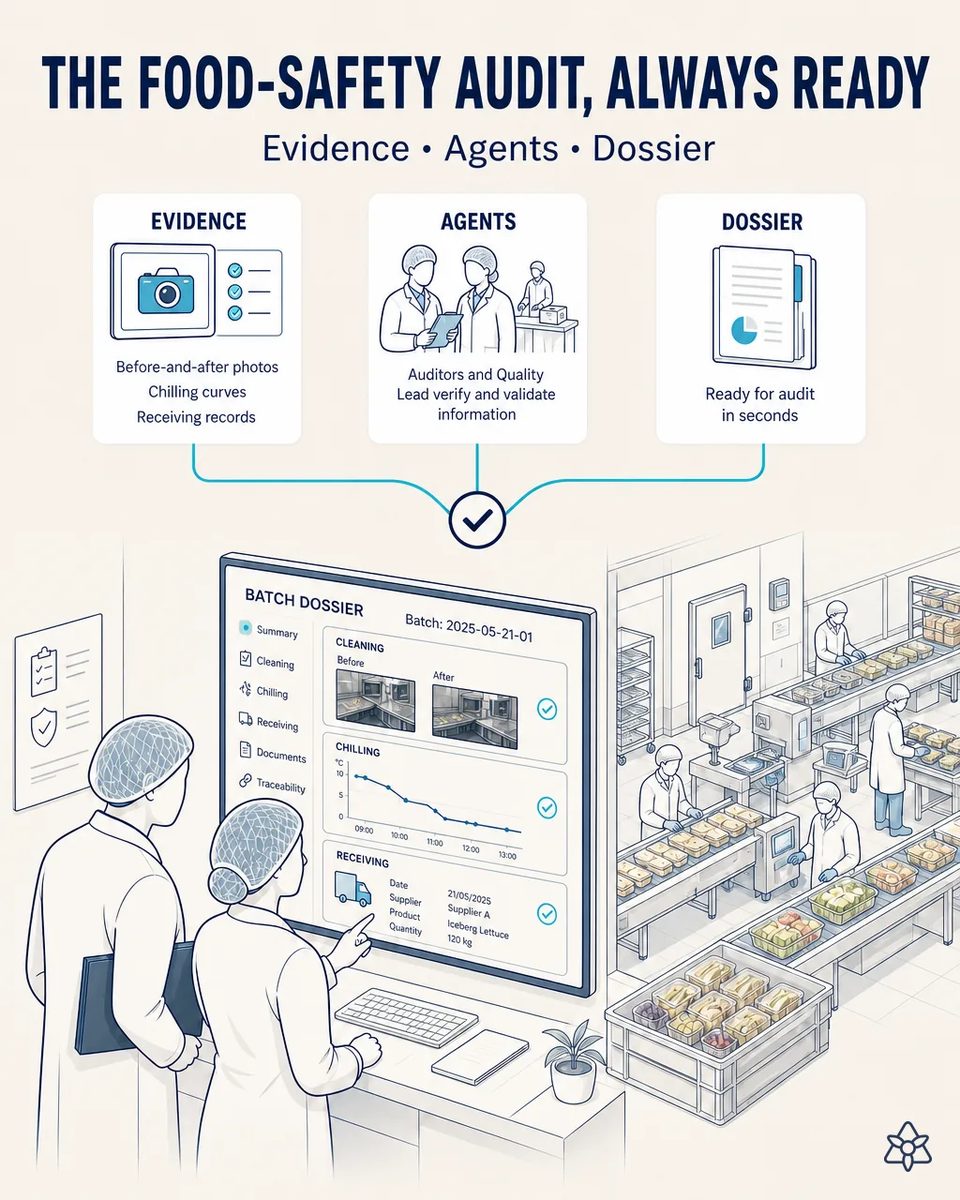
The proof exists, scattered, and it is rebuilt by hand every time someone asks.
Health inspections, institutional customer audits, public tender requirements: all ask for proof of HACCP, cleaning, temperatures and traceability. Today someone spends weeks rebuilding it from paper.
- Health inspections, audits by institutional customers and public tender requirements all ask for the same thing: proof of HACCP, cleaning, temperatures and traceability.
- Today someone spends weeks rebuilding it from paper, spreadsheets and photos on phones, for every request, and each request wants it in its own format. The same evidence gets gathered three times a year by the same people.
- Anything rebuilt after the fact inherits the gaps of whatever nobody wrote down, and that is precisely where non-conformities appear. A missing chilling record is found in front of the auditor instead of in the kitchen.
- For an operator that supplies hospitals, companies and public bodies, a weak dossier in a tender is a contract lost, not just a bad afternoon. The kitchen may be doing everything right and still score poorly because it cannot show it in time.
Agents on top of Connect and Edge — the dossier assembles itself by batch and standard.
With the previous pieces, every clean-down has its photo, every chilling cycle its curve, every delivery its batch and temperature. It only needs organizing. iLEAN Agents automatically organizes that evidence by batch, by period and by standard: HACCP, customer requirements or schemes such as IFS if certified. The quality lead reviews the dossier and shares it with the auditor through a web portal, with time-stamped photos, signatures and records.
With the previous cases in place, every clean-down already has its photo, every chilling cycle its curve, every delivery its batch and temperature. Agents organizes that evidence by batch, period and standard, and the quality lead reviews it before it is shared. The difference is direction: the dossier closes when the batch happens, not when the auditor calls. Nothing has to be remembered, scanned or chased the week before an inspection.
Rebuilding for each audit versus the dossier that is always there
| Aspect | Today | With iLEAN Agents |
|---|---|---|
| Preparing for a health inspection | Weeks of rebuilding | Dossier available instantly |
| Hospital or company customer audit | Same work, new format | Same evidence, another view |
| Public tender documentation | Assembled under deadline | Exported by period and standard |
| Chilling curves and cleaning photos | On paper or not at all | Linked to each batch |
| Gap in the records | Found by the auditor | Flagged when it happens |
| Sharing with the auditor | Email attachments and binders | Web portal with time stamps |
Weeks rebuilding paperwork → dossier by batch, period and standard available instantly.
Impact estimate — to be validated with your audit and tender calendar.
The block below is an estimate to be validated against your plant's actual data. We put it forward so the committee has an order of magnitude; we refine it during the assessment.
- Estimated payback 6-12 months.
- No more weeks rebuilding paperwork: a dossier by batch, period and standard available instantly. The quality team gets those weeks back for actual food-safety work.
- Fewer non-conformities caused by documentation gaps, because gaps are flagged when they occur. A missing record shows up the same day, while it can still be explained.
- And a strong argument in public tenders, where proving food safety is part of winning the contract. Evidence that used to take weeks to assemble can be attached to the bid the same day it is requested.
Payback 6-12 months · from weeks rebuilding to an instant dossier (estimate to be validated). No more weeks of rebuilding and fewer non-conformities from documentation gaps; a strong argument in tenders. Estimated payback of 6 to 12 months. Estimate to be validated.
And the fair question from the production manager
“Can an auditor trust a dossier assembled by software?” — the dossier is not written by the software; it is assembled from records captured at the moment they happened, each with its time stamp, photo or signature. Indexing those records by batch and standard is an anchored task, where the best models drop below 1.5% error [1], and the quality lead reviews the dossier before sharing it. Nothing in it can be edited after the fact without leaving a trace.
[1] OpenAI paper "Why Language Models Hallucinate", 2025 — on the reliability of AI in anchored tasks.
What people ask about the food-safety audit dossier
Which standards can the dossier be organized against?
HACCP, each institutional customer's requirements, and schemes such as IFS if you are certified. The evidence is the same; the index changes. When a new customer adds a requirement, it is mapped once and every future dossier already includes it.
How does the auditor access it?
Through a web portal scoped to the period and the scope of their audit, with time-stamped photos, signatures and records. They do not enter your systems. Access is time-limited and logged, so you always know who looked at what and when.
Does it help with public tender documentation?
Yes. Tender requirements are one more view of the same evidence, exported by period and standard instead of assembled under deadline. That matters for operators bidding for hospital and public-building contracts, where documentation weighs heavily in the score.
Does it need the Edge cases deployed first?
No. It organizes whatever is being captured. With receiving and the chiller panel alone, temperature and traceability evidence is already covered. As more cases go live, the dossier fills in on its own, from receiving through chilling to the allergen changeover.
What about records from before iLEAN in a vending kitchen?
They stay where they are. The dossier builds from the first day onward; bringing in older records is optional. Most operators see a complete dossier for the current period within a few months of starting.
More cases from this series
- Allergen recipe changeover validated by cameraEdge cameras validate clean-downs between allergen recipes; the line does not restart without visual OK…
- The blast chiller that now talksA camera reads the blast chiller panel and records each batch's chilling curve without replacing the…
- Fresh goods receiving with one photoFresh goods receiving with one photo: delivery note, batch, use-by and temperature into the ERP with one…
- From the HACCP spreadsheet to the ERP without retypingFrom the HACCP spreadsheet to the ERP without retyping, with human validation and up to 80% fewer…
- The kitchen lead speaks, iLEAN takes notesThe kitchen lead dictates with gloves on; iLEAN structures the issue and replies with support in…
- Snap the kitchen production sheetOne photo of the kitchen production sheet and the fresh batch exists in the system instantly, with…
Tell us how many weeks a year your quality team spends rebuilding audit paperwork.
We work on your plant's real data, not ours. Assessment with no commitment.
Request estimated ROI within 48h ‹ See all cases of fresh-food vending See food industry