Fresh goods receiving with one photo
Vegetables, cured meats, bread and dairy arrive. The receiving lead has a delivery note with many lines, batch and use-by labels, and an arrival temperature to record. Either the truck waits, or it gets recorded fast and wrong. The summary appears on the tablet, the lead validates it with one tap and iLEAN posts it to the ERP through the API. Ingredient-to-product traceability is closed at the door.
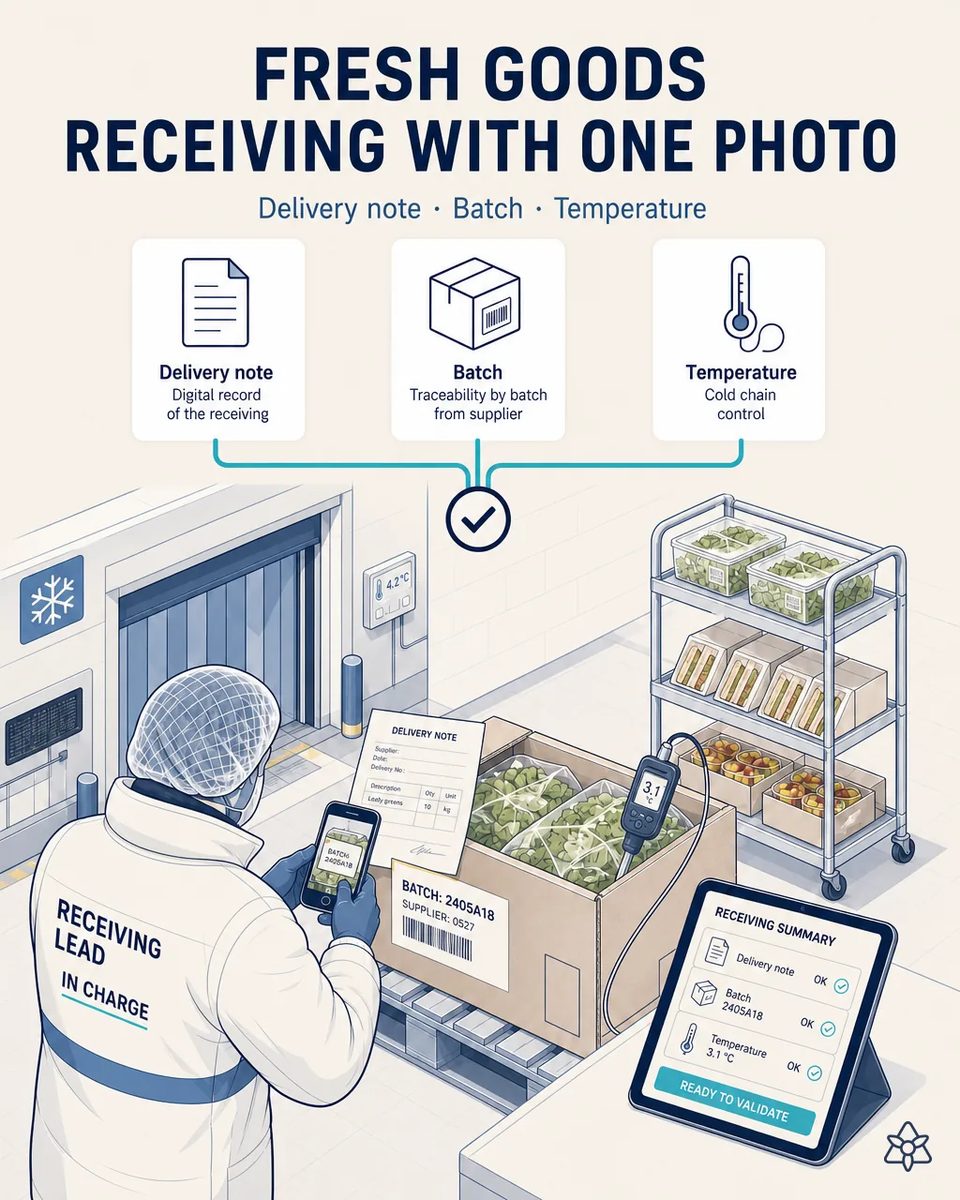
Traceability to the vending machine starts at the receiving door, under pressure.
Vegetables, cured meats, bread and dairy arrive. The receiving lead has a delivery note with many lines, batch and use-by labels, and an arrival temperature to record. Either the truck waits, or it gets recorded fast and wrong.
- Vegetables, cured meats, bread and dairy arrive every morning. The receiving lead has a delivery note with many lines, batch and use-by labels on each pallet and an arrival temperature to record. Several suppliers often arrive within the same hour, each with its own delivery note format.
- Either the truck waits while everything is typed, or it gets recorded fast and wrong. Both happen, often on the same morning. The receiving lead is rarely the problem; the volume is.
- A mistyped batch at receiving breaks the chain before it starts: if a supplier recalls a lettuce batch, nobody can say with certainty which sandwiches and which machines it reached.
- And the receiving module needs several active ERP licenses, paid every month for people whose real job is checking goods, not typing them.
Connect in photo mode at receiving — delivery note, labels and temperature, posted after one tap.
With iLEAN Connect, they photograph the delivery note and the pallet labels. iLEAN recognizes the layout, reads barcodes, GS1-128 or plain text, and extracts supplier, batch, quantity, use-by date and temperature. The summary appears on the tablet, the lead validates it with one tap and iLEAN posts it to the ERP through the API. Ingredient-to-product traceability is closed at the door. The receiving module usually needs several active licenses. With Connect, only the validator needs to log in: a typical 50 to 70% cut in receiving and warehouse licenses, plus fewer carrier waiting charges.
The receiving lead photographs what is already there: the supplier's delivery note and the pallet labels. iLEAN reads barcodes, GS1-128 or plain text, the lead validates on the tablet and the record goes to the ERP. Ingredient-to-product traceability is closed at the door. The truck leaves sooner and the ERP gets a record nobody typed. Nothing changes for the supplier or the carrier.
Typed receiving versus receiving from a photo
| Aspect | Today | With iLEAN Connect |
|---|---|---|
| Supplier truck at the door | Waits while lines are typed | Unloaded in minutes |
| Batch and use-by from labels | Keyed by hand, errors included | Read from barcode or text |
| Arrival temperature | Written on the delivery note | Captured with the record |
| Supplier recall of a lettuce batch | Days to trace | Sandwiches and machines in one query |
| Carrier waiting charges | Accepted as normal | Fewer |
| Receiving-module licenses | Several active users | 50 to 70% fewer |
Truck waiting and mistyped batches → unloading in minutes and full traceability from the door; receiving licenses −50 to −70%.
Impact estimate — to be validated with your daily deliveries.
The block below is an estimate to be validated against your plant's actual data. We put it forward so the committee has an order of magnitude; we refine it during the assessment.
- Estimated payback 3-8 months.
- A typical cut of 50 to 70% in receiving and warehouse licenses, since only the validator needs to log in.
- Much faster unloading, fewer carrier waiting charges and zero mistyped batches. The receiving lead goes back to checking product, which is the actual job.
- And full traceability from the receiving door to the vending machine, ready the day a supplier recall arrives. That is the moment when knowing exactly which machines to empty decides the cost of the recall.
Payback 3-8 months · -50 to -70% receiving-module ERP licenses (estimate to be validated). Much faster unloading, zero mistyped batches and full traceability. Estimated payback of 3 to 8 months. Estimate to be validated.
And the fair question from the production manager
“Will it read every supplier's delivery note?” — yes, without asking any of them to change: the model extracts the structure of each note without a template per supplier, and reads GS1-128 or plain text on the labels. Extracting those fields is an anchored task, where the best models drop below 1.5% error [1], and the lead validates the summary before anything is posted.
[1] OpenAI paper "Why Language Models Hallucinate", 2025 — on the reliability of AI in anchored tasks.
What people ask about photographing fresh goods at receiving
Do suppliers have to change their delivery notes or labels?
No. iLEAN reads each supplier's note as it comes, and labels whether they carry GS1-128 barcodes or only printed text. Onboarding a new supplier means nothing more than photographing their first delivery note.
How is the arrival temperature captured?
From the probe reading or the delivery note, recorded with the batch. If it is outside the range set for that ingredient, the lead sees it before validating. That record is what lets you prove the cold chain from the moment the ingredient entered the central kitchen.
What if the delivery note and the pallet label disagree?
The discrepancy is shown on the tablet and the lead decides. That mismatch is exactly what typing in a hurry lets through today. Over time the history of mismatches by supplier is also a solid basis for the next supplier review.
Does it work for bread, greens and cured meats alike?
Yes. What changes between them is the shelf life and the temperature range, and both come in with the record. Use-by dates on greens are short, and catching a short date at receiving changes what the kitchen plans to make first.
Can receiving go live before the kitchen cases?
Yes, and it often makes sense: it is the start of traceability, and it pays on its own through licenses and faster unloading. Once kitchen batches are captured too, the link from ingredient batch to sandwich batch to machine closes on its own.
More cases from this series
- Allergen recipe changeover validated by cameraEdge cameras validate clean-downs between allergen recipes; the line does not restart without visual OK…
- The food-safety audit, always readyiLEAN Agents organizes HACCP, cleaning and temperature evidence by batch: audits and tenders always…
- The blast chiller that now talksA camera reads the blast chiller panel and records each batch's chilling curve without replacing the…
- From the HACCP spreadsheet to the ERP without retypingFrom the HACCP spreadsheet to the ERP without retyping, with human validation and up to 80% fewer…
- The kitchen lead speaks, iLEAN takes notesThe kitchen lead dictates with gloves on; iLEAN structures the issue and replies with support in…
- Snap the kitchen production sheetOne photo of the kitchen production sheet and the fresh batch exists in the system instantly, with…
Tell us how long a fresh goods delivery keeps your receiving lead busy today.
We work on your plant's real data, not ours. Assessment with no commitment.
Request estimated ROI within 48h ‹ See all cases of fresh-food vending See food industry