Allergen recipe changeover validated by camera
In the same shift, the same line assembles sandwiches with egg, with nuts, with cheese, and a gluten-free range. Between recipes there is a clean-down that today is certified with a paper signature. iLEAN Edge places cameras where product builds up. They compare the actual state with the clean reference and flag any visible residue.
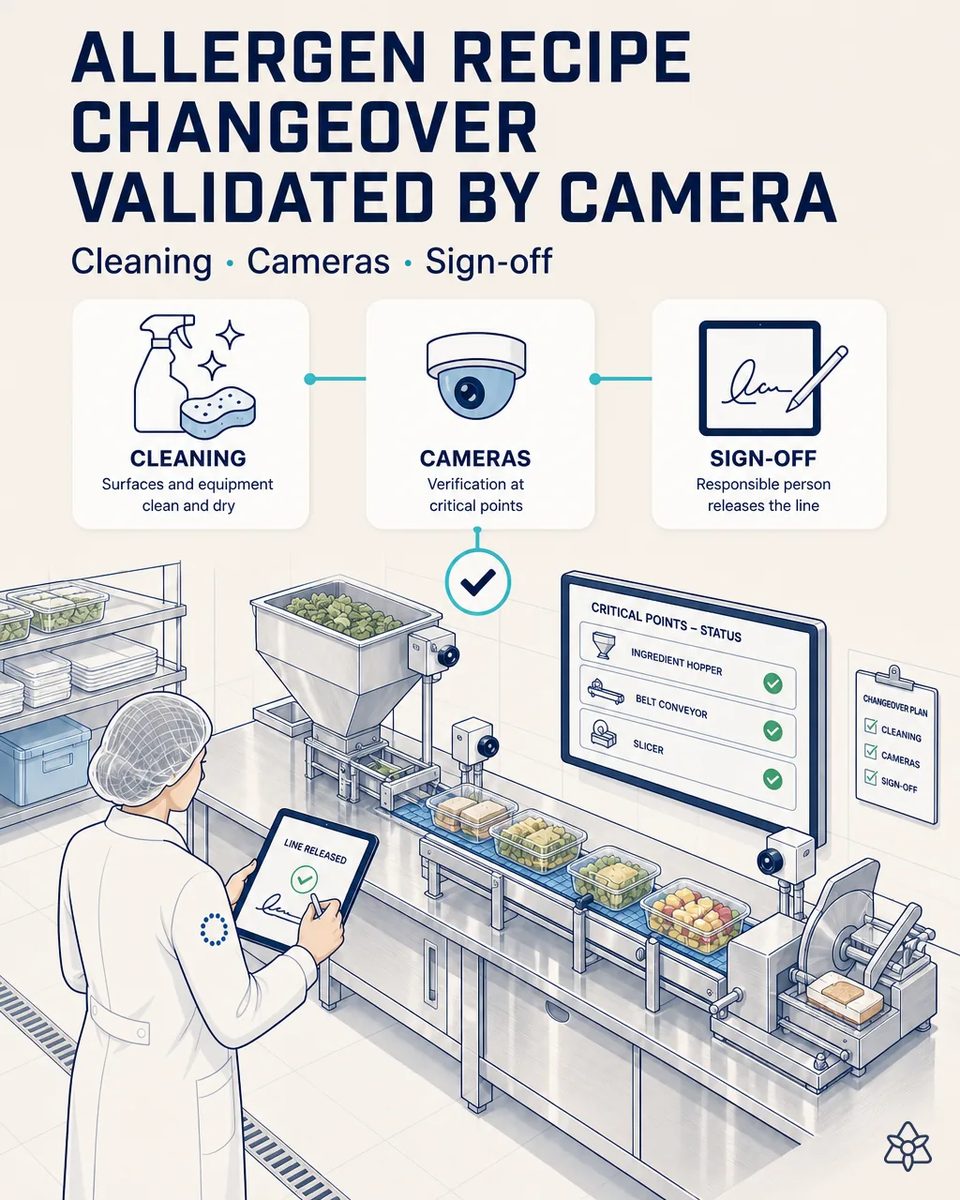
One line, several allergens per shift, and a paper signature between them.
In the same shift, the same line assembles sandwiches with egg, with nuts, with cheese, and a gluten-free range. Between recipes there is a clean-down that today is certified with a paper signature. If traces of an allergen remain on the slicer or the belt, the first batch of the next recipe is contaminated. And inside a vending machine there is nobody to warn the consumer.
- In the same shift, the same line assembles sandwiches with egg, with nuts, with cheese, and a gluten-free range.
- Between recipes there is a clean-down, and today it is certified with a paper signature. The signature says it was done; it does not show how well. Under shift pressure, that difference matters.
- If traces of an allergen remain on the slicer, the hopper or the belt, the first batch of the next recipe is contaminated. The slicer is the hardest point to clean well and the easiest one to sign off quickly.
- And unlike a shop or a canteen, inside a vending machine there is nobody to warn the consumer. The label is the only safeguard, and it assumes the line was clean.
Edge with JIDOKA AI — no restart until every camera clears and quality signs.
iLEAN Edge places cameras where product builds up. They compare the actual state with the clean reference and flag any visible residue. The line is not released until every camera says OK and the quality lead signs off looking at the evidence. The AI provides proof; the person decides.
Cameras sit where product builds up and compare the actual state with the clean reference. The AI provides the proof; the quality lead decides, looking at it. The signature stays, but now it rests on an image of each critical point. For a channel where nobody can warn the consumer at the point of sale, that difference is the whole safeguard. The line restarts when the evidence says so, not when the clock says so.
The signed clean-down versus the clean-down validated by camera
| Aspect | Today | With iLEAN Edge |
|---|---|---|
| What releases the line | A signature on a sheet | Every point clear plus sign-off |
| Egg or cheese residue on the slicer | Seen if someone looks | Flagged against the clean reference |
| Nut traces in the ingredient hopper | Assumed cleaned | Checked by camera |
| First batch of the gluten-free range | Released on trust | Released on evidence |
| Proof after a complaint | The signature | Time-stamped image per point |
| Changeover under time pressure | Steps get shortened | No restart without clearance |
Paper signature without evidence → line release with visual evidence per critical point and human sign-off.
Impact estimate — to be validated with your changeover schedule.
The block below is an estimate to be validated against your plant's actual data. We put it forward so the committee has an order of magnitude; we refine it during the assessment.
- Estimated payback 6-12 months.
- Zero start-ups without cleaning evidence: every recipe changeover leaves an image per critical point and a signature. The proof sits in the batch dossier, not in a binder.
- Protection against allergen cross-contact in a channel where nobody can warn the consumer at the point of sale. Allergen labeling is only as true as the clean-down that came before it.
- And a defensible record when an institutional customer or an inspector asks how allergen changeovers are controlled.
Payback 6-12 months · zero start-ups without cleaning evidence (estimate to be validated). Recipe changeovers with objective evidence and protection against allergen cross-contact. Estimated payback of 6 to 12 months. Estimate to be validated.
And the fair question from the production manager
“What if the cameras hold the line for residue that is not there?” — that is the right worry, because changeovers sit on the shift's critical path. Each point is compared with its own clean reference, which makes it an anchored task where the best models drop below 1.5% error [1]. In doubt, the system does not block silently: it shows the image to the quality lead, who decides.
[1] OpenAI paper "Why Language Models Hallucinate", 2025 — on the reliability of AI in anchored tasks.
What people ask about camera-validated allergen changeovers
Which points on the line get a camera in a vending kitchen?
Where product builds up: typically the ingredient hopper, the belt and the slicer. The exact points are agreed with your quality team at commissioning. Each point gets its own clean reference image, taken with your equipment and your lighting.
Does it replace our cleaning procedure?
No. The procedure stays as validated; the cameras add evidence that it left each critical point clean. Auditors tend to value that combination: a validated procedure plus objective evidence that it was followed.
Can it see allergen traces that are invisible?
It detects visible residue against the clean reference. Invisible traces remain the job of your verification tests, which the dossier records alongside. The camera evidence and the lab result end up side by side in the batch dossier, which is what an auditor wants to see.
Does it lengthen the changeover?
The check takes seconds once the clean-down is done. What it removes is the rework and doubt when a step was shortened. In practice, kitchens find that the visible evidence speeds up the sign-off, because quality no longer needs to walk the line to trust it.
Can quality release the line if a camera fails?
Yes, with an exception signed and recorded as such. What cannot happen is a restart with no trace of who decided it. Exceptions are rare and visible in the history, which is itself useful information for quality.
More cases from this series
- The food-safety audit, always readyiLEAN Agents organizes HACCP, cleaning and temperature evidence by batch: audits and tenders always…
- The blast chiller that now talksA camera reads the blast chiller panel and records each batch's chilling curve without replacing the…
- Fresh goods receiving with one photoFresh goods receiving with one photo: delivery note, batch, use-by and temperature into the ERP with one…
- From the HACCP spreadsheet to the ERP without retypingFrom the HACCP spreadsheet to the ERP without retyping, with human validation and up to 80% fewer…
- The kitchen lead speaks, iLEAN takes notesThe kitchen lead dictates with gloves on; iLEAN structures the issue and replies with support in…
- Snap the kitchen production sheetOne photo of the kitchen production sheet and the fresh batch exists in the system instantly, with…
Tell us how many allergen recipe changeovers your line runs per shift.
We work on your plant's real data, not ours. Assessment with no commitment.
Request estimated ROI within 48h ‹ See all cases of fresh-food vending See food industry