The supplier alert that arrives in time
The sliced-bread supplier writes early in the morning: delivery will be late. Or a customer asks by messaging app for extra product for an event. The message lands in the inbox of someone busy with something else. With iLEAN Connect, a dedicated mailbox and messaging number are in copy. iLEAN reads the intent, matches it against the production plan and the routes, and proposes the concrete action: which recipe to bring forward and which route to adjust.
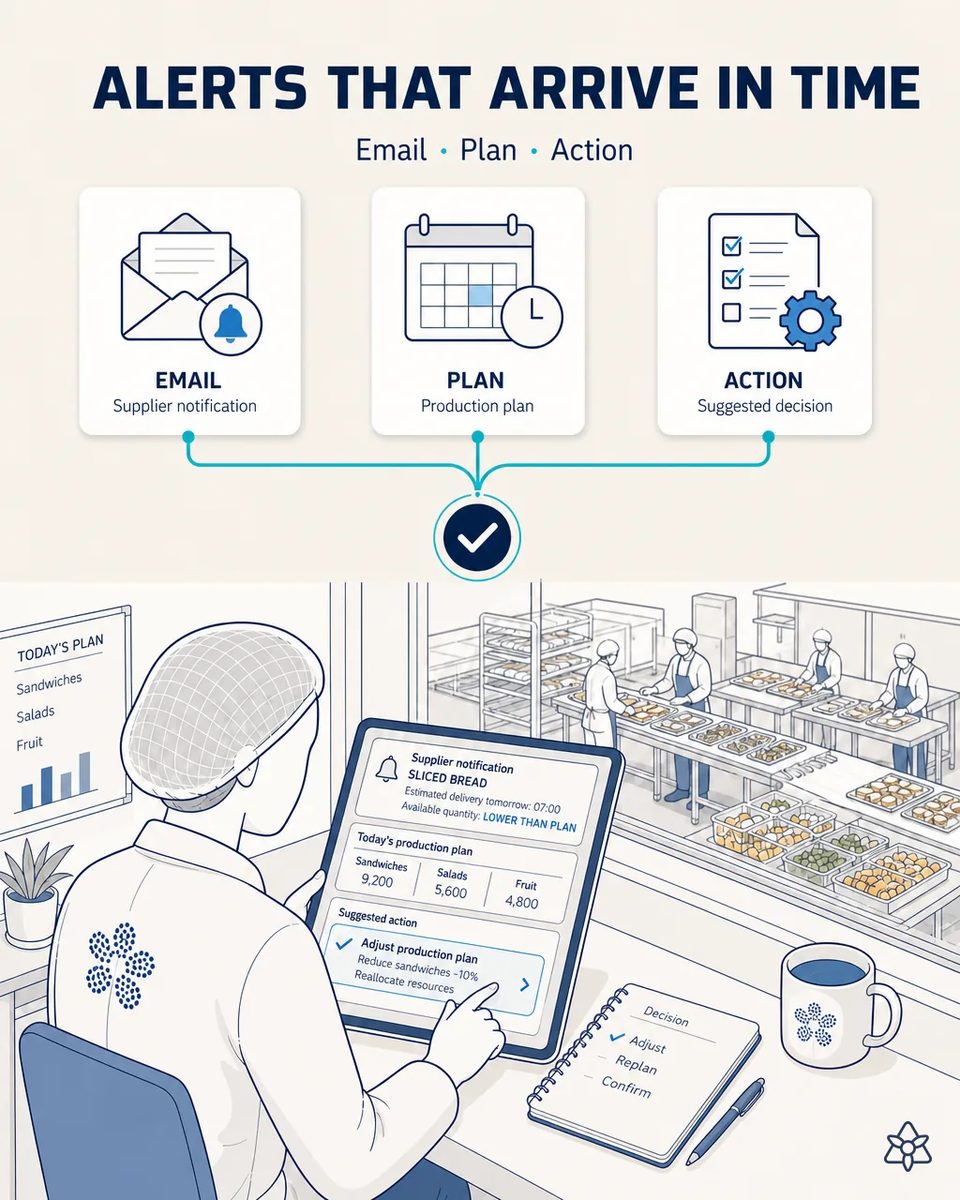
The message that changes the day arrives before anyone has time to read it.
The sliced-bread supplier writes early in the morning: delivery will be late. Or a customer asks by messaging app for extra product for an event. The message lands in the inbox of someone busy with something else. If the email is read mid-morning, the line has already started with a plan it cannot meet, and the afternoon delivery routes leave short.
- The sliced-bread supplier writes at dawn: delivery will be late. Or an institutional customer asks by messaging app for extra sandwiches for an event tomorrow. Both arrive before most of the office is in.
- The message lands in the inbox of someone busy with the morning start, competing with everything else, and nobody connects it to the plan or the routes.
- If it is read mid-morning, the assembly line has already started with a plan it cannot meet, and the afternoon restocking routes leave with gaps in the machines.
- The cost is not the delay itself: it is the stoppage on the line, the recipe made in the wrong order and the empty spirals that a lost sale leaves behind.
Connect in copy on the operational channels — the planner receives a proposal, not a message.
With iLEAN Connect, a dedicated mailbox and messaging number are in copy. iLEAN reads the intent, matches it against the production plan and the routes, and proposes the concrete action: which recipe to bring forward and which route to adjust. The alert reaches the right role with the proposal ready. The planning lead accepts or corrects it. Humans in command.
iLEAN does not replace the inbox: it sits in copy, reads the intent and does the cross-check nobody has time for at six in the morning. What reaches the planner is the action already worked out against the plan and the routes, ready to accept or correct. The planner keeps judgment; what they lose is the hour spent finding out.
Today's supplier message versus the message already matched to the plan
| Aspect | Today | With iLEAN Connect |
|---|---|---|
| Time to act on a late bread delivery | Hours, once the line is running | Seconds, before the start |
| Link to the production plan | Done in someone's head | Matched automatically |
| Effect on restocking routes | Discovered at loading | Shown with the proposal |
| Event order from a customer | Lost in a chat | Structured and routed |
| What the planner gets | A raw message | Recipe to bring forward and route to adjust |
| Final say | Whoever reads it first | The planning lead |
Alert read hours late with the line already running → replanning proposal in seconds to the right role.
Impact estimate — to be validated with your alert frequency.
The block below is an estimate to be validated against your plant's actual data. We put it forward so the committee has an order of magnitude; we refine it during the assessment.
- Estimated payback 3-7 months, depending on how often supplier and customer alerts change the day.
- From hours of delay to seconds to replan, before the line commits to a plan it cannot meet.
- Fewer line stoppages caused by late information.
- And fewer empty slots in the machines on the afternoon routes, which is where the lost sale shows. Each gap is a sale lost in a machine the customer expected to find full.
Payback 3-7 months · from hours of delay to seconds to replan (estimate to be validated). Fewer stoppages and fewer empty slots in machines caused by late information. Estimated payback of 3 to 7 months depending on alert frequency. Estimate to be validated.
And the fair question from the production manager
“What if it misunderstands a supplier email and proposes the wrong change?” — identifying the intent of a short operational message and matching it to a known plan is an anchored task, where the best models drop below 1.5% error [1]. And nothing changes on its own: the proposal reaches the planning lead, who accepts it, corrects it or discards it.
[1] OpenAI paper "Why Language Models Hallucinate", 2025 — on the reliability of AI in anchored tasks.
What people ask about supplier alerts in a vending kitchen
Which channels does iLEAN read?
A dedicated mailbox and a business messaging number that suppliers and customers already write to, with iLEAN in copy. Personal inboxes are not touched. Setting them up takes days, not months, and suppliers keep writing exactly as they write now.
Does it know which recipes use the delayed ingredient?
Yes, by crossing the message with the recipe master and the day's production plan. That is how it can say which recipe to bring forward while the bread arrives. It also knows which restocking routes carry that recipe tomorrow, so the proposal covers both the kitchen and the road.
Does it also handle extra orders for an event?
Yes. A customer asking for extra product is read the same way and turned into a proposal for production and for the route that serves that site. Event orders are where the margin often is, and they are also the ones most easily lost in a chat at the end of the day.
Can it change the plan or the routes by itself?
No. It proposes; the planning lead decides. Humans stay in command of the plan and of what leaves on each route. Every accepted or corrected proposal is recorded, which over time shows which suppliers and customers change the day most often.
Who receives the alert if the planner is off shift?
The role defined for that kind of alert and that time slot. The routing is set up with your team at the start and adjusted as you use it. Nobody has to remember to forward anything: if the alert matters, it reaches someone who can act on it before the line starts.
More cases from this series
- Allergen recipe changeover validated by cameraEdge cameras validate clean-downs between allergen recipes; the line does not restart without visual OK…
- The food-safety audit, always readyiLEAN Agents organizes HACCP, cleaning and temperature evidence by batch: audits and tenders always…
- The blast chiller that now talksA camera reads the blast chiller panel and records each batch's chilling curve without replacing the…
- Fresh goods receiving with one photoFresh goods receiving with one photo: delivery note, batch, use-by and temperature into the ERP with one…
- From the HACCP spreadsheet to the ERP without retypingFrom the HACCP spreadsheet to the ERP without retyping, with human validation and up to 80% fewer…
- The kitchen lead speaks, iLEAN takes notesThe kitchen lead dictates with gloves on; iLEAN structures the issue and replies with support in…
Tell us how often a supplier change reaches you after your line has started.
We work on your plant's real data, not ours. Assessment with no commitment.
Request estimated ROI within 48h ‹ See all cases of fresh-food vending See food industry