Every pack sealed and correctly labeled
Dozens of sandwiches and salads per minute leave the packer. A poorly sealed film or a crooked or unreadable label slips past the human eye at the end of a long shift. iLEAN Edge puts a camera over the belt. A model trained on good and bad packs of each format checks seal, label and legibility in milliseconds.
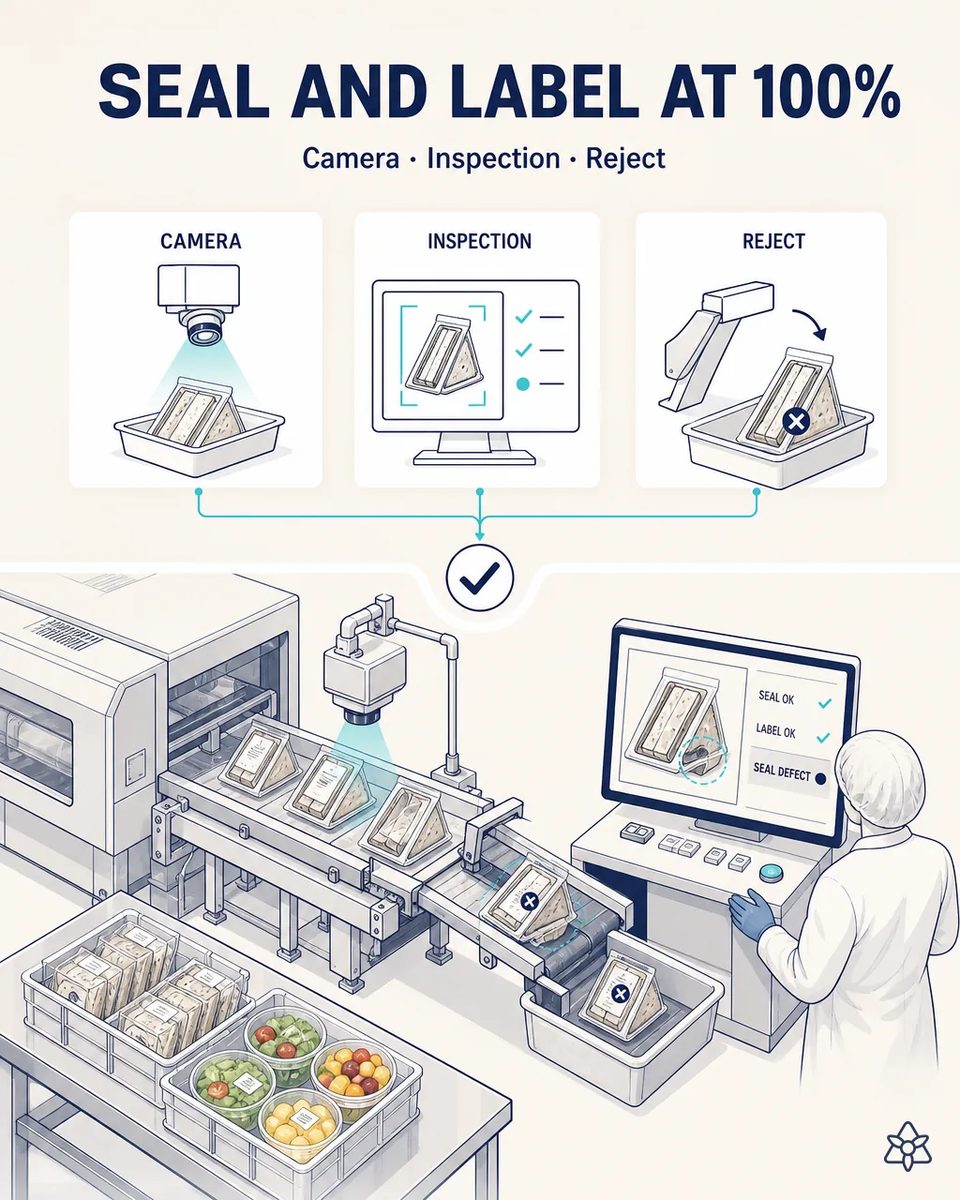
At packer speed, a weak seal or a crooked label is invisible by the end of a shift.
Dozens of sandwiches and salads per minute leave the packer. A poorly sealed film or a crooked or unreadable label slips past the human eye at the end of a long shift. A poorly sealed fresh pack means shorter shelf life and risk to the consumer; an unreadable label is a batch without traceability inside a machine.
- Dozens of sandwiches and salads per minute leave the packer. A poorly heat-sealed film or a crooked, smudged or unreadable label slips past the human eye, especially at the end of a long shift.
- Sampling catches some of them. The ones it misses travel on a restocking route and sit in a refrigerated machine. Sampling was designed for a slower line.
- A badly sealed fresh pack means shorter shelf life and risk to the consumer; an unreadable label is a batch without traceability inside a machine, and an allergen declaration nobody can read.
- Each one that escapes ends as a complaint, a withdrawal by the route driver or, in a hospital or a public building, a question about the contract. The packer was fine; one reel of film or one label roll was not.
Edge — local vision over the belt, pack by pack, before boxing.
iLEAN Edge puts a camera over the belt. A model trained on good and bad packs of each format checks seal, label and legibility in milliseconds. The faulty pack is diverted before boxing. The operator sees the flagged image and decides whether to rework or discard.
Inspection moves from a sample to every pack, at line speed, without the operator having to look harder. The operator still decides on each flagged pack: rework the label, reseal or discard. What changes is that nothing badly sealed gets as far as the crate. And every rejected pack leaves an image, so the packer can be adjusted before the defect becomes a pattern. The line speed stays the same; only the escapes disappear.
Inspection by sampling versus inspection of every pack
| Aspect | Today | With iLEAN Edge |
|---|---|---|
| Share of packs checked | A sample per hour | 100%, in line |
| Weak or wrinkled heat seal | Seen if it is obvious | Classified in milliseconds |
| Label crooked or unreadable | Depends on attention | Checked for position and legibility |
| Faulty pack | Boxed and shipped | Diverted before boxing |
| Withdrawals from machines | Part of the routine | Fewer |
| Decision on a flagged pack | — | The operator, with the image |
Sampling → 100% pack inspection; complaints and machine withdrawals down.
Impact estimate — to be validated with your complaint and withdrawal records.
The block below is an estimate to be validated against your plant's actual data. We put it forward so the committee has an order of magnitude; we refine it during the assessment.
- Estimated payback 5-12 months.
- From sampling to 100% in-line pack inspection on the covered formats.
- Fewer complaints and fewer withdrawals by route drivers from the machines. Each withdrawal avoided is a route stop that sells instead of collecting.
- And shelf life protected where it is decided: at the seal, before the pack leaves the kitchen. A good seal is what lets the product reach the end of its declared shelf life in the machine.
Payback 5-12 months · 100% in-line pack inspection (estimate to be validated). From sampling to 100% pack inspection, with fewer complaints and fewer machine withdrawals. Estimated payback of 5 to 12 months. Estimate to be validated.
And the fair question from the production manager
“What if it rejects good packs and slows the line?” — the false positive is the real risk of any vision system, which is why the model is trained on good and bad packs of your own formats, wedge, baguette, salad bowl, under that line's lighting. Classifying seal and label against that known catalog is an anchored task, where the best models drop below 1.5% error [1], and doubtful packs go to the operator rather than straight to the bin.
[1] OpenAI paper "Why Language Models Hallucinate", 2025 — on the reliability of AI in anchored tasks.
What people ask about seal and label vision on the packing line
Does it keep up with the packer's speed?
Yes. Inference runs locally next to the line and resolves in milliseconds per pack, without depending on the network or the cloud. That also means no images of your products leave the kitchen unless you decide otherwise.
Which heat sealing defects does it catch?
Open or partial seals, wrinkles in the seal area and product trapped in the seal, the defects that shorten shelf life without being obvious. Those are the defects a tired operator misses most often, because the pack looks fine from a distance.
Does it check what the label says or only that it is there?
Position and legibility, and it can read batch and use-by date to confirm they match the active batch. A label that is present but unreadable is treated as a defect. That closes the loop with the production sheet: the label on the pack has to match the batch that was declared.
Can one camera handle wedges, baguettes and salad bowls?
Yes, by switching the model to the format running on the line. Each format is trained with real packs from your kitchen. Adding a new format means collecting real packs from a few runs and training on them before it goes live.
What happens to the diverted packs?
They go to a reject tray and the operator sees the flagged image to decide whether to relabel, reseal or discard. Every diverted pack keeps its image, so quality can see which defects are recurring and on which packer settings.
More cases from this series
- Allergen recipe changeover validated by cameraEdge cameras validate clean-downs between allergen recipes; the line does not restart without visual OK…
- The food-safety audit, always readyiLEAN Agents organizes HACCP, cleaning and temperature evidence by batch: audits and tenders always…
- The blast chiller that now talksA camera reads the blast chiller panel and records each batch's chilling curve without replacing the…
- Fresh goods receiving with one photoFresh goods receiving with one photo: delivery note, batch, use-by and temperature into the ERP with one…
- From the HACCP spreadsheet to the ERP without retypingFrom the HACCP spreadsheet to the ERP without retyping, with human validation and up to 80% fewer…
- The kitchen lead speaks, iLEAN takes notesThe kitchen lead dictates with gloves on; iLEAN structures the issue and replies with support in…
Tell us how many packs per shift your team inspects by eye today.
We work on your plant's real data, not ours. Assessment with no commitment.
Request estimated ROI within 48h ‹ See all cases of fresh-food vending See food industry